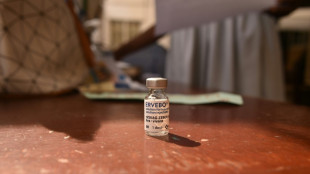
US approves new drug to treat Alzheimer's disease / Photo: ALAIN JOCARD - AFP

The US Food and Drug Administration on Friday approved a highly anticipated new drug designed to slow cognitive decline in patients in mild and early stages of Alzheimer's disease.
The FDA approval of the drug, Leqembi, also known as lecanemab, comes just days after the regulatory agency was harshly criticized in a congressional report for its green-lighting of another Alzheimer's drug, Aduhelm.
And it was granted despite trial results showing the monoclonal antibody treatment carries risks of brain swelling and bleeding.
Both drugs were approved through an accelerated process that allows the FDA to fast-track approval of drugs for serious conditions where there is an unmet medical need.
Leqembi and Aduhelm, which were jointly developed by Japan's Eisai and Biogen of the United States, "represent an important advancement in the ongoing fight to effectively treat Alzheimer's disease," the FDA said in a statement.
"Alzheimer's disease immeasurably incapacitates the lives of those who suffer from it and has devastating effects on their loved ones," Billy Dunn of the FDA's Center for Drug Evaluation and Research said in a statement.
Leqembi, Dunn said, is "the latest therapy to target and affect the underlying disease process of Alzheimer's, instead of only treating the symptoms of the disease."
Approximately 6.5 million Americans suffer from Alzheimer's, which is characterized by memory loss and declining mental acuity.
Preliminary data from a trial of Leqembi was released in September and found it slowed cognitive decline in Alzheimer's patients by 27 percent.
The phase three trial involved nearly 1,800 people, divided between those given the drug and given a placebo, and ran over 18 months.
The complete trial data, published in the New England Journal of Medicine, raised concern about the incidence of "adverse effects" including brain bleeds and swelling.
The results showed that 17.3 percent of patients administered the drug experienced brain bleeds, compared with nine percent of those receiving a placebo.
And 12.6 percent of those taking the drug experienced brain swelling, compared with just 1.7 percent of those in the placebo group.
Deaths were reported at approximately the same rate in both arms of the trial of the drug.
- $26,500 a year -
In Alzheimer's disease, two key proteins, tau and amyloid beta, build up into tangles and plaques, known together as aggregates, which cause brain cells to die and lead to brain shrinkage.
Leqembi, which is administered intravenously once every two weeks, works by targeting amyloid.
In the trial, patients receiving Leqembi had a statistically significant reduction in brain amyloid plaque compared to the placebo arm, which had no reduction of amyloid beta plaque.
Biogen and Eisai previously brought Aduhelm to market, but there was significant controversy over whether it worked, and its approval in 2021 led to three high-level resignations in the FDA.
A US congressional investigation said the accelerated approval process for Aduhelm, the first drug approved in decades to treat Alzheimer's, was "rife with irregularities" and criticized both the agency and Biogen.
The Cambridge, Massachusetts-based Biogen set an "unjustifiably high price" for Aduhelm of $56,000 a year, the congressional report said.
Eisai said Leqembi would be priced initially at $26,500 per year and estimated that 100,000 Americans could be receiving the drug by three years from now.
Joanne Pike, president and CEO of the Alzheimer's Association, welcomed the approval of Leqembi but expressed concern that its high cost could put it out of reach of most Americans, particularly if it is not covered by Medicare, the government health insurance program for the elderly.
"People living with this fatal disease today do not have time to wait for a miracle drug or cure," Pike said in a statement.
Y.Ishikawa--JT