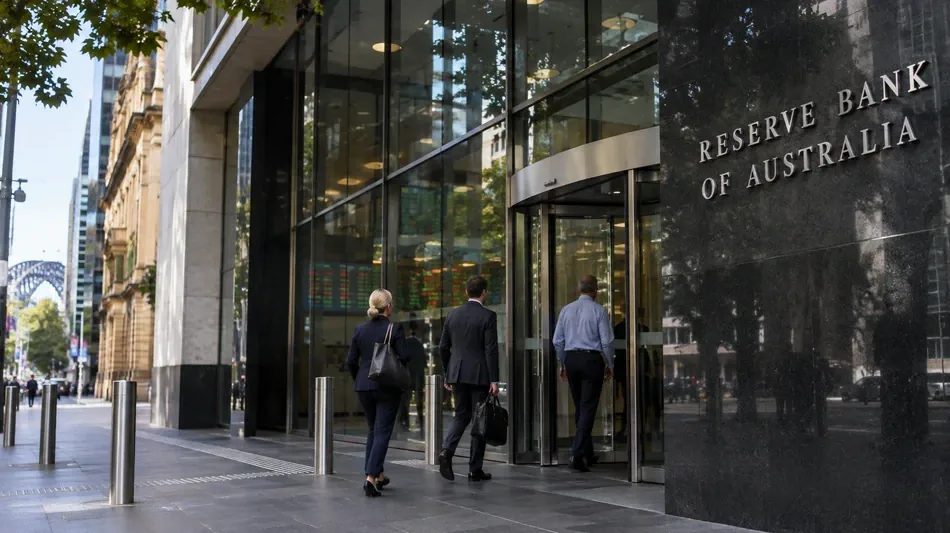
RBA Inflation Target Origins: Why Australia Chose a Range Over Zero

The Reserve Bank of Australia’s decision to raise interest rates amid rising inflation has renewed scrutiny on its monetary policy framework, particularly the origins and rationale behind its specific 2 to 3 per cent target range.
The Reserve Bank of Australia (RBA) has increased interest rates to their highest level in 18 years, imposing further financial pressure on indebted households as it attempts to curb persistent inflation. RBA Governor Michele Bullock stated that current price growth remains too elevated and must be reduced to align with the central bank’s established target range of 2 to 3 per cent.
Headline inflation in Australia is currently rising at an annual rate of 4.3 per cent. Addressing the public regarding the latest monetary policy decision, Ms Bullock emphasized that while the bank aims to avoid triggering a recession, controlling excess demand is paramount. "We are not looking to tip the economy into recession if we can avoid it, but we do need to get inflation down, and we do have excess demand at the moment, so that is the key," she said.
The specific numerical target of 2 to 3 per cent carries significant weight in economic policy, yet its origins are rooted in historical debates rather than precise scientific derivation. The RBA adopted its inflation-targeting framework in the early 1990s, drawing inspiration from New Zealand, which became the first nation to formally implement such a system in 1990.
However, Australian officials did not adopt New Zealand’s initial model wholesale. When New Zealand set an original target of 0 to 2 per cent, senior RBA figures viewed the lower bound as fundamentally flawed. Stephen Grenville, who served at the RBA from 1982 to 2001 and spent his final five years as deputy governor, explained this divergence in a 2023 interview for the bank’s oral history collection.
Dr. Grenville argued that targeting zero inflation misunderstands the nature of modern economies. "Any inflation target that contemplates getting to zero — or would think that being at, or near, zero is a good thing — just misunderstands the nature of inflation," he said. He noted that economies function more effectively with some degree of inflation because it allows relative prices to adjust and accounts for quality improvements in goods and services.
Furthermore, Dr. Grenville criticized New Zealand’s original framework for creating rigid boundaries, which he described as "electric fences." Under the initial New Zealand model, crossing the upper limit of 2 per cent was treated with severe consequences, including discussions about sacking the governor if targets were breached. This created a scenario where an inflation rate of 1.9 per cent was acceptable, but 2.1 per cent triggered punitive measures.
In contrast, the RBA proposed viewing the target as an archer’s aim rather than a hard boundary. "We thought the proper way to think about an inflation target was like an archer's target: that an archer always aims for the centre [and] doesn't expect to hit the centre of the bullseye all the time, but consistently aims for the bullseye," Dr. Grenville recalled.
This perspective led to the adoption of a "thick point" concept rather than a single number or a strict range with penalties. The RBA officials believed that while they could not sustainably keep inflation at 2 per cent, aiming lower would signal insufficient effort. Consequently, they suggested the 2 to 3 per cent band as an aspirational center, acknowledging that staying strictly within it was unrealistic.
Dr. Grenville highlighted another critical innovation: the inclusion of a time dimension. The RBA specified that inflation should return to the target "over the course of the cycle," recognizing that economic fluctuations occur over many years. This approach allowed monetary policy to influence the shape of the business cycle without demanding immediate correction.
"The critical thing was the time dimension, and I think we were clearly the first to grapple with that idea that you had to get a time dimension into the inflation target," Dr. Grenville said. He noted that as other countries adopted inflation targeting in the following years, they largely embraced this formula of allowing time for adjustment.
Despite these historical nuances, current economic conditions remain challenging. After raising rates for the fifth time in 2026, Ms Bullock acknowledged that home loan borrowers would experience increased pain from higher borrowing costs. However, she warned that prolonged high inflation would cause greater damage if left unchecked.
The RBA now projects that headline inflation will peak at 4.5 per cent by the end of this year, up from the current 4.3 per cent. The central bank does not expect inflation to return to its target band until late 2027, underscoring the long-term nature of the policy adjustments required to stabilize prices.
K.Tanaka--JT