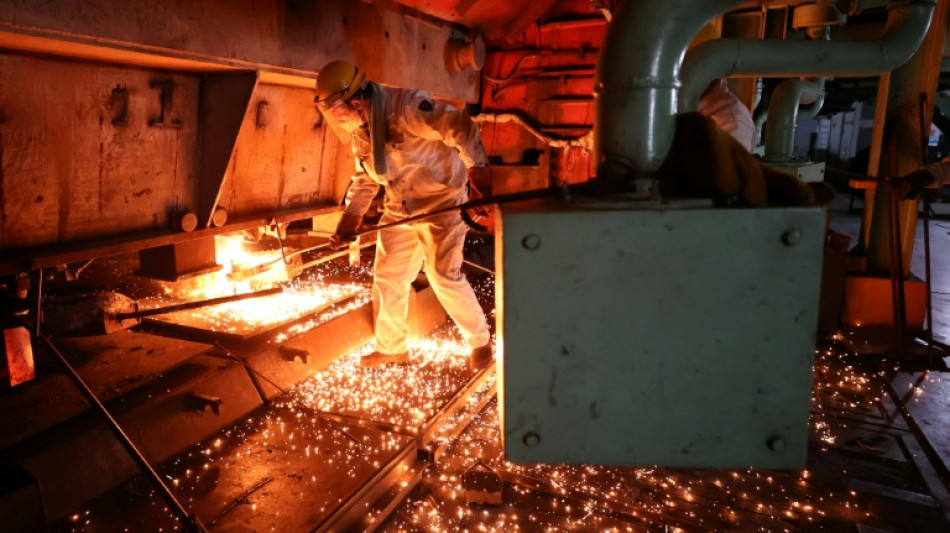
China's April consumption, factory output growth slowest in years / Photo: - - CN-STR/AFP

China's consumer spending and factory output grew at their slowest pace in years last month, official data showed Monday, a stark sign of the challenges Beijing faces to reignite domestic activity.
The world's second-largest economy has struggled to mount a strong recovery since the Covid-19 pandemic ended, despite a historic boom in exports.
Economists have long argued that China should shift towards an economic model led more by household spending than traditional drivers including exports and construction.
Retail sales growth slid to just 0.2 percent in April compared to the same month last year, the National Bureau of Statistics (NBS) said Monday.
The figure represented the slowest increase since December 2022, when the country was reeling from an outbreak of Covid-19 infections after the abrupt scrapping of pandemic control policies.
It missed a Bloomberg forecast of 2.0 percent in April based on a survey of economists.
Industrial production also came up short of expectations last month, the official data showed, growing 4.1 percent year-on-year, down from 5.7 percent in March.
That was the slowest increase in factory output recorded by the NBS since July of 2023.
"The external environment remains complex and volatile," said NBS spokesperson Fu Linghui at a press conference following the data's publication.
"Domestically, the imbalance of strong supply and weak demand remains a prominent issue," he added.
Monday's data "sent a clear warning signal to those expecting a rebound in domestic demand," Alicia Garcia-Herrero, Asia-Pacific chief economist at Natixis, told AFP.
The country's growth model "has bifurcated into two distinct trends: weakening domestic demand and a shining performance in high-tech products", she said.
"The export market appears to be the only way to make the system sustainable, at least in the short run."
- Spending slump -
A years-long crisis in the once-booming property sector has spooked consumers, though analysts say there have been signs of slight recovery in the real estate market in recent months.
NBS data showed Monday that new home prices in a selection of 70 cities dropped at a slower rate in April than in previous months.
Beijing is targeting overall economic growth this year of between 4.5 and five percent year-on-year, down from the 2025 target of around five percent.
Official data released last month suggested that the economy was on track to meet that goal, though experts warn the full impact on China's economy from the still-unresolved US-Israeli war on Iran has yet to be realised.
Consumer prices increased in April as the cost of crude oil rose globally due to the war, the NBS said last week.
However, analysts warn that deflationary pressure is still weighing on the Chinese economy.
As domestic consumption slumps, exports from the manufacturing powerhouse have boomed, offering Beijing a key economic lifeline.
The country recorded an unprecedented $1.2 trillion trade surplus last year, with challenges in trade with the United States offset by booming shipments to other markets, including Southeast Asia.
"Domestic headwinds look to have intensified last month, especially when it comes to construction activity," Julian Evans-Pritchard of Capital Economics wrote following Monday's data publication.
"But with external demand picking up and the electronics sector in an upswing, we still think that China's economy is on course to hold up well this year," he said.
"All told, the April activity data are disappointing but not cause for alarm just yet," he wrote, adding that he anticipates growth remaining "resilient over the rest of the year".
K.Tanaka--JT