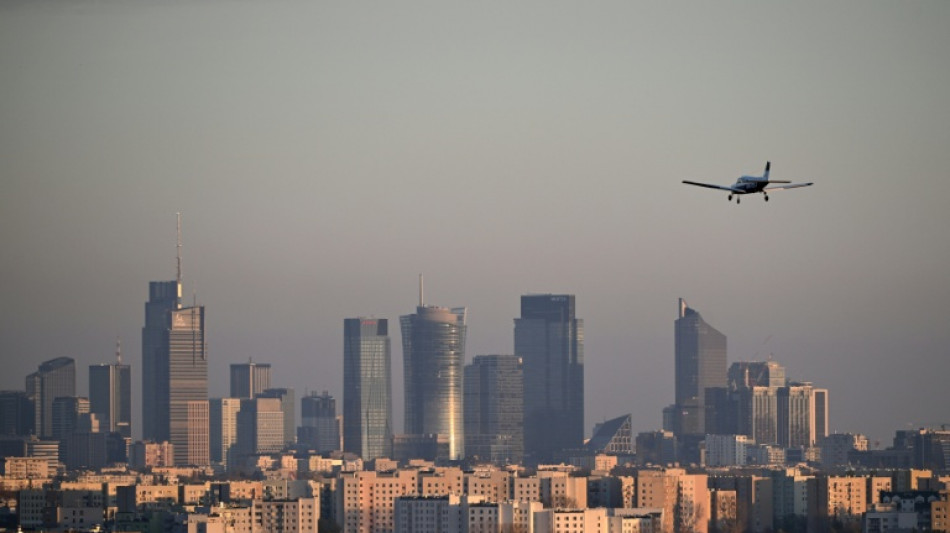
From rations to G20's doorstep: Poland savours economic 'miracle' / Photo: Sergei GAPON - AFP

Many Poles scoffed in 1980 when Lech Walesa, leader of the nascent Solidarity union, promised that Poland would become "a second Japan" -- yet the country now finds itself primed to join the G20 club of major economies.
Since the fall of communism 35 years ago, Poland has transformed itself from a command economy notorious for rationed goods and empty store shelves to one of the engines of European growth.
With a GDP of around $1 trillion, Poland now has the 20th largest economy in the world, surpassing those of Sweden, Switzerland or Taiwan.
When adjusted for purchasing power, its per capita GDP will exceed Japan's this year and reach 80 percent of the European average, according to the IMF and Eurostat.
"For my generation, it's a huge achievement; for my parents' generation, it's a miracle," Finance Minister Andrzej Domanski said recently.
This year the Polish economy is widely expected to surpass the government's 3.4 percent growth target, making it one of the best performers in the EU, and the jobless rate is down to just over three percent.
That performance has gotten the attention of Washington, which has invited Warsaw to attend the G20 summit it is hosting in Miami next December, after excluding South Africa over a diplomatic spat.
"Poland, a nation that was once trapped behind the Iron Curtain but now ranks among the world's 20 largest economies, will be joining us to assume its rightful place in the G20," Secretary of State Marco Rubio said in December.
- More than catching up -
Poland's recognition on the world stage has become a source of pride for many Poles, who entered the 1990s with a strong desire to "catch up with the West," according to Maciej Witucki, head of the country's Lewiathan business association.
Around 67 percent of Poles report being satisfied with their material situation, a record high, according to a CBOS poll in late December.
"Today, not only are we catching up with the West, but we have surpassed it in many aspects of daily life," Witucki said, not far from gleaming skyscrapers and a new site for the Warsaw Museum of Modern Art, designed by US architect Thomas Phifer.
"In France, in thirty years, the only thing that has changed is the prices, now in euros and no longer in francs," he added. "In Warsaw, everything evolves every two or three years."
For Bastien Loiseau, a French-Polish filmmaker who has lived in Warsaw for the past twenty years, Poland's massive transformations are a part of daily life.
The country boasts a modern highway network, efficient public transportation, widespread high-speed internet, and safety and cleanliness in public spaces.
"Compared to France, a country that is difficult to change, Poland is changing enormously," Loiseau said.
Jean Rossi, a French business lawyer who has long been based in Poland, said he believed that "this miracle is primarily due to the Poles themselves".
Beyond a solid education system, he praised a widespread belief that "they cannot rely on the state at all".
The country has however relied on EU funds to help modernise the country since joining the bloc in 2004, and is set to be the largest recipient of EU funds in the bloc's 2028-34 budget, receiving 123 billion euros ($145 billion).
"Poland has made extremely good use of European funds, both for its infrastructure and for industry," Witucki said, with small and midsize companies benefiting in particular.
- No one left to work? -
The optimistic picture is not without warning signs, as economists point to increased social spending as a growing burden on public finances, and the war in neighbouring Ukraine as a deterrent to future investments.
The main challenge, however, is Poland's birth rate, which has fallen below the EU average to 1.1 children per woman, according to the country's statistics agency.
Despite generous maternal leave and social programs for families, the agency says the population could shrink to 30 million people by 2060 from around 38 million now.
"There won't be anyone left to work," said Rossi, noting that a reluctance to let in Ukrainians due to rising anti-immigrant sentiment could be counterproductive.
Experts also point to a low level of innovation and research spending, among the lowest in the EU, and relatively low pay for scientists, contributing to a "brain drain".
But Rossi, like many others, remains optimistic, noting high-profile projects in the works including nuclear power plants and high-speed trains, and a burgeoning space industry.
"You can't do everything at once. First, they had to build the infrastructure; now that that's done, they'll focus on research and development," he said.
M.Sugiyama--JT