The Japan Times - South Korea sees record birth rate growth for Jan-May

EUR -
AED 4.323624
AFN 75.940287
ALL 95.687478
AMD 441.242259
ANG 2.107224
AOA 1080.758104
ARS 1599.419799
AUD 1.642433
AWG 2.120604
AZN 2.006077
BAM 1.955544
BBD 2.375189
BDT 144.991026
BGN 1.96385
BHD 0.445242
BIF 3506.541132
BMD 1.177296
BND 1.500804
BOB 8.148934
BRL 5.863881
BSD 1.179346
BTN 109.436679
BWP 15.822929
BYN 3.349562
BYR 23075.00039
BZD 2.37179
CAD 1.62202
CDF 2719.554043
CHF 0.919924
CLF 0.026581
CLP 1046.173097
CNY 8.02651
CNH 8.025203
COP 4252.443522
CRC 537.829619
CUC 1.177296
CUP 31.198342
CVE 110.250573
CZK 24.292918
DJF 210.002519
DKK 7.478542
DOP 70.700748
DZD 156.180562
EGP 61.083063
ERN 17.659439
ETB 184.137404
FJD 2.6116
FKP 0.869683
GBP 0.870234
GEL 3.183245
GGP 0.869683
GHS 13.031295
GIP 0.869683
GMD 86.535785
GNF 10346.646031
GTQ 9.01882
GYD 246.727713
HKD 9.228764
HNL 31.3339
HRK 7.540232
HTG 154.429791
HUF 361.795271
IDR 20178.852382
ILS 3.484549
IMP 0.869683
INR 109.021729
IQD 1544.897834
IRR 1555796.58282
ISK 143.712969
JEP 0.869683
JMD 186.4556
JOD 0.834749
JPY 186.748615
KES 151.890124
KGS 102.954982
KHR 4717.38268
KMF 492.110114
KPW 1059.54421
KRW 1727.223095
KWD 0.363031
KYD 0.982771
KZT 552.967638
LAK 26018.595189
LBP 105605.880343
LKR 372.771219
LRD 216.991604
LSL 19.329071
LTL 3.476249
LVL 0.712135
LYD 7.457024
MAD 10.880676
MDL 20.272347
MGA 4891.359913
MKD 61.631935
MMK 2472.587069
MNT 4209.502521
MOP 9.512755
MRU 47.136832
MUR 54.497475
MVR 18.20144
MWK 2044.932399
MXN 20.380292
MYR 4.653267
MZN 75.294007
NAD 19.329071
NGN 1580.496695
NIO 43.394321
NOK 11.029737
NPR 175.099086
NZD 2.013677
OMR 0.454021
PAB 1.179346
PEN 4.057269
PGK 5.112331
PHP 70.124501
PKR 328.817071
PLN 4.231614
PYG 7513.016842
QAR 4.299437
RON 5.098167
RSD 117.334646
RUB 89.63827
RWF 1723.174504
SAR 4.416103
SBD 9.460335
SCR 17.672434
SDG 707.555258
SEK 10.789215
SGD 1.495406
SHP 0.87897
SLE 28.990957
SLL 24687.302663
SOS 674.011798
SRD 44.391165
STD 24367.648971
STN 24.496794
SVC 10.31865
SYP 130.128292
SZL 19.323471
THB 37.700592
TJS 11.120745
TMT 4.126422
TND 3.422652
TOP 2.834646
TRY 52.795135
TTD 8.009952
TWD 37.061709
TZS 3060.299527
UAH 51.917706
UGX 4367.428475
USD 1.177296
UYU 46.913861
UZS 14311.127236
VES 564.698282
VND 31004.088534
VUV 139.188822
WST 3.1983
XAF 655.871172
XAG 0.014532
XAU 0.000243
XCD 3.181702
XCG 2.125422
XDR 0.815693
XOF 655.871172
XPF 119.331742
YER 280.907036
ZAR 19.209
ZMK 10597.080419
ZMW 22.436064
ZWL 379.088812
  • RBGPF

    -13.5000

    69

    -19.57%

  • JRI

    0.1800

    13.09

    +1.38%

  • BCC

    4.2400

    83.04

    +5.11%

  • GSK

    1.2200

    58.35

    +2.09%

  • BCE

    -0.0700

    24.09

    -0.29%

  • CMSD

    0.1800

    23.08

    +0.78%

  • RELX

    0.4700

    36.68

    +1.28%

  • NGG

    -0.6000

    86.92

    -0.69%

  • CMSC

    0.1500

    22.77

    +0.66%

  • RIO

    0.4400

    100.15

    +0.44%

  • BTI

    0.5400

    56.68

    +0.95%

  • RYCEF

    0.5600

    17.66

    +3.17%

  • AZN

    4.3300

    204.8

    +2.11%

  • VOD

    -0.2200

    15.48

    -1.42%

  • BP

    -3.0400

    44.59

    -6.82%

South Korea sees record birth rate growth for Jan-May
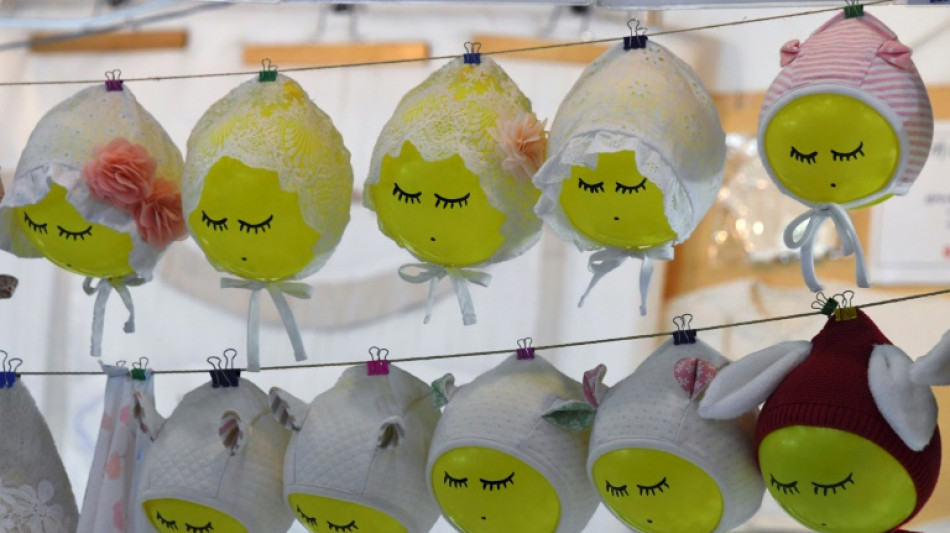
South Korea sees record birth rate growth for Jan-May / Photo: JUNG Yeon-Je - AFP/File

South Korea sees record birth rate growth for Jan-May

South Korea registered record birth rate growth during the first five months of the year, a statistics agency official told AFP on Wednesday.

Text size:

The country has one of the world's longest life expectancies and lowest birth rates -- a combination that presents a looming demographic challenge.

Seoul has poured billions of dollars into efforts to encourage women to have more children and maintain population stability.

"The number of newborns for the January–May period stood at 106,048, a 6.9 percent increase, the highest growth rate since such data collection began in 1981," said Kang hyun-young from Statistics Korea.

The surge follows South Korea's first annual increase in the number of births in more than a decade, driven by a rise in marriages. In 2024, the number of newborns rose by 8,300, or 3.6 percent, to 238,300 from the previous year.

April in particular saw a spike, with year-on-year growth reaching 8.7 percent and the number of births totalling 20,717 that month.

The latest figure marks a sharp turnaround from early 2024, when the number of births for the January–May period dropped by 2.7 percent from the previous year.

The fertility rate, or the average number of babies a woman is expected to have in her lifetime, for May stood at 0.75.

The country needs a fertility rate of 2.1 children in order to maintain the country's population of 51 million.

At current rates, the population will nearly halve to 26.8 million by 2100, according to the Institute for Health Metrics and Evaluation at the University of Washington in Seattle.

- Marriage correlation -

The increase is attributable "to a rise in the number of women in their early 30s, leading to an overall increase in marriages", Kang told AFP.

"In South Korea, there is a strong correlation between marriage and childbirth, which has driven the increase in births during the first five months," she added.

In 2024, the country saw a 14.8 percent on-year increase in the number of marriages, with more than 220,000 couples tying the knot.

Many government benefits designed to support child-rearing do not cover parents who are not legally married.

Analysts say there are multiple reasons for the low birth rate, from high child-rearing costs and property prices to a notoriously competitive society that makes well-paid jobs difficult to secure.

The double burden for working mothers of managing the brunt of household chores and childcare while also maintaining their careers is another key factor, they say.

In a bid to reverse the trend, the South Korean government offers cash subsidies, babysitting services, and support for infertility treatment.

Neighbouring Japan is grappling with the same issue -- it has the world's second-oldest population after Monaco, and the country's relatively strict immigration rules mean it faces growing labour shortages.

Y.Kato--JT