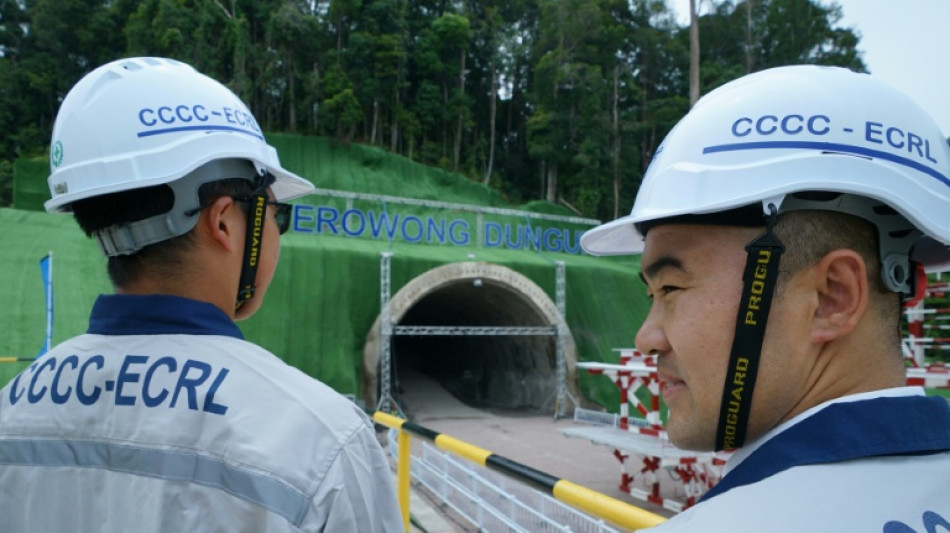
Western aid cuts cede ground to China in Southeast Asia: study / Photo: Rushdi SAMSUDIN - AFP/File

China is set to expand its influence over Southeast Asia's development as the Trump administration and other Western donors slash aid, a study by an Australian think tank said Sunday.
The region is in an "uncertain moment", facing cuts in official development finance from the West as well as "especially punitive" US trade tariffs, the Sydney-based Lowy Institute said.
"Declining Western aid risks ceding a greater role to China, though other Asian donors will also gain in importance," it said.
Total official development finance to Southeast Asia -- including grants, low-rate loans and other loans -- grew "modestly" to US$29 billion in 2023, the annual report said.
But US President Donald Trump has since halted about US$60 billion in development assistance -- most of the United States' overseas aid programme.
Seven European countries -- including France and Germany -- and the European Union have announced US$17.2 billion in aid cuts to be implemented between 2025 and 2029, it said.
And the United Kingdom has said it is reducing annual aid by US$7.6 billion, redirecting government money towards defence.
Based on recent announcements, overall official development finance to Southeast Asia will fall by more than US$2 billion by 2026, the study projected.
"These cuts will hit Southeast Asia hard," it said.
"Poorer countries and social sector priorities such as health, education, and civil society support that rely on bilateral aid funding are likely to lose out the most."
Higher-income countries already capture most of the region's official development finance, said the institute's Southeast Asia Aid Map report.
Poorer countries such as East Timor, Cambodia, Laos and Myanmar are being left behind, creating a deepening divide that could undermine long-term stability, equity and resilience, it warned.
Despite substantial economic development across most of Southeast Asia, around 86 million people still live on less than US$3.65 a day, it said.
- 'Global concern' -
"The centre of gravity in Southeast Asia's development finance landscape looks set to drift East, notably to Beijing but also Tokyo and Seoul," the study said.
As trade ties with the United States have weakened, Southeast Asian countries' development options could shrink, it said, leaving them with less leverage to negotiate favourable terms with Beijing.
"China's relative importance as a development actor in the region will rise as Western development support recedes," it said.
Beijing's development finance to the region rose by US$1.6 billion to US$4.9 billion in 2023 -- mostly through big infrastructure projects such as rail links in Indonesia and Malaysia, the report said.
At the same time, China's infrastructure commitments to Southeast Asia surged fourfold to almost US$10 billion, largely due to the revival of the Kyaukphyu Deep Sea Port project in Myanmar.
By contrast, Western alternative infrastructure projects had failed to materialise in recent years, the study said.
"Similarly, Western promises to support the region's clean energy transition have yet to translate into more projects on the ground -- of global concern given coal-dependent Southeast Asia is a major source of rapidly growing carbon emissions."
S.Yamada--JT