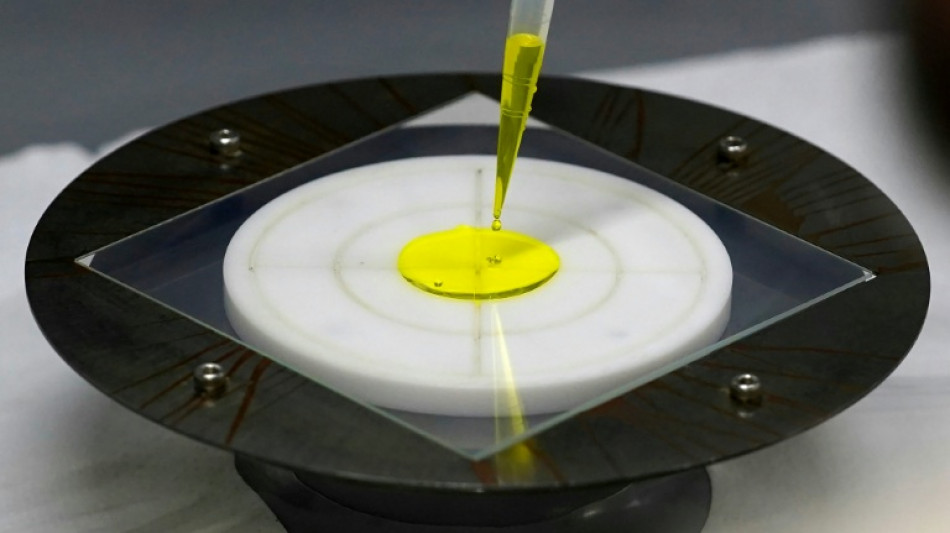
Japan sees bright future for ultra-thin, flexible solar panels / Photo: Kazuhiro NOGI - AFP

Japan is heavily investing in a new kind of ultra-thin, flexible solar panel that it hopes will help it meet renewable energy goals while challenging China's dominance of the sector.
Pliable perovskite panels are perfect for mountainous Japan, with its shortage of flat plots for traditional solar farms. And a key component of the panels is iodine, something Japan produces more of than any country but Chile.
The push faces some obstacles: perovskite panels contain toxic lead, and, for now, produce less power and have shorter lifespans than their silicon counterparts.
Still, with a goal of net-zero by 2050 and a desire to break China's solar supremacy, perovskite cells are "our best card to achieve both decarbonisation and industrial competitiveness," minister of industry Yoji Muto said in November.
"We need to succeed in their implementation in society at all costs," he said.
The government is offering generous incentives to get industry on board, including a 157-billion-yen ($1 billion) subsidy to plastic maker Sekisui Chemical for a factory to produce enough perovskite solar panels to generate 100 megawatts by 2027, enough to power 30,000 households.
By 2040, Japan wants to install enough perovskite panels to generate 20 gigawatts of electricity, equivalent to adding about 20 nuclear reactors.
That should help Japan's target to have renewable energy cover up to 50 percent of electricity demand by 2040.
- Breaking the silicon ceiling -
The nation is looking to solar power, including perovskite and silicon-based solar cells, to cover up to 29 percent of all electricity demand by that time, a sharp rise from 9.8 percent in 2023.
"To increase the amount of renewable energy and achieve carbon neutrality, I think we will have to mobilise all the technologies available," said Hiroshi Segawa, a specialist in next-generation solar technology at the University of Tokyo.
"Perovskite solar panels can be built domestically, from the raw materials to production to installation. In that sense, they could significantly contribute to things like energy security and economic security," he told AFP.
Tokyo wants to avoid a repeat of the past boom and bust of the Japanese solar business.
In the early 2000s, Japanese-made silicon solar panels accounted for almost half the global market.
Now, China controls more than 80 percent of the global solar supply chain, from the production of key raw material to assembling modules.
Silicon solar panels are made of thin wafers that are processed into cells that generate electricity.
They must be protected by reinforced glass sheets and metal frames, making the final products heavy and cumbersome.
Perovskite solar cells, however, are created by printing or painting ingredients such as iodine and lead onto surfaces like film or sheet glass.
The final product can be just a millimetre thick and a tenth the weight of a conventional silicon solar cell.
Perovskite panels' malleability means they can be installed on uneven and curved surfaces, a key feature in Japan, where 70 percent of the country is mountainous.
- Generating where power is used -
The panels are already being incorporated into several projects, including a 46-storey Tokyo building to be completed by 2028.
The southwestern city of Fukuoka has also said it wants to cover a domed baseball stadium with perovskite panels.
And major electronics brand Panasonic is working on integrating perovskite into windowpanes.
"What if all of these windows had solar cells integrated in them?" said Yukihiro Kaneko, general manager of Panasonic's perovskite PV development department, gesturing to the glass-covered high-rise buildings surrounding the firm's Tokyo office.
That would allow power to be generated where it is used, and reduce the burden on the national grid, Kaneko added.
For all the enthusiasm, perovskite panels remain far from mass production.
They are less efficient than their silicon counterparts, and have a lifespan of just a decade, compared to 30 years for conventional units.
The toxic lead they contain also means they need careful disposal after use.
However, the technology is advancing fast. Some prototypes can perform nearly as powerfully as silicon panels and their durability is expected to reach 20 years soon.
University professor Segawa believes Japan could have a capacity of 40 gigawatts from perovskite by 2040, while the technology could also speed up renewable uptake elsewhere.
"We should not think of it as either silicon or perovskite. We should look at how we can maximise our ability to utilise renewable energy," Segawa said.
"If Japan could show a good model, I think it can be brought overseas."
M.Fujitav--JT