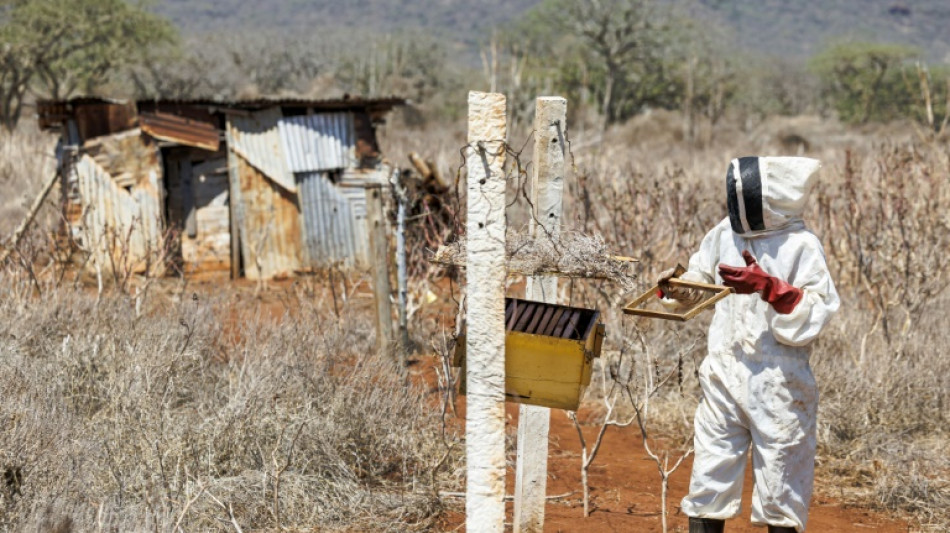
Bees help tackle elephant-human conflict in Kenya / Photo: Tony KARUMBA - AFP

"We used to hate elephants a lot," Kenyan farmer Charity Mwangome says, pausing from her work under the shade of a baobab tree.
The bees humming in the background are part of the reason why her hatred has dimmed.
The diminutive 58-year-old said rapacious elephants would often destroy months of work in her farmland that sits between two parts of Kenya's world-renowned Tsavo National Park.
Beloved by tourists -- who contribute around 10 percent of Kenya's GDP -- the animals are loathed by most local farmers, who form the backbone of the nation's economy.
Elephant conservation has been a roaring success: numbers in Tsavo rose from around 6,000 in the mid-1990s to almost 15,000 elephants in 2021, according to the Kenya Wildlife Service (KWS).
But the human population also expanded, encroaching on grazing and migration routes for the herds.
Resulting clashes are becoming the number one cause of elephant deaths, says KWS.
Refused compensation when she lost her crops, Mwangome admits she was mad with the conservationists.
But a long-running project by charity Save the Elephants offered her an unlikely solution -- deterring some of nature's biggest animals with some of its smallest: African honeybees.
Cheery yellow beehive fences now protect several local plots, including Mwangome's.
A nine-year study published last month found that elephants avoided farms with the ferocious bees 86 percent of the time.
"The beehive fences came to our rescue," said Mwangome.
- Hacking nature -
The deep humming of 70,000 bees is enough to make many flee, including a six-tonne elephant, but Loise Kawira calmly removes a tray in her apiary to demonstrate the intricate combs of wax and honey.
Kawira, who joined Save the Elephants in 2021 as their consultant beekeeper, trains and monitors farmers in the delicate art.
The project supports 49 farmers, whose plots are surrounded by 15 connected hives.
Each is strung on greased wire a few metres off the ground, which protects them from badgers and insects, but also means they shake when disturbed by a hungry elephant.
"Once the elephants hear the sound of the bees and the smell, they run away," Kawira told AFP.
"It hacks the interaction between elephants and bees," added Ewan Brennan, local project coordinator.
It has been effective, but recent droughts, exacerbated by climate change, have raised challenges.
"(In) the total heat, the dryness, bees have absconded," said Kawira.
It is also expensive -- about 150,000 Kenyan shillings ($1,100) to install hives -- well beyond the means of subsistence farmers, though the project organisers say it is still cheaper than electric fences.
- 'I was going to die' -
Just moments after AFP arrived at Mwanajuma Kibula's farm, which abuts one of the Tsavo parks, her beehive fence had seen off an elephant.
The five-tonne animal, its skin caked in red mud, rumbled into the area and then did an abrupt about-face.
"I know my crops are protected," Kibula said with palpable relief.
Kibula, 48, also harvests honey twice a year from her hives, making 450 shillings per jar -- enough to pay school fees for her children.
She is fortunate to have protection from the biggest land mammals on Earth.
"An elephant ripped off my roof, I had to hide under the bed because I knew I was going to die," said a less-fortunate neighbour, Hendrita Mwalada, 67.
For those who can't afford bees, Save the Elephants offers other solutions, such as metal-sheet fences that clatter when shaken by approaching elephants, and diesel- or chilli-soaked rags that deter them.
It is not always enough.
"I have tried planting but every time the crops are ready, the elephants come and destroy the crops," Mwalada told AFP.
"That has been the story of my life, a life full of too much struggling."
K.Yamaguchi--JT