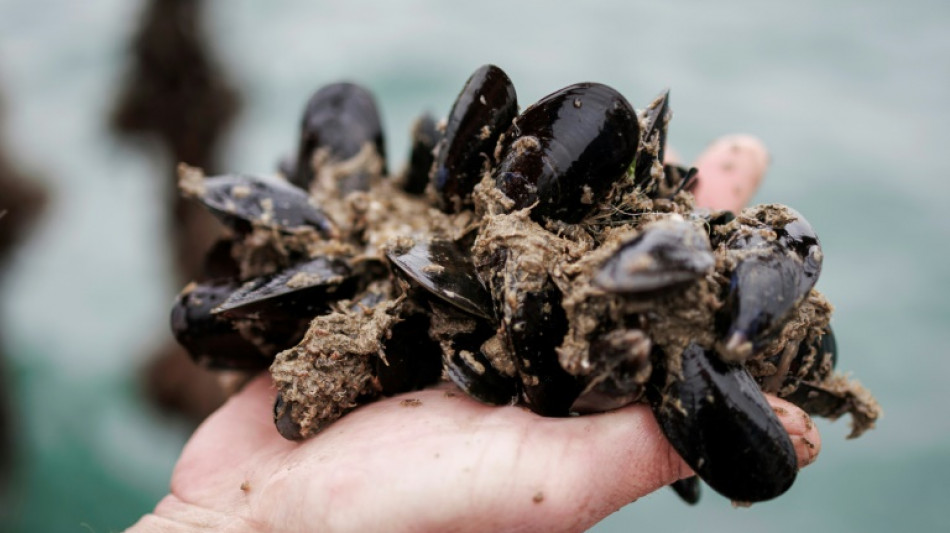
Belgium flexes its new locally sourced mussels / Photo: Simon Wohlfahrt - AFP/File

It is a popular tradition to eat mussels in Brussels but what may surprise many is that none of the molluscs visitors enjoy are locally sourced in Belgium.
That is, until now. A Belgian supermarket group has taken on the challenge of harvesting local mussels, already reaping rich rewards, with business booming.
Off the coast of Nieuwpoort, near the French border, a crane hoists mussel-clad ropes onto a boat.
They are part of the 12-kilometre (seven-mile) network the Colruyt chain established in 2023.
Such a sight had never been seen in Belgium before and Colruyt hopes it will grow, especially to challenge the dominance of Dutch mussels in the local market.
"We harvest a tonne in about four hours, with four people. We would like in the future to do three to four tonnes a day," says Stijn Van Hoestenberghe, as he takes an AFP team to a mussel farm he manages.
This year Colruyt is counting on a harvest of 50 tonnes, up from six last year, and "maybe 200" in 2025, Van Hoestenberghe adds.
It's not easy work, Van Hoestenberghe admits, because of the strong sea currents, storms and dense maritime traffic in the area.
A far cry from the wide and deep Scheldt estuary where the renowned Zeeland mussel grows in the south of the Netherlands, which supplies much of the European market.
"The Dutch part of the delta is a gigantic protected zone, which makes it easier to set up (mussel) farms than in the open sea," explains Jerome Mallefet, marine biology expert at Belgium's UCLouvain University.
Establishing more mussels farms off the Belgian coast -- described by Mallefet as "a motorway for boats" -- is more difficult because of offshore wind turbines and trawling activity, the expert adds.
Today, experts estimate that Belgium, one of the biggest consumers of mussels in Europe alongside Spain, France and Denmark, gets more than 90 percent of its mussels from Dutch farmers in Zeeland.
- Foreign mussels roped in -
Despite the progress, Colruyt has greater ambitions to muscle into the market since its supplies will at best meet one percent of the needs of Belgium, where around 20,000 tonnes of mussels are consumed a year.
"It's clear that there's room for growth," the company says.
For now, Colruyt's "100-percent Belgian" mussels are delivered to four of its stores and around 15 restaurants in Belgium.
One of its arguments for developing the market is that the mussels are "sustainably" farmed since the ropes used are made from recycled fishing nets.
Mussels are a seasonal foodstuff. The best time to eat them, say experts, is when the size and flesh have developed, usually from September to December.
On the historical Grand Place in Brussels, a major tourist destination in Belgium, a restaurant owner tells AFP he offers the highly popular traditional dish of mussels and fries on his menu all year round.
Like his customers, his mussels come from around Europe.
"We have many people eating mussels here... So we have Zeelandese mussels between June and February, and after that we have Danish mussels, or even German mussels, depending on demand," says Jean-Philippe Bosman, owner of the Le Roy d'Espagne restaurant.
"Having a local producer is good but they would need to supply us with the quantities we want on time... and that is more complicated."
Y.Hara--JT