Olympic 'curse' strikes again as Beijing costs mount

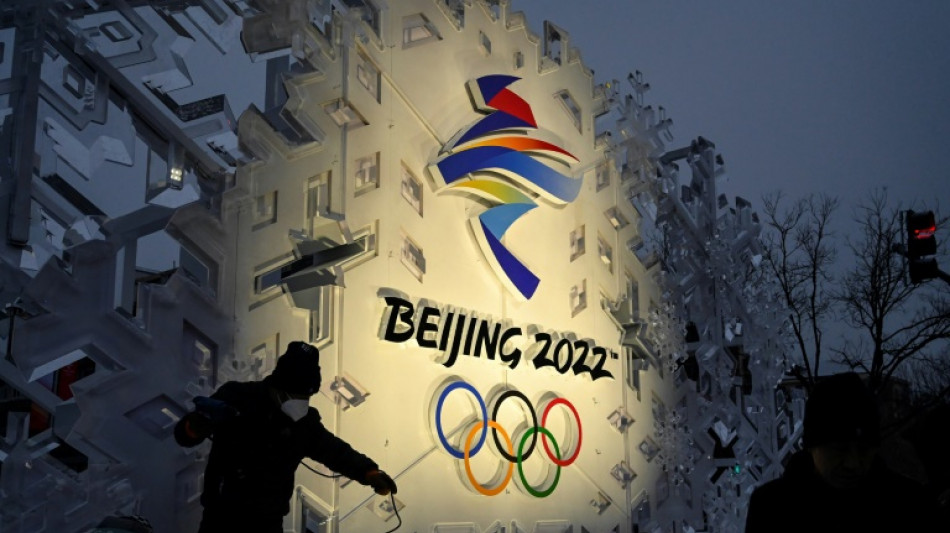
The "curse" of Olympic overspending looks set to strike again at the Beijing Games, with stringent Covid measures and loss of ticket sale revenues pushing up costs for China.
It's not unusual for nations to find the bill for hosting an Olympics ballooning, but the pandemic and China's zero-Covid approach has made preparations for the February 4-20 Winter Games particularly difficult.
With increasingly strict rules imposed as domestic outbreaks spread in China, organisers announced last week that they will not sell tickets to the public because of the "complicated" Covid situation.
Instead, invitations will be given to select people. The organising committee had originally calculated ticketing revenue to be worth $118 million.
That total was already in question after it was confirmed last year there would be no international spectators at the Games because of China's weeks-long quarantine requirements and closed borders.
Budget was a key part of China being awarded the Games, with Beijing winning the bid over only one other contender as other cities backed out over high costs.
Beijing Olympics communications manager Zhao Weidong recently admitted to reporters that the pandemic might mean a need to "increase some expenses".
However he pointed out that others could be reduced, without giving specifics.
- 'Screwed' -
In 2015, Beijing said it was counting on a budget of just over $3 billion, which included the costs of organising and building sports facilities.
But excluded was a huge amount of new infrastructure needed, including the construction of a high-speed rail line between Beijing and the ski slopes.
The cost of hosting the Olympics usually doubles between the award date and the opening ceremony, experts say.
Wladimir Andreff, a specialist in sports economics from the University of Paris 1 Pantheon-Sorbonne, called it the "curse" of successful Olympics bids.
"Whoever wins them gets screwed," he said.
To get the Games all candidates "systematically underestimate the costs and overestimate the profits" expected, Andreff added.
The pandemic has brought additional problems and costs.
Last summer's Covid-delayed Tokyo Olympics, the first to be held in coronavirus times, ended up at around twice the budget proposed in the city's original 2013 bid.
That was even as organisers said they had saved cash by simplifying events and avoiding the cost of hosting fans, with most events closed to spectators.
- 'Certain shortfall' -
In Beijing, athletes, support staff, volunteers and journalists will all be kept in a "closed loop" to prevent any contact with the population and limit the risk of contamination.
This "bubble" -- which is considerably stricter than the one in Tokyo -- requires a battery of measures to isolate Games participants from the outside world, as well as daily Covid screening tests.
Andreff said the absence of international spectators should not be underestimated.
"Hundreds of thousands of foreign tourists who were expected will not come," said Andreff. "There will be a certain shortfall due to the pandemic."
But Andrew Zimbalist, specialist in sports economics at Smith College in the United States, cautioned that even without the virus, assumptions the Games draw more tourists were not necessarily correct.
In 2008 -- when Beijing hosted a Summer Olympics -- tourism dropped by around a fifth, he said, amid heavy security measures.
"Normal tourists were discouraged from going to Beijing 2008 because they were concerned about congestion, high prices and the possibility of terrorism or other potentially dangerous incidents," he said.
"So normal tourism goes down as Olympic tourism goes up."
- All about image -
Beijing is hoping for a financial boost domestically that will last long beyond the Games.
The government committed to introducing 300 million Chinese to winter sports –- a goal achieved, according to official figures -- which they hope will generate a profitable future industry.
But this also means new infrastructure.
The Yanqing resort, for example, was built especially for the Olympics -- constructing the first track in China for bobsleigh, skeleton and luge from scratch.
Matthieu Llorca, lecturer at the University of Burgundy, said additional costs will probably be linked to pandemic control and not integrated into the final Olympics budget.
He said this reallocation will allow authorities to claim the Games were both "successful and at a lower cost".
Ultimately, he said, China -- the world's second-largest economy -- probably won't worry too much about the money.
"They don't look at how much it will cost," he said.
"They will look at the image of the country."
M.Sugiyama--JT