Iraq's First Jewish Museum Opens Amidst Political Debate

Baghdad’s newly opened Shamash Jewish Museum has ignited a contentious public debate in Iraq. While supporters view the institution as a vital step toward healing historical wounds and preserving heritage, skeptics question its timing amid regional tensions with Israel, fearing it may signal diplomatic normalization.
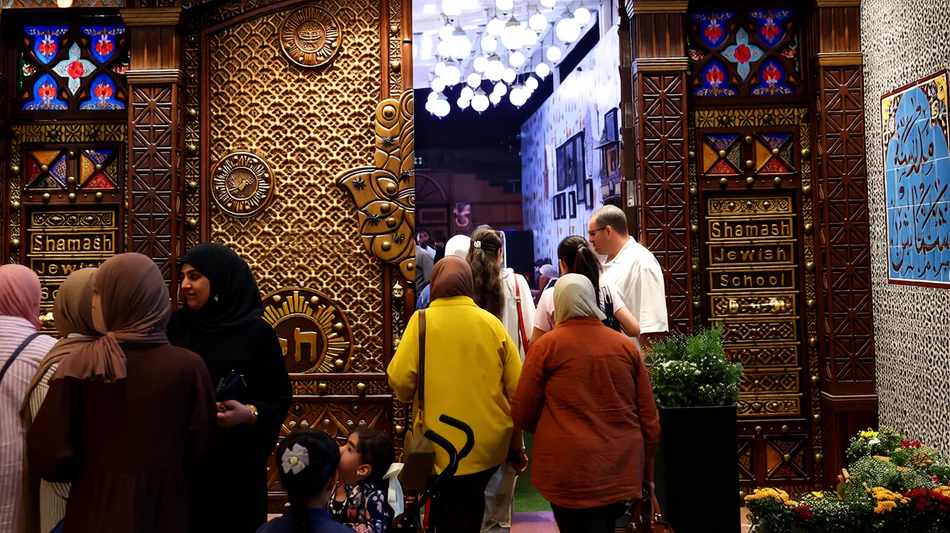
The elegant glass-fronted wooden display cases inside the Shamash Jewish Museum in Baghdad hold a paper trail to a vanished Iraq. Neatly arranged documents, some originals yellowed and fraying at the edges and others carefully reproduced copies, reconstruct the daily life of Iraqi Jews: school certificates, handwritten letters, identity cards, marriage contracts, and family photographs of children in uniforms and shopkeepers in their stores.
On the walls hang framed black-and-white portraits, including that of Sassoon Heskel (1860–1932), an Iraqi-Jewish statesman and the first minister of finance of the Kingdom of Iraq, alongside a brass seven-branched candelabrum. A message on one shelf states that the museum offers an opportunity to “rediscover an important part of Iraq's diverse cultural and religious heritage,” while helping to “preserve its memory for future generations.”
Set up in the former Shamash Jewish School founded in 1928 by Jewish philanthropist Yacoub Shlomo Shamash on Baghdad’s bustling commercial Al Rasheed Street, the museum has been anything but quiet since it opened last month. Dozens of Iraqis visit when it opens its doors three days a week, and the question that follows them out of the door is: is this simply a celebration of heritage, or the beginning of something else?
The museum, which was inaugurated by the Jewish Endowment, has reopened a wound in Iraqi society and sparked a wide debate about the timing and purpose of its opening. For many, the answer is healing. For others, the timing – in the midst of war in Gaza, continuing confrontations with Israel in the region and persistent regional talk about establishing relations – makes the opening impossible to read as neutral.
Supporters argue that Iraq cannot be whole without acknowledging a community that once made up a fifth of Baghdad's population and helped to build the modern state. Sceptics argue that no cultural project exists in a vacuum, that even a museum can be read as a political signal.
That tension was present on the museum's benches and in the careful language of its curators, who insist the project is Iraqi, legitimate and funded entirely from community resources. An 83-year-old retired employee of the Ministry of Commerce, on his second visit, embodied both sides of the argument at once.
The man, who preferred to speak anonymously, said Jews are part of Iraqi society and that it is “impossible to deny their rights and role in building Iraq in its modern history”. He highlighted one of Heskel's major achievements when he insisted during negotiations with the British after the discovery of oil that exploration rights be paid for in gold shillings rather than paper currency, a decision that protected the nation's wealth when paper currencies later deteriorated after the Second World War erupted.
The man said his memory dates back to when he was about 10 in the 1950s, when his family moved to Al Qoshul neighbourhood in old Baghdad after buying a house from a Jewish family. “They were kind, polite and clean people,” he told The National, sitting on one of the wooden benches along one side of the building, with a wheeled walker next to him. “Their relationship with Muslims was good, and we respected them and they respected us.”
Yet in the same breath he warned that the museum's opening could be a harbinger of further steps leading to establishing relations with Israel, which is currently banned under Iraqi law. “There is no harm in preserving heritage, but we must at the same time educate the generations about what Israel is doing now in Gaza and Palestine and about its goal of a Greater Israel from the Nile to the Euphrates,” he said. “Is this the right time for such a step?” he said. “No one can trust Israel now.”
Murtadha Issa, 24, made the opposite distinction more sharply, saying the museum's opening felt more like a mending of Iraqi society. “What happened with the Jews in Iraq was a big mistake,” Mr Issa, an engineering student at the University of Technology in Baghdad, told The National. “Our problem was, and still is, with Zionism and the usurping entity [Israel], not with Judaism and the moderates among them.”
The museum could be the “beginning of fixing the wound in Iraqi society, because this is their country and their heritage”, he added, expressing hope for the Jewish community to return.
Lawyer Ammar Al Tamimi, the legal representative of the Jewish community in Iraq, who manages the community's properties in the Endowment, is keen to pre-empt the suspicion. The Endowment works in accordance with Iraqi law, Mr Al Tamimi told The National. All its money is deposited in the state-run Al Rafidain Bank and the “state is aware of every thousand dinars that enters the account”, he said.
One of the main roles of the Jewish Endowment, which dates back to 1950s, is to “take the initiative from time to time to take care of these places”, he said. “None of us has any connection with any external element at all and the administration [of the Endowment] is independent, with the knowledge of the state,” he added.
The history the museum documents explains why the debate is so sensitive. During Ottoman rule and into the first half of the 20th century, Jews made up about a fifth of Baghdad's population, with a presence in Mesopotamia stretching back 2,600 years to the Babylonian Captivity in the sixth century BC.
In 1947, Iraq's Jewish community numbered about 150,000, one of the largest in the Middle East. Around 125,000 were airlifted to Israel between 1950 and 1952 after the deadly 1941 Farhud pogrom, in which mobs killed dozens of Jews. Properties belonging to Jews were either looted or destroyed, marking the start of their emigration from the country. Pressure on the community increased after the establishment of the State of Israel in 1948.
Official figures show only a handful of Jews remain in Baghdad today, living quietly for safety reasons, while around 90 Jews of Kurdish origin still live in the Iraq's Kurdistan region, according to the Endowment. Some synagogues and Jewish sites remain in Iraq, most of them in Baghdad and Hilla, to south of the capital, although many have been turned into warehouses or fallen into ruin.
The Shamash School itself was impounded by the government in the 1970s and converted into a public school, until a court ruling returned it to the community in 1992, Mr Al Tamimi said. Efforts to revive it faced successive setbacks: sanctions on Iraq in the 1990s, the US-led invasion in 2003, sectarian clashes in 2006 and 2007, and the rise of ISIS between 2014 and 2017.
Now, as Iraq experiences relative stability and a growing thirst for culture, the community's leader, Khalida Fouad Eliyahu, 64, a dentist born in Baghdad, has led the restoration. Mr Al Tamimi said the museum was created to preserve the school's memory after demographic and economic changes transformed the surrounding area into a commercial district with warehouses, where it can no longer operate as a school, and that Ms Eliyahu wants to restore other landmarks linked to the country's centuries-old Jewish presence.
The museum also pays tribute to figures such as the celebrated singer Salima Murad, born into a Jewish family in Baghdad, who rose to fame in the 1920s and 1930s performing the traditional Iraqi Maqam, and to the physician Dhafer Fouad Eliyahu (1960-2021), Ms Eliyahu's brother, who was known for providing free medical services in Baghdad, where he remained until his death.
K.Abe--JT