Russian playwright tells story of wounded soldiers / Photo: TATYANA MAKEYEVA - AFP

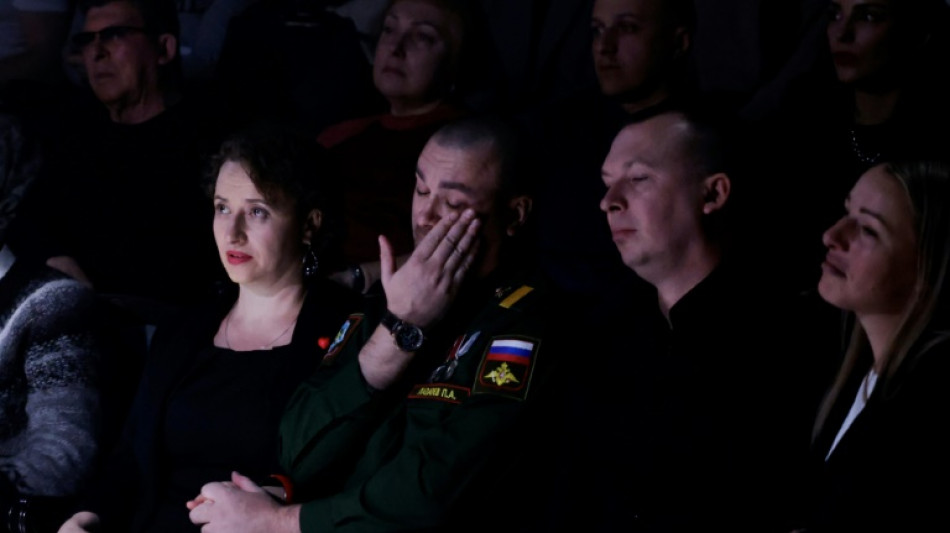
Sat in a Moscow theatre, Pavel wiped tears as he watched actors perform a dramatised version of his life: from his childhood in the south of Russia, near Ukraine, to his mobilisation into the Russian army and amputation after combat.
A few audience members smiled, some cried, most watched in silence.
Since Moscow launched its offensive against Ukraine three years ago, hundreds of thousands of Ukrainian and Russian soldiers have been killed and wounded.
But in Russia, showing and talking about the wounded is largely taboo -- both among supporters of the offensive and its critics.
"Radio-Pasha", a play written by former journalist Irina Bugrysheva, aims to change this.
It is based on her own experience as a masseuse treating battle wounded.
She said society was not accustomed to seeing wounded soldiers portrayed in the media.
"When I went to volunteer at the hospital in the fall of 2022, I started writing notes," Bugrysheva told AFP.
"I realised that what I was seeing was some other life that we are not told about, that we don't see on TV, that we don't hear on the radio."
- 'I don't take sides' -
Bugrysheva said she gave up journalism and social media at the start of the offensive on February 24, 2022 and trained to become a masseuse.
"I opened my Facebook and just closed it, because people -- who were close before -- were saying I was the one bombing Kyiv," she said.
Months later, she was volunteering at a hospital where wounded soldiers returning from Ukraine were being treated.
After her visits to the hospital, Bugrysheva took up writing again.
She compiled her experiences in a book titled "I touch the war with my hands", which will be published soon.
"I don't take sides. My focus is on the human soul alone," she said.
Bugrysheva came up with the title Radio-Pasha while watching soldier Pavel "Pasha" Lazarev talking non-stop on the phone at the hospital where he was being treated.
Her story caught the attention of Lyudmila Manonina-Petrovich, director of the small Kovcheg theatre in Saint Petersburg, who staged "Radio-Pasha".
Manonina-Petrovich said she wanted the audience to understand the plight of the soldiers returning from Ukraine.
"So that society would be ready for this return -- ready to accept it," she said.
- 'Very touching' -
That evening, on the smallest stage of the Vakhtangov Theatre in Moscow, there were only around a hundred spectators in attendance.
Among them was Alexei, a 27-year-old soldier who had returned from Ukraine.
He struggled to hold back tears.
"It was very touching. Lots of memories come flooding back. And you realise that nothing was in vain," he said.
Throughout the performance, the real Pavel Lazarev squeezed Bugrysheva's hand. A factory worker, he remembers the day he was mobilised.
"I had already done my military service in Chechnya. I knew I would be useful," he told AFP. "They called me up, and I went."
He said he took part in the fighting for the eastern Ukrainian city of Marinka, which Moscow took full control of at the end of 2023.
Wounded in combat, his leg had to be amputated.
"Through these performances, every fighter sees himself, endures this pain, and it becomes easier for him," he said.
But few venues are willing to host the plays and the organisers are having a hard time financing their project.
Private organisations and the authorities have shown no interest so far.
For the past three years, the Russian army has sought to portray the image of healthy soldiers on the road to victory.
The play is mainly performed in small cultural centres in the suburbs of Saint Petersburg.
Critics of the offensive do not condone the play either, as they reject compassion towards those fighting for Moscow.
Konstantin Zelensky, the actor who plays Lazarev, said he was upset that the theatrical community was indifferent to the play.
"I didn't have to make up anything. My brother was mobilised, he's in his third year of the special military operation," the actor said.
"Our so-called theatrical bohemians don't hide their lack of support for the special military operation. So we just get together and do it ourselves," he said.
M.Matsumoto--JT