New life breathed into Tunisia's bagpipes / Photo: FETHI BELAID - AFP

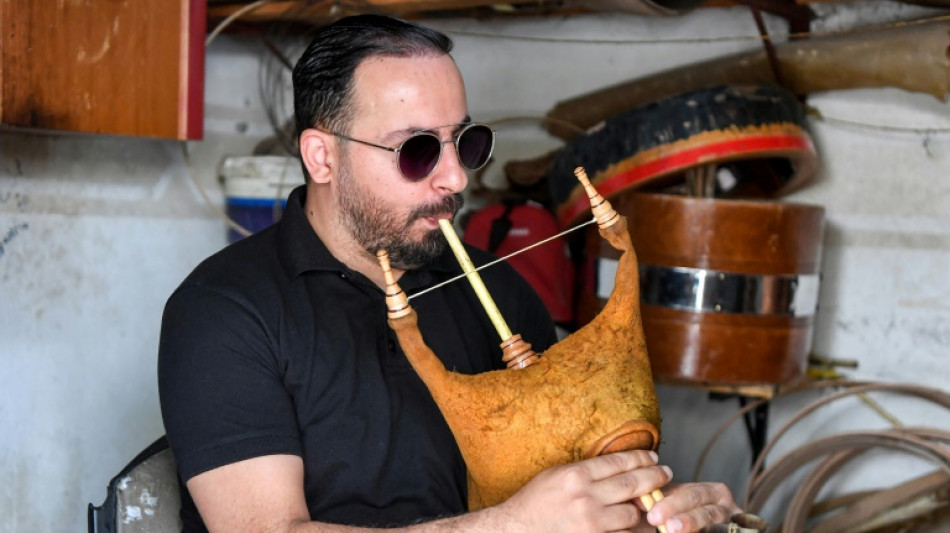
At his workshop in Tunisia's capital, Khaled ben Khemis pieces together a type of bagpipe once banned from airwaves but now embraced by artists infusing its sound into new musical styles.
Known as a "mizwad", it "must be made from natural elements", the 50-year-old craftsman said, taking two cow horns and connecting them to pieces of river reed and a goatskin bag for producing the musical notes.
He has made the instrument for 30 years.
Most musical historians agree the mizwad first appeared in Tunisia at the beginning of the 20th century and was confined to working-class suburbs for decades before growing in stature to now be incorporated into other genres, including hip-hop and jazz.
The increased popularity has seen commercial manufacturers turning out mizwads.
But modern variations that replace natural materials with plastic "do not have the soul of those made with reeds", ben Khemis said of the new models, which cost up to 1,000 dinars ($320).
He acknowledged the instrument has, however, evolved.
"Before we played out of tune, and we made it in a hurry," he said.
- Bad image -
The mizwad spawned its own musical style that was frowned upon by authorities for associations with alcohol, drugs and prison -- where many songs were composed.
"It was a musical genre whose reputation was bad just like those who played it," said Noureddine Kahlaoui, a self-described mizwad "activist" aged in his seventies.
"Criminals and those on the run were always found by authorities at mizwad concerts," said the popular artist who has played the instrument for 40 years.
The songs address "daring subjects criticising society, politics, migration and racism", said Rachid Cherif, a musicology researcher.
Mizwad concerts are traditionally held in poor and marginalised neighbourhoods, particularly for weddings.
Song lyrics can be abrasive and considered rude, drawing resentment from families and sometimes triggering brawls at parties.
These elements combined to see Tunisia's authorities ban the mizwad on public television channels until the 1990s -- leading folk artists to undertake a restoration of the instrument's image.
In July 1991, a "Nouba" concert that mixed folk, popular and Sufi music was staged in Carthage's ancient Roman amphitheatre and broadcast on television, marking a fundamental step in the mizwad's rehabilitation.
But some snobbery toward the instrument remains.
In 2022, officials from Tunis's municipal theatre refused to allow a mizwad show, deeming the institution too prestigious to host such a concert.
- Jazz and rap -
"Despite the criticism, we have worked so that this original heritage can progress," said Kahlaoui, who describes the mizwad's evolution as "dazzling".
For the researcher Cherif, "the mizwad occupies a prominent place in the history of Tunisian popular music" due to its fundamental identity. It "consolidates the idea of belonging to a nation, an ethnic group and a culture", he said.
In recent years, a new generation of musicians has taken up the instrument, mixing it with contemporary genres offering more room for creativity such as rap and world music.
"Thanks to what I learnt during my studies, I understood what could be done with this instrument," said Montassar Jebali, 32, who plays mizwad in several jazz and hip-hop ensembles.
Jebali studied Arabic music at the Higher Institute of Music of Tunisia, where the mizwad is not taught.
"I used my academic knowledge to find out which instrument it went well with," he said.
Jebali's concerts and those of other contemporary mizwad players have been popular with young Tunisians.
"The mizwad is gaining ground" and will have its international breakthrough, he said. "Perhaps not tomorrow, but after tomorrow."
K.Inoue--JT