The Japan Times - Europe's first majority Black orchestra debuts stateside

EUR -
AED 4.266327
AFN 72.602888
ALL 96.045598
AMD 437.103753
ANG 2.079534
AOA 1065.27595
ARS 1623.419796
AUD 1.660456
AWG 2.093668
AZN 1.975506
BAM 1.956712
BBD 2.335279
BDT 142.276321
BGN 1.985698
BHD 0.438497
BIF 3443.70526
BMD 1.161697
BND 1.483604
BOB 8.029743
BRL 6.079504
BSD 1.15945
BTN 108.641175
BWP 15.887543
BYN 3.432585
BYR 22769.251731
BZD 2.331977
CAD 1.597925
CDF 2645.76246
CHF 0.915444
CLF 0.027004
CLP 1066.274537
CNY 8.007222
CNH 8.005872
COP 4304.062361
CRC 540.256487
CUC 1.161697
CUP 30.784958
CVE 110.316423
CZK 24.448487
DJF 206.475358
DKK 7.471933
DOP 69.462978
DZD 154.02952
EGP 61.070967
ERN 17.425448
ETB 179.250199
FJD 2.578737
FKP 0.867845
GBP 0.865714
GEL 3.142339
GGP 0.867845
GHS 12.667905
GIP 0.867845
GMD 85.390256
GNF 10162.73729
GTQ 8.879139
GYD 242.663116
HKD 9.093354
HNL 30.703577
HRK 7.535916
HTG 152.032177
HUF 390.334619
IDR 19619.36971
ILS 3.630708
IMP 0.867845
INR 109.529569
IQD 1518.908029
IRR 1525336.568915
ISK 143.806627
JEP 0.867845
JMD 182.976868
JOD 0.823622
JPY 184.409451
KES 150.265186
KGS 101.588619
KHR 4653.209117
KMF 494.883011
KPW 1045.493347
KRW 1735.49382
KWD 0.356014
KYD 0.96625
KZT 559.740919
LAK 24963.42164
LBP 103836.408796
LKR 364.45989
LRD 212.768265
LSL 19.766644
LTL 3.430188
LVL 0.702699
LYD 7.392414
MAD 10.809339
MDL 20.279278
MGA 4841.256719
MKD 61.640387
MMK 2439.131634
MNT 4146.061617
MOP 9.344056
MRU 46.244955
MUR 54.010439
MVR 17.959772
MWK 2010.537198
MXN 20.597114
MYR 4.585206
MZN 74.244083
NAD 19.766814
NGN 1597.6344
NIO 42.66989
NOK 11.261939
NPR 173.828525
NZD 1.989603
OMR 0.446615
PAB 1.15944
PEN 4.010569
PGK 5.007377
PHP 69.733125
PKR 323.935489
PLN 4.271285
PYG 7565.494041
QAR 4.228171
RON 5.09555
RSD 117.445202
RUB 93.517752
RWF 1696.290714
SAR 4.361242
SBD 9.342334
SCR 16.817866
SDG 698.179481
SEK 10.809778
SGD 1.484032
SHP 0.871573
SLE 28.579044
SLL 24360.207686
SOS 662.614577
SRD 43.378208
STD 24044.772443
STN 24.511637
SVC 10.145729
SYP 128.922229
SZL 19.765384
THB 37.720244
TJS 11.125286
TMT 4.077555
TND 3.400885
TOP 2.797086
TRY 51.514847
TTD 7.877672
TWD 37.105515
TZS 2982.724285
UAH 50.922437
UGX 4342.024005
USD 1.161697
UYU 47.252026
UZS 14145.593872
VES 533.07716
VND 30618.835095
VUV 138.774207
WST 3.193358
XAF 656.262912
XAG 0.015927
XAU 0.000256
XCD 3.139542
XCG 2.089674
XDR 0.81618
XOF 656.260087
XPF 119.331742
YER 277.187548
ZAR 19.614746
ZMK 10456.646968
ZMW 21.943134
ZWL 374.065804
  • RBGPF

    -13.5000

    69

    -19.57%

  • RYCEF

    -0.4500

    15.6

    -2.88%

  • NGG

    0.2700

    82.33

    +0.33%

  • GSK

    0.9600

    52.95

    +1.81%

  • BCE

    0.0700

    25.83

    +0.27%

  • AZN

    1.7100

    185.78

    +0.92%

  • BCC

    1.6900

    73.57

    +2.3%

  • BTI

    -0.1600

    57.76

    -0.28%

  • CMSC

    -0.0100

    22.87

    -0.04%

  • RIO

    0.9300

    86.77

    +1.07%

  • RELX

    -1.3500

    32.46

    -4.16%

  • CMSD

    -0.1100

    22.63

    -0.49%

  • JRI

    0.1800

    11.86

    +1.52%

  • VOD

    0.1800

    14.66

    +1.23%

  • BP

    1.2200

    44.79

    +2.72%

Europe's first majority Black orchestra debuts stateside
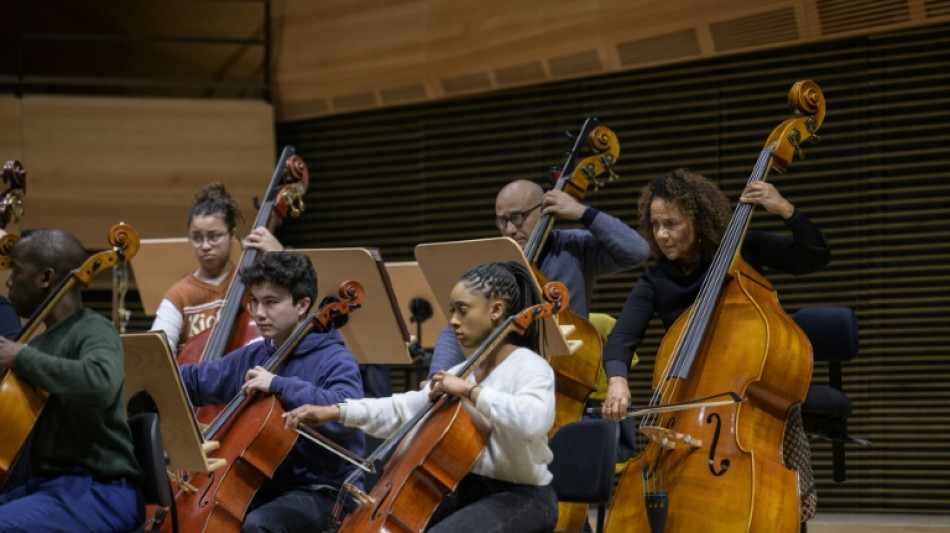
Europe's first majority Black orchestra debuts stateside / Photo: ANGELA WEISS - AFP

Europe's first majority Black orchestra debuts stateside

After more than three decades in the classical music industry, British double bassist Chi-chi Nwanoku began grappling with the question that had troubled her for years: Why was she consistently the only Black musician onstage?

Text size:

"Why did I never ask anyone about it? Why did we never talk about it?" she describes wondering. "Was I being tolerated, or were people just completely unaware?"

"Or were people okay with the status quo?"

In 2015 Nwanoku took a leading role in creating a more diverse future for classical music, which, from musicians to conductors to repertoire, traditionally skews heavily white.

She founded Chineke!, Europe's first majority Black and ethnically diverse professional orchestra, which this week played at the prestigious New York Philharmonic's David Geffen Hall in Manhattan's Lincoln Center.

The performance was part of their long-awaited North American debut tour -- it was among the many performances the pandemic pushed back -- which included stops in New York, Ottawa, Toronto, Boston, Worcester and Ann Arbor.

The New York show featured the pioneering composer Florence Price's Symphony No. 1, along with a rendition of Mozart's Clarinet Concerto featuring the New York Phil's principal clarinet Anthony McGill.

- 'Door-opener' -

The London-headquartered Chineke! echoes similar efforts in the United States, including the Detroit-based Sphinx organization that promotes representation of Black and Latino artists in classical music.

Yet the League of American Orchestras, which represents professional and amateur symphonies across the United States, found in a 2014 study on diversity that just 1.4 percent of orchestra musicians were Black -- and there's little reason to believe much has changed.

"Because the great majority of American orchestras are not individually transparent with racial and ethnic data on their artists, we do not know the percentage of Black orchestral artists in our orchestras today," writes the Black Orchestral Network, a collective of Black musicians from more than 40 orchestras launched in 2022.

"From our vantage point, however, we have seen little meaningful progress."

It's mind-boggling to Nwanoku, who told AFP during a rehearsal break that "it seems to me that the only colleagues of color that I see who have a job in an orchestra in this country are those who are exceptional."

"We have to be that much better to actually be given a job."

Nwanoku believes that especially for young people, seeing more diverse faces onstage is "an immediate door-opener."

"It's the most incredibly winning thing to feel represented on a stage," she said. "Even if when you walk through the front of house to buy a ticket, if you don't see anyone who looks like you, that is immediately uncomfortable."

"But when you see people that look like you in any place -- in the supermarket, at the train station, at the concert hall, at the cinema -- you immediately feel that is a place that I can walk into with confidence," Nwanoku continued.

"You can be what you can see."

T.Maeda--JT