Benin leans into painful past to attract tourists / Photo: OLYMPIA DE MAISMONT - AFP

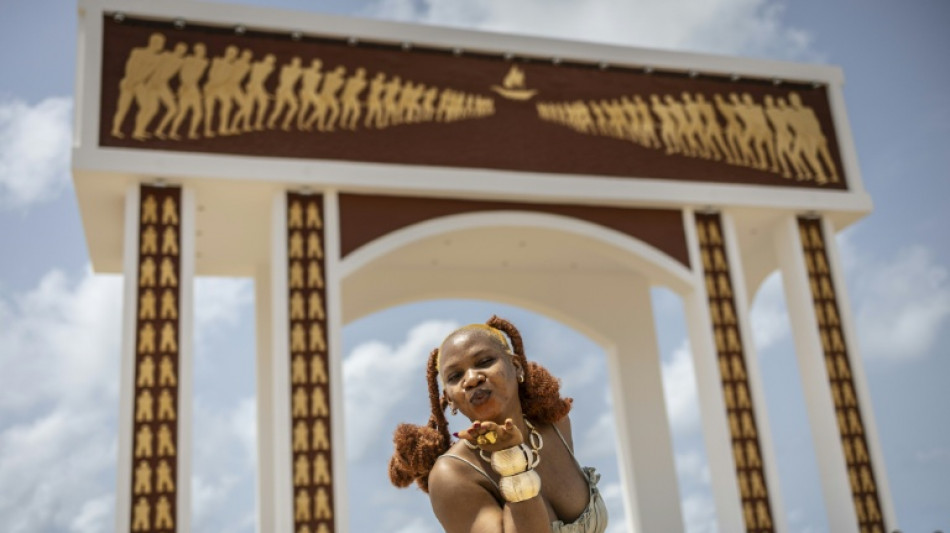
Tourists crowded beneath the Door of No Return, an arch built by the beach at Ouidah in southern Benin in memory of those crammed onto slave ships bound for the New World.
Benin, which holds a presidential election on Sunday, has in recent years leaned into its painful past to encourage tourism.
Once a key departure point in the transatlantic slave trade, the coastal town of Ouidah lies at the heart of the push to reclaim the country's history, culture and heritage.
Standing nearly 17 metres (56 feet) tall on the seafront, the Door of No Return has been fully restored, now a must-see landmark for visitors.
Its ochre-and-gold facade is carved with figures of chained slaves, frozen mid-stride towards the ocean.
Nearby, a life-size replica of L'Aurore -- one of the last three-masted ships to leave Ouidah for Cuba around 1860 -- is set to open soon as an immersive museum of the slave trade.
"It reminds us of where we come from. It's important to develop tourism around our history because it's very rich, little known, and we want to showcase it," said Arsene Ahounou, an engineer from the commercial capital Cotonou visiting for the day.
"For us natives, understanding our history matters," he added.
Pausing for selfies with friends visiting from Nigeria, Onyinye Anumba said that seeing the site with her own eyes was "awesome".
"As an African, I've read many things about this place... so just being here makes me proud about what Africa has," she said.
- 'Demystify Vodun' -
Elsewhere, tourists explored the 13th-century Python Temple to learn about Voodoo culture -- the popular animist religion rooted in Ouidah.
As many posed for photos with snakes draped around their shoulders, guides explained the reptile's spiritual significance in Voodoo (Vodun in the local Fon language) beliefs.
Having worked in Beninese tourism for more than 35 years, Modeste Zinsou, the temple's head guide, said the sector had evolved.
"This isn't mass tourism, it's cultural tourism. The sacred element remains. We're reconstructing our own history, in which we completely demystify Vodun and the cliches around it," he said.
Benin is the birthplace of Voodoo, which now has its own international festival, the Vodun Days.
The three days of dancing, mask parades and traditional ceremonies have become a major tourist attraction.
This year it drew around two million visitors, most of them Beninese.
"The government has worked to encourage domestic tourism, meaning Beninese people going out and reclaiming their identity," added Zinsou.
- 'Our Eiffel Tower' -
To boost tourism, Benin has launched major infrastructure projects, including road and hotel renovations.
A Club Med resort is planned for 2027 and visa procedures have been eased for many nationalities.
"We're not a country with mineral wealth, so we had to identify where our wealth lies," said Alain Godonou, an adviser to the president on heritage and museums.
"History shows that Benin is a land of great cultures and traditions, and a witness to a pivotal moment in human history -- the slave trade," he said.
Godonou hopes tourism will account for 10 to 15 percent of GDP within a decade, up from about six percent today.
Sunday's election in the west African country is to replace the architect of this tourism drive, outgoing president Patrice Talon, who is stepping down after two five-year terms.
The frontrunner to succeed him, Romuald Wadagni, the finance minister from the ruling party, has pledged to carry the projects forward.
Since 2024, Benin has allowed anyone with an African ancestor who was enslaved and shipped to the Americas to acquire Beninese nationality.
"It was important for Benin to do justice to this diaspora by granting the nationality that should have been theirs," Godonou said.
In the heart of Cotonou, the country's largest city, the Amazon Monument is now a major attraction.
The towering 30-metre metal statue depicts a warrior of the Dahomey kingdom, rifle at her side and dagger in hand.
On Easter Monday, a public holiday, crowds of Beninese visitors strolled through the plaza, snapping pictures of the statue.
"It's a source of pride! We don't have the money to go on holiday in France or elsewhere," said vendor Geraldine Sedami Yagbo.
"This statue is our Eiffel Tower."
K.Yamaguchi--JT