The Japan Times - Brazil police probe plight of near-extinct blue parrot

EUR -
AED 4.320095
AFN 75.885663
ALL 95.39106
AMD 434.359293
ANG 2.105503
AOA 1079.875165
ARS 1641.608916
AUD 1.626097
AWG 2.117403
AZN 2.00155
BAM 1.955617
BBD 2.368967
BDT 144.323592
BGN 1.962246
BHD 0.444119
BIF 3501.171877
BMD 1.176335
BND 1.49156
BOB 8.128238
BRL 5.776866
BSD 1.176185
BTN 111.070676
BWP 15.79252
BYN 3.324188
BYR 23056.161221
BZD 2.365567
CAD 1.606091
CDF 2724.390954
CHF 0.915576
CLF 0.026587
CLP 1046.373458
CNY 8.005017
CNH 8.000023
COP 4398.19802
CRC 540.701063
CUC 1.176335
CUP 31.172871
CVE 110.244828
CZK 24.30766
DJF 209.470369
DKK 7.473237
DOP 69.953444
DZD 155.593016
EGP 62.020486
ERN 17.645021
ETB 183.670087
FJD 2.570173
FKP 0.864396
GBP 0.864212
GEL 3.152187
GGP 0.864396
GHS 13.250758
GIP 0.864396
GMD 85.872502
GNF 10320.111643
GTQ 8.981158
GYD 246.116934
HKD 9.20856
HNL 31.271069
HRK 7.533241
HTG 154.005567
HUF 356.064543
IDR 20432.346547
ILS 3.416253
IMP 0.864396
INR 111.13652
IQD 1540.955585
IRR 1544409.901346
ISK 143.806836
JEP 0.864396
JMD 185.392625
JOD 0.834004
JPY 184.389884
KES 151.900296
KGS 102.835777
KHR 4719.557692
KMF 492.883828
KPW 1058.643569
KRW 1725.519067
KWD 0.361876
KYD 0.980308
KZT 543.610531
LAK 25796.582394
LBP 105337.827942
LKR 378.68071
LRD 215.849771
LSL 19.297891
LTL 3.473411
LVL 0.711553
LYD 7.437639
MAD 10.757232
MDL 20.115115
MGA 4913.101009
MKD 61.641843
MMK 2469.840437
MNT 4209.987489
MOP 9.484411
MRU 47.016594
MUR 55.076306
MVR 18.180264
MWK 2039.30888
MXN 20.271482
MYR 4.612434
MZN 75.167161
NAD 19.297891
NGN 1599.45028
NIO 43.28208
NOK 10.821804
NPR 177.729344
NZD 1.973736
OMR 0.452335
PAB 1.17629
PEN 4.066656
PGK 5.19405
PHP 71.143536
PKR 327.806219
PLN 4.232417
PYG 7184.685358
QAR 4.299213
RON 5.224695
RSD 117.388809
RUB 87.170473
RWF 1724.438389
SAR 4.447279
SBD 9.448624
SCR 16.852352
SDG 706.388119
SEK 10.84046
SGD 1.491516
SHP 0.878253
SLE 28.944025
SLL 24667.14716
SOS 672.236999
SRD 44.031407
STD 24347.754442
STN 24.495518
SVC 10.292117
SYP 130.036684
SZL 19.285193
THB 37.889551
TJS 10.974871
TMT 4.128935
TND 3.41668
TOP 2.832332
TRY 53.363256
TTD 7.971541
TWD 36.930438
TZS 3063.933249
UAH 51.665846
UGX 4407.193579
USD 1.176335
UYU 46.911416
UZS 14267.389376
VES 583.707963
VND 30947.014765
VUV 138.838256
WST 3.180917
XAF 655.895531
XAG 0.014572
XAU 0.00025
XCD 3.179103
XCG 2.119812
XDR 0.818154
XOF 655.836996
XPF 119.331742
YER 280.672359
ZAR 19.312335
ZMK 10588.444039
ZMW 22.394901
ZWL 378.779312
  • RBGPF

    0.0000

    63.18

    0%

  • GSK

    -0.4150

    50.085

    -0.83%

  • BTI

    -0.0300

    58.05

    -0.05%

  • BCC

    -0.2450

    72.515

    -0.34%

  • JRI

    0.0060

    13.156

    +0.05%

  • NGG

    0.9500

    86.86

    +1.09%

  • CMSC

    0.0000

    22.97

    0%

  • AZN

    -0.6800

    181.84

    -0.37%

  • RELX

    0.0209

    33.525

    +0.06%

  • RIO

    2.1100

    105.22

    +2.01%

  • RYCEF

    -0.0500

    17.45

    -0.29%

  • CMSD

    0.0000

    23.42

    0%

  • BP

    -0.0050

    43.805

    -0.01%

  • BCE

    -0.2350

    24.335

    -0.97%

  • VOD

    0.4200

    16.11

    +2.61%

Brazil police probe plight of near-extinct blue parrot
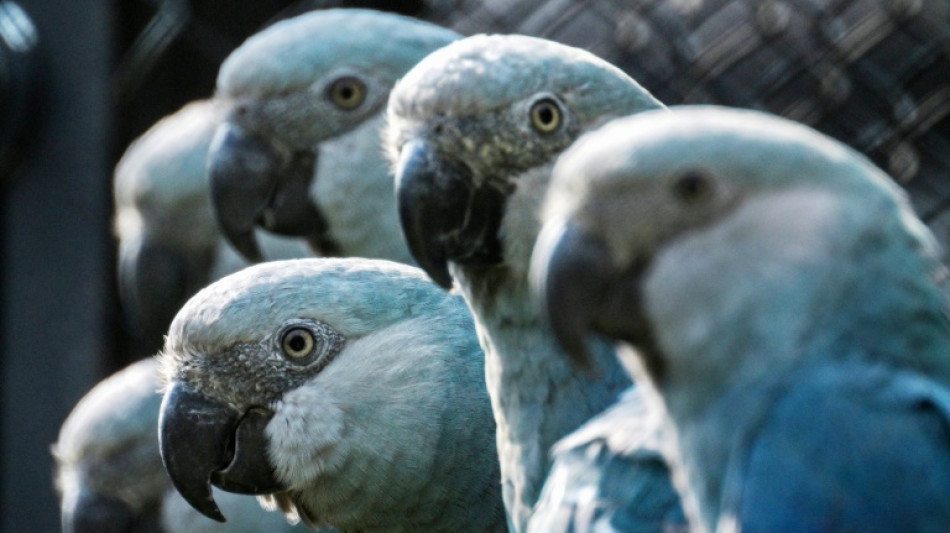
Brazil police probe plight of near-extinct blue parrot / Photo: Nelson ALMEIDA - AFP/File

Brazil police probe plight of near-extinct blue parrot

Brazilian police said Wednesday they were probing the outbreak of a lethal virus among some of the last Spix's Macaws, one of the world's rarest birds -- made famous as the blue parrot in the 2011 animated film "Rio."

Text size:

The conservation of the Spix's macaw has been the subject of a fierce battle between private breeders and the government.

The Spix's macaw was last seen in the wild 25 years ago.

In 2020, a group of captive-bred birds was brought from Germany for a program to reintroduce them to their natural habitat in northeast Brazil.

Last week, Brazil's conservation agency, ICMBio, said that all 11 surviving Spix's macaws that had been released to the wild have tested positive for the incurable circovirus, which is considered deadly.

On Tuesday, it reported another 20 in captivity had tested positive.

The agency has fined the breeding center 1.8 million reais ($336,000) for failing to implement biosafety protocols to curb the spread of the virus.

In a statement, police said they had seized cellphones and computers from the Spix's Macaw Breeding Center as part of "Operation Blue Hope".

"Those under investigation may face charges of spreading a disease capable of harming wildlife, causing death to wild animals, and obstructing environmental inspections," said police.

The center had resisted efforts to recapture the wild Spix's macaws, which a court ordered them to do in October.

In statements sent to AFP, the breeding center said only five of 103 macaws under its care had tested positive for the virus, rejecting accusations of negligence.

It argued that tropical parrots such as the Spix's macaw were "especially resistant to circovirus."

It said it was "completely calm" over the police investigation.

Circovirus causes beak and feather disease in parrot species but poses no risk to humans.

ICMBio said the interpretation of test results was "not simple".

"No positive Spix's macaw is necessarily doomed, but it is also not certain that, after a negative result, they are cured," it said.

"We are talking about a Brazilian bird of high conservation value," said Claudia Sacramento, who is coordinating the response to the outbreak at ICMBio.

"Those responsible for the contamination must be held accountable."

The breeding center is a partner of the German Association for the Conservation of Threatened Parrots (ACTP), which holds 75 percent of the world's registered Spix's macaws, according to ICMBio.

Brazil terminated its partnership with ATCP in 2024 after the German organization sold 26 of the birds to a private zoo in India without its consent.

Y.Kimura--JT