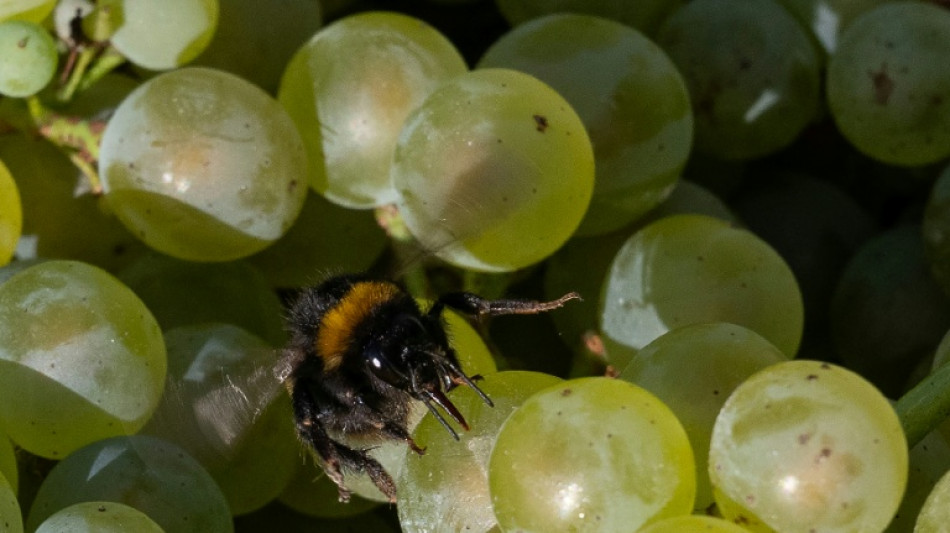
In France's north, winegrowers bet on a warmer future / Photo: Sebastien Salom-Gomis - AFP

In a green valley in Normandy, rows of grapevines stretch across slopes where an apple orchard once stood.
In a land long associated with cider and Calvados, winemaker Sebastien Fricker is betting that a warming climate can turn one of France's northernmost regions into its newest wine country.
"These days, to have a fine vineyard and good grapes, you really need a stable climate from spring right through to autumn," said Fricker. "And at the moment, Normandy is very well suited to that."
The heir to five generations of winemakers in the Loire Valley left his family's historic wine-growing region in central France as climate change and worsening soil quality made growing conditions increasingly challenging.
"I really couldn't see myself taking on another vineyard in the Loire," the 36-year-old said.
"That's what led me to Normandy. I thought: perhaps it's time to take a step back and consider what the next 50 years of viticulture might look like."
In 2020, Fricker settled on four hectares of land in a village in the Calvados department, about a 30-minute drive from the seaside resort of Deauville. He now grows two white and two red grape varieties, including Chardonnay and Cabernet Sauvignon.
He chose the village of Marolles for the quality of its terroir, its clay-limestone soil and a stable climate with few thunderstorms and limited temperature variations.
Even in late August, despite recent extreme heat, the vegetation remained green here.
This year, successive heatwaves, wildfires and drought, disrupted life for France's winegrowers, leading to historically early harvests, lower yields, and an increased risk of smoke taint.
- 'New wine regions' -
Fricker believes climate change will inevitably reshape France's wine map.
In recent years, vineyards have been expanding into Normandy, Brittany and Hauts-de-France, France's northernmost region, long associated with grey skies, rain and blustery weather rather than wine production.
"We will no longer be able to produce solely in the south," Fricker said.
For now the output remains negligible.
Normandy has around 20 producers cultivating 20 hectares, compared with 85,000 hectares in the southwestern region of Bordeaux.
Together they produce fewer than 100,000 bottles a year.
Maxime Gazeau of the Norman Winegrowers' Union (SyViNor) said almost all locally made wine is sold directly by producers.
"We have no problem selling our wine," he said, adding that the main challenge remained producing "high-quality wine".
Vine planting is strictly regulated in the European Union. While climate change has made vine-growing more viable in northern France, industry experts say its spread has also been aided by an EU reform that eased vine-planting rules in 2016.
Among those to benefit were Marina and Loic Fourrure, who have been cultivating six hectares of vines in Theix-Noyalo in the northwestern region of Brittany since 2021, with an inlet and marshes the backdrop to their vineyard.
"Brittany is now a very good place to plant vines," said Marina Fourrure, hard at work harvesting her plots during an exceptionally early vintage.
- 'Mind-blowing' -
She said winegrowers from the south had told her and her husband they were right to be growing grapes in Brittany and complained that extreme weather was disrupting vine growth and driving up alcohol levels.
"Sugar levels are getting far too high, they need to find solutions, but perhaps the pleasure has gone out of it," said the winemaker.
Climate disruption could also be felt in Brittany, she said.
"There are no upsides to global warming," she added.
Her husband, Loic Fourrure, chimed in.
"We've had frosts, droughts and excessive rain. And we are harvesting on August 22," he said. "It's properly mind-blowing."
At the same time he said they had managed to demonstrate that winegrowing in Brittany has "potential for the future".
Loic Fourrure is co-president of the Breton Winegrowers' Association that represents some 50 estates spanning around 160 hectares.
But he warned that establishing vineyards was a long-term effort.
"To call it a winegrowing El Dorado would be going a bit too far," he said.
"It will be another 20 years before our vines are fully mature and capable of producing really fine grapes."
Vineyards in the Hauts-de-France region, which lies along the English Channel, now cover approximately 130 hectares, estimated Bruno Cardot, a local winegrower.
"Today we have the climate that the Champagne wine region had in the 1970s," he said.
"Climate change is clearly pushing all kinds of agriculture, including viticulture, northwards in France," he added.
cln-mac-laf-as/sw/giv
H.Hayashi--JT