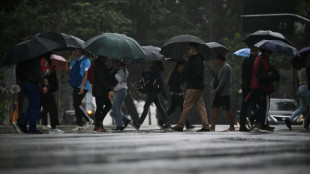
Record-smashing heat wave surges from West to eastern US, Canada / Photo: Amid FARAHI - AFP/File

A record-smashing heat wave was spreading Tuesday from the Mountain West toward the eastern United States and Canada, placing more than 100 million people under heat alerts.
Hot and dry conditions also contributed to fierce wildfires in southwestern Ontario and northern Minnesota, with air quality expected to worsen over the Midwestern and Northeastern United States in the coming days.
The phenomenon known as a heat dome has already shattered all-time temperature records in western states, including 111F (44C) in Billings, Montana, where the previous record was 108F, and 109F in Salt Lake City, where the previous one was 107F.
Extreme heat and humidity persist in the Mountain West but are now spilling over to the densely populated East Coast, which also faced brutal temperatures earlier in the month, as well as Canada's Ontario and, to a lesser extent, Montreal.
"Above average temperatures and dangerous levels of heat are forecast to enter the Northeast on Tuesday before the most intense heat occurs on Wednesday and expands into the Mid-Atlantic," said the US National Weather Service.
US cities from Richmond, Virginia, to Boston, Massachusetts, are set to see temperatures soar from the upper 90s to near 100 degrees, with daily high records under threat.
In Ottawa, the federal capital of Canada, and Toronto, highs are expected to reach 100.4F on Tuesday, with temperatures feeling even hotter because of high humidity levels.
"Hot and humid air can also bring deteriorating air quality and can result in the Air Quality Health Index approaching the high-risk category," Environment and Climate Change Canada said.
In Montreal, the sky turned yellow on Tuesday morning due to smoke from wildfires burning several hundred miles away in northern Quebec and northwestern Ontario.
Cooler temperatures are expected to follow by the end of the week, though the heat dome will persist in the US Mountain West for the rest of July.
Heat domes are large areas of high pressure, where sinking air suppresses development of precipitation and clouds, allowing heat to build up over days and weeks.
- New climate reality -
"We know that heat domes are, of course, a natural part of the climate system," Marc Alessi, a climate scientist at the Union of Concerned Scientists, said in a briefing.
"But the climate system now is fundamentally different due to fossil fuel-driven climate change," he said. "Our atmosphere is much warmer. Our oceans are much warmer. They're releasing a lot more heat into the atmosphere, and this heat dome is an example of you know what fossil fuel-driven climate change looks like."
Scientists from the World Weather Attribution group released an analysis showing the hot and humid conditions in the earlier East Coast hot spell -- which fell as America celebrated its 250th anniversary on July 4 -- would have been "virtually impossible" without human-caused climate change.
Scientists say a brewing "super" El Nino in the equatorial Pacific could also be influencing the heat dome.
Record-warm sea surface temperatures in the central Pacific are shifting where tropical storms form and release energy, which in turn is distorting the jet stream over the western US and allowing hot air to get trapped in place.
US forecasters expect El Nino to peak between October and December at potentially record-breaking levels, with the strongest spike in temperature to follow in 2027.
Compounded with human-induced climate change, the last El Nino contributed to making 2023 the second-hottest year on record and 2024 the all-time high.
M.Yamazaki--JT