The Japan Times - 'Extreme cold': Winter storm forecast to slam huge expanse of US

EUR -
AED 4.286951
AFN 77.041935
ALL 92.239359
AMD 424.151071
ANG 2.089232
AOA 1071.591028
ARS 1764.688182
AUD 1.629502
AWG 2.09824
AZN 1.985645
BAM 1.955574
BBD 2.348629
BDT 143.493447
BGN 1.980186
BHD 0.439649
BIF 3481.398391
BMD 1.16731
BND 1.481629
BOB 13.427451
BRL 6.009199
BSD 1.166065
BTN 111.209171
BWP 15.613199
BYN 3.517994
BYR 22879.282683
BZD 2.345329
CAD 1.615517
CDF 2659.721351
CHF 0.936136
CLF 0.027087
CLP 1066.069918
CNY 7.844734
CNH 7.841255
COP 3613.922777
CRC 529.038971
CUC 1.16731
CUP 30.933724
CVE 110.252281
CZK 24.070814
DJF 207.656045
DKK 7.475415
DOP 68.292122
DZD 155.261725
EGP 58.801741
ERN 17.509655
ETB 188.214888
FJD 2.559386
FKP 0.856451
GBP 0.855423
GEL 3.040819
GGP 0.856451
GHS 13.0025
GIP 0.856451
GMD 85.798605
GNF 10245.818059
GTQ 8.896974
GYD 243.971856
HKD 9.150015
HNL 31.277392
HRK 7.53417
HTG 152.552402
HUF 360.976737
IDR 20657.891104
ILS 3.47754
IMP 0.856451
INR 110.882928
IQD 1527.623776
IRR 1604584.79479
ISK 141.209394
JEP 0.856451
JMD 185.07865
JOD 0.827648
JPY 185.884848
KES 151.084766
KGS 102.081325
KHR 4719.455571
KMF 493.77205
KPW 1050.57965
KRW 1615.364885
KWD 0.360197
KYD 0.971788
KZT 533.948405
LAK 26172.980727
LBP 104425.653624
LKR 383.015816
LRD 211.645585
LSL 18.652448
LTL 3.446764
LVL 0.706094
LYD 7.383148
MAD 10.775357
MDL 20.150675
MGA 4990.424313
MKD 61.521856
MMK 2451.084129
MNT 4198.275285
MOP 9.414714
MRU 46.757606
MUR 54.595383
MVR 18.046666
MWK 2022.066738
MXN 19.782981
MYR 4.716053
MZN 74.596975
NAD 18.652448
NGN 1571.911262
NIO 42.915049
NOK 10.880832
NPR 177.934474
NZD 1.954066
OMR 0.448831
PAB 1.166165
PEN 3.913649
PGK 5.170404
PHP 71.920912
PKR 323.50958
PLN 4.303482
PYG 6990.193622
QAR 4.25091
RON 5.256752
RSD 117.296015
RUB 97.645083
RWF 1718.90171
SAR 4.382697
SBD 9.3611
SCR 16.062454
SDG 702.137104
SEK 11.038898
SGD 1.48162
SHP 0.864821
SLE 28.773862
SLL 24477.913292
SOS 666.423122
SRD 44.26676
STD 24160.967267
STN 24.497174
SVC 10.203823
SYP 15177.368943
SZL 18.650848
THB 38.182828
TJS 10.75156
TMT 4.097259
TND 3.397908
TOP 2.810603
TRY 56.169457
TTD 7.922086
TWD 37.186773
TZS 3093.370102
UAH 52.10009
UGX 4349.498249
USD 1.16731
UYU 46.874593
UZS 13733.415735
VES 914.800628
VND 30480.807623
VUV 138.094437
WST 3.170349
XAF 655.881339
XAG 0.016967
XAU 0.000251
XCD 3.154715
XCG 2.101658
XDR 0.825349
XOF 655.881339
XPF 119.331742
YER 276.774218
ZAR 18.59676
ZMK 10507.191229
ZMW 22.208438
ZWL 375.873454
  • RBGPF

    1.3300

    69.89

    +1.9%

  • CMSD

    0.2000

    21.26

    +0.94%

  • CMSC

    0.1120

    21.34

    +0.52%

  • BCE

    -0.2600

    23.59

    -1.1%

  • AZN

    2.9500

    169.66

    +1.74%

  • RIO

    2.0100

    106.81

    +1.88%

  • RYCEF

    0.5500

    20.8

    +2.64%

  • GSK

    0.2900

    52.07

    +0.56%

  • NGG

    0.7500

    81.17

    +0.92%

  • BTI

    -0.2400

    56.47

    -0.43%

  • RELX

    -0.5100

    35.88

    -1.42%

  • VOD

    0.1500

    16.13

    +0.93%

  • JRI

    0.1100

    12.48

    +0.88%

  • BCC

    -1.2000

    81.04

    -1.48%

  • BP

    -0.8800

    42.86

    -2.05%

'Extreme cold': Winter storm forecast to slam huge expanse of US
'Extreme cold': Winter storm forecast to slam huge expanse of US / Photo: CHARLY TRIBALLEAU - AFP/File

'Extreme cold': Winter storm forecast to slam huge expanse of US

A winter storm bringing very cold temperatures is expected to slam a massive stretch of the United States this week with more than 175 million people facing the prospect of power outages and travel disruptions.

Text size:

Winter Storm Fern is forecast to engulf an area stretching from Texas and the Great Plains region to the mid-Atlantic and northeastern states. Forecasts warned it could be 2,000 miles (3,219 kilometers) long -- well over half the length of the continental US.

The storm's peak is expected to come Thursday and Friday, with Texas already having declared an emergency.

More than a foot of snow could be seen across the mid-Atlantic region, forecasters warned, with Virginia and Maryland likely to bear the brunt as arctic air locks in.

US weather channels were running apocalyptic predictions of "crippling ice," and a 1,500-mile (2,414-kilometer) "snow zone" liable to see record-breaking snowfall, while warning that freezing rain could damage power infrastructure and trees.

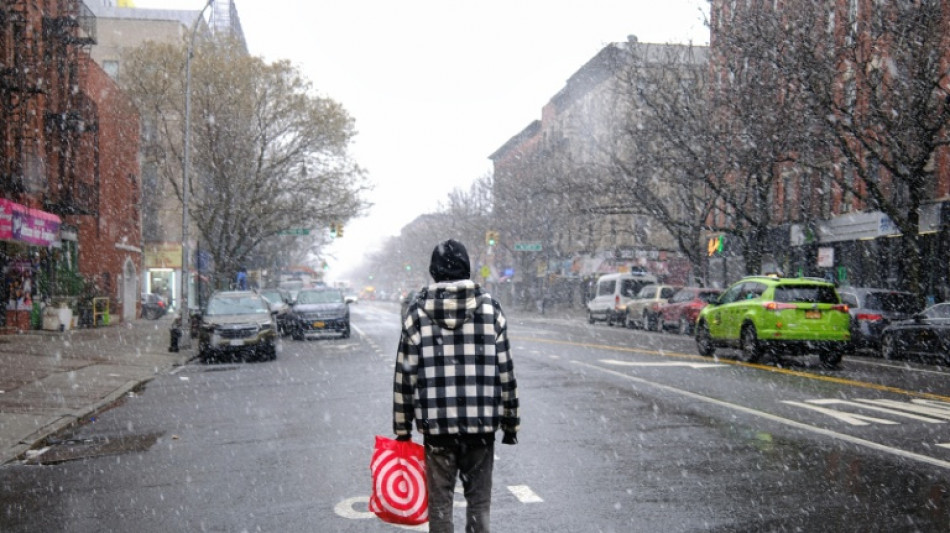
New York City, the US financial capital and the country's most populous urban area, could see as much as 12 inches of snow, the Weather Channel warned.

"Frigid temperatures will expand across the eastern two-thirds of the country behind an Arctic cold front," the National Weather Service said in an advisory.

"Frigid sub-zero and single digit temperatures will expand from the Northern Plains Thursday into the Mid-Mississippi Valley, Ohio Valley and Northeast by Sunday.

"This Arctic blast will be accompanied by gusty winds, leading to dangerous wind chills. The coldest wind chills may fall below minus 50 Fahrenheit (minus 46C) across the Northern Plains.

"Extreme cold warnings, extreme cold watches and cold weather advisories are in effect for parts of the Northern Plains and Upper Midwest beginning (Wednesday)."

An extremely cold air mass, combined with a frontal zone to its south will produce a major winter storm from the Central-Southern Plains region to the East Coast starting Friday and lasting into the weekend, the advisory added.

Some areas likely to be affected were bracing for the arrival of severe weather conditions.

In Texas, Governor Greg Abbott on Tuesday declared a state of emergency and activated emergency resources including the state's national guard and transport department assets to help ease the pressure on roads.

A combination of snow, rain and sleet could make travel almost impossible, local media warned.

The Monroe County Road Commission, which covers a large area outside Detroit, Michigan, warned "there is a shortage of salt."

"This year we've used more than we have the last four Decembers combined," David Leach, the commission's managing director, told CBS News.

In past years, rural areas in the northeast have been entirely cut off while snowplows attempted to clear roads.

K.Yoshida--JT