The Japan Times - North Carolina braces for flooding from Hurricane Erin

EUR -
AED 4.092924
AFN 72.441335
ALL 90.604799
AMD 404.328906
ANG 1.994678
AOA 1023.091852
ARS 1722.63001
AUD 1.622193
AWG 2.006062
AZN 1.899515
BAM 1.951595
BBD 2.2542
BDT 139.559331
BGN 1.947921
BHD 0.422288
BIF 3348.450829
BMD 1.114479
BND 1.430959
BOB 13.275399
BRL 6.222245
BSD 1.119388
BTN 105.198359
BWP 15.356777
BYN 3.351474
BYR 21843.787311
BZD 2.25123
CAD 1.584382
CDF 2580.019043
CHF 0.922911
CLF 0.027867
CLP 1096.769632
CNY 7.433964
CNH 7.432828
COP 3686.428873
CRC 506.306931
CUC 1.114479
CUP 26.864881
CVE 110.027954
CZK 24.361507
DJF 199.300223
DKK 7.475529
DOP 67.893424
DZD 152.256787
EGP 59.774185
ERN 16.717184
ETB 179.598353
FJD 2.519857
FKP 0.836624
GBP 0.836656
GEL 2.89598
GGP 0.836624
GHS 13.10776
GIP 0.836624
GMD 82.471349
GNF 9916.59101
GTQ 8.553572
GYD 234.554671
HKD 8.743477
HNL 30.091157
HRK 7.543919
HTG 146.720611
HUF 364.475297
IDR 20246.014572
ILS 3.534849
IMP 0.836624
INR 104.329942
IQD 1696.928877
IRR 2124280.454419
ISK 136.802071
JEP 0.836624
JMD 177.655661
JOD 0.790165
JPY 177.017119
KES 144.860251
KGS 97.460959
KHR 4565.185156
KMF 492.600023
KPW 1003.031007
KRW 1485.087442
KWD 0.346648
KYD 0.932782
KZT 499.748847
LAK 25194.928305
LBP 100236.400804
LKR 372.005207
LRD 190.288332
LSL 18.350589
LTL 3.290767
LVL 0.674137
LYD 7.175541
MAD 10.919176
MDL 20.114034
MGA 5115.45806
MKD 61.542793
MMK 2340.1222
MNT 4015.973573
MOP 9.044334
MRU 45.155513
MUR 52.57029
MVR 17.169762
MWK 1941.000853
MXN 20.704345
MYR 4.540834
MZN 71.225937
NAD 18.351
NGN 1500.578936
NIO 40.957263
NOK 10.638404
NPR 168.31662
NZD 1.992532
OMR 0.428535
PAB 1.119388
PEN 3.814779
PGK 5.013205
PHP 70.420562
PKR 309.57754
PLN 4.398401
PYG 6909.06109
QAR 4.080409
RON 5.343142
RSD 117.641101
RUB 92.331298
RWF 1656.117168
SAR 4.187115
SBD 9.016967
SCR 15.394883
SDG 670.358157
SEK 11.035548
SGD 1.428745
SHP 0.835097
SLE 25.520776
SLL 23370.071127
SOS 639.716043
SRD 41.844251
STD 23067.464026
STN 24.447111
SVC 9.79481
SYP 14490.454884
SZL 18.356452
THB 37.457677
TJS 10.286945
TMT 3.900676
TND 3.34294
TOP 2.683398
TRY 55.982763
TTD 7.591576
TWD 36.607325
TZS 2946.005856
UAH 50.912057
UGX 4567.160419
USD 1.114479
UYU 45.292016
UZS 13403.761862
VES 1003.577698
VND 28582.484249
VUV 133.533734
WST 3.106119
XAF 655.957
XAG 0.021033
XAU 0.000274652382
XCD 3.011935
XCG 2.017336
XDR 0.787994
XOF 655.957
XPF 119.331742
YER 263.568898
ZAR 18.432078
ZMK 10031.652605
ZMW 22.803394
ZWL 358.861765
SSP 6403.124549
MXV 2.326334
  • RYCEF

    0.1000

    19.81

    +0.5%

  • VOD

    -0.2500

    16.33

    -1.53%

  • CMSC

    -0.2800

    20.12

    -1.39%

  • RBGPF

    -2.0000

    65

    -3.08%

  • RIO

    -0.2500

    94.16

    -0.27%

  • BTI

    -1.2000

    54.85

    -2.19%

  • NGG

    -0.3000

    74.94

    -0.4%

  • GSK

    -0.3500

    49.35

    -0.71%

  • BCE

    -0.4200

    20.14

    -2.09%

  • CMSD

    -0.3400

    19.93

    -1.71%

  • BP

    -0.9100

    43.52

    -2.09%

  • RELX

    0.1700

    33.24

    +0.51%

  • BCC

    -0.6200

    75.97

    -0.82%

  • AZN

    -1.9400

    164.21

    -1.18%

  • JRI

    0.0000

    10.77

    0%

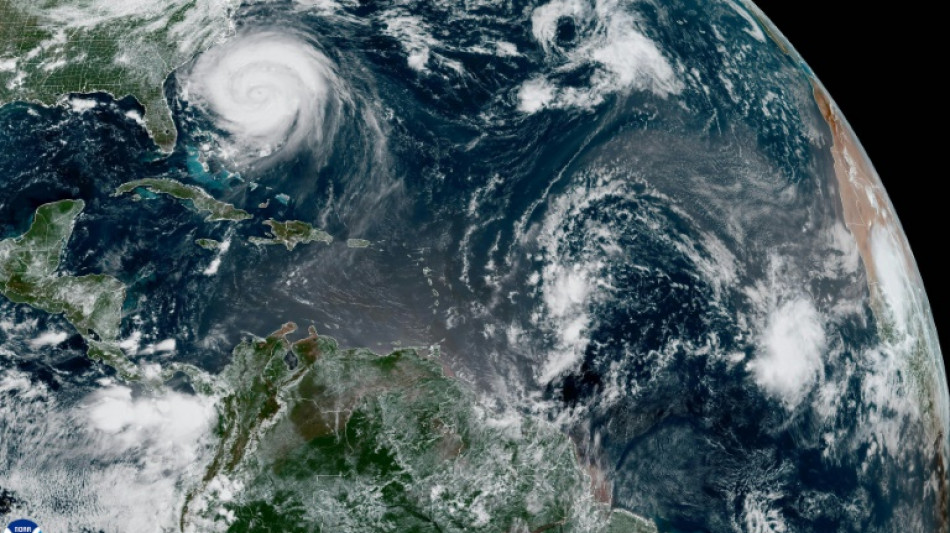
North Carolina braces for flooding from Hurricane Erin
North Carolina braces for flooding from Hurricane Erin / Photo: Handout - NOAA/AFP

North Carolina braces for flooding from Hurricane Erin

Hurricane Erin's furthest bands began brushing the outer banks of North Carolina's coast Wednesday, where the Category 2 storm triggered mandatory evacuation orders, and officials warned summer beachgoers along the US East Coast of life-threatening surf and rip currents in coming days.

Text size:

Landfall isn't expected for Erin -- welcome news for the southern US state still reeling from last year's deadly Hurricane Helene -- but North Carolina officials declared an emergency Tuesday as Erin's predicted impacts began taking shape.

Portions of coastal North Carolina and Virginia were under tropical storm warnings, according to officials at the National Hurricane Center (NHC).

"Swells generated by Erin will affect the Bahamas, Bermuda, the east coast of the United States and Atlantic Canada during the next several days," NHC said, adding that "Erin is a large hurricane."

As of Wednesday afternoon, Erin was churning northward some 245 miles (395 kilometers) southeast of North Carolina, packing maximum sustained winds of 110 mph (175 kph), the NHC said -- with the possibility it could still restrengthen to a major hurricane.

Its unusually large size means tropical storm-force winds extend hundreds of miles from its center, earning it the moniker "Enormous Erin" by hurricane specialist Michael Lowry, who wrote on Substack the United States was fortunate to be spared a direct hit.

Mandatory evacuation orders were in effect for Ocracoke and Hatteras Islands in North Carolina.

North Carolina Governor Josh Stein urged residents to store enough food, water and supplies to last up to five days -- and to safeguard important documents like insurance policies.

"We have already pre-positioned three swift water rescue teams and 200 National Guard troops to various locations on the coast, along with boats, high clearance vehicles and aircraft," he added.

- Massive waves -

Highway 12 -- which runs through the scenic Outer Banks of North Carolina, a string of low-lying islands and spits already under threat from sea-level rise and erosion -- could be left impassable by waves as high as 20 feet (six meters).

Last year's Hurricane Helene caused approximately $60 billion in damage to North Carolina, equivalent to almost two years of the state's budget, said Stein, who criticized what he called inadequate federal assistance from the administration of President Donald Trump.

Trump has mused about dismantling the Federal Emergency Management Agency (FEMA) -- whose work he believes should fall to state leaders and has long been a target of conspiracy theories from the political right.

- Insurance risks -

The Atlantic hurricane season, which runs from June 1 to November 30, has entered its historical peak.

Despite a relatively quiet start with just four named storms so far, the National Oceanic and Atmospheric Administration continues to forecast an above-normal season.

Scientists say climate change is supercharging tropical cyclones: warmer oceans fuel stronger winds, a warmer atmosphere intensifies rainfall, and higher sea levels magnify storm surge.

There is also some evidence, though less certainty, that climate change is making hurricanes more frequent.

Y.Kimura--JT