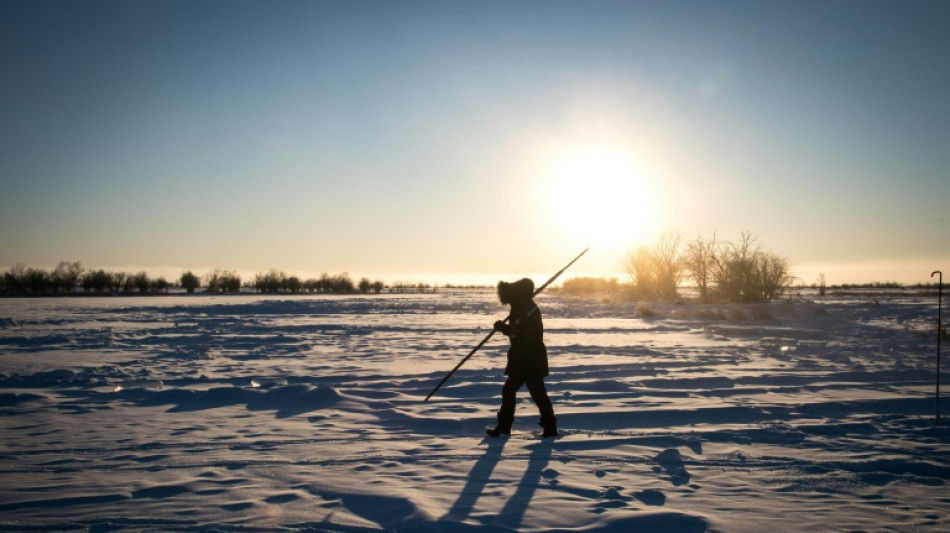
Sink to source: Arctic is now emitting more carbon than it absorbs / Photo: Mladen ANTONOV - AFP/File

After locking carbon dioxide in its frozen soil for millennia, the Arctic tundra is undergoing a dramatic transformation, driven by frequent wildfires that are turning it into a net source of carbon dioxide emissions, a US agency said Tuesday.
This stark shift is detailed in the National Oceanic and Atmospheric Administration's 2024 Arctic Report Card, which revealed that annual surface air temperatures in the Arctic this year were the second-warmest on record since 1900.
"Our observations now show that the Arctic tundra, which is experiencing warming and increased wildfire, is now emitting more carbon than it stores, which will worsen climate change impacts," said NOAA Administrator Rick Spinrad.
The finding is based on average of observations recorded from 2001-2020.
Climate warming exerts dual effects on the Arctic. While it stimulates plant productivity and growth, which remove carbon dioxide from the atmosphere, it also leads to increased surface air temperatures that cause permafrost to thaw.
Thawing permafrost releases carbon previously trapped in frozen soil as carbon dioxide and methane -- two potent greenhouse gases -- through microbial decomposition.
In 2024, Alaska recorded its second-warmest permafrost temperatures on record, the report said.
Human-caused climate change is also intensifying high-latitude wildfires, which have increased in burned area, intensity, and associated carbon emissions.
Wildfires not only combust vegetation and soil organic matter, releasing carbon into the atmosphere, but they also strip away insulating soil layers, accelerating long-term permafrost thaw and its associated carbon emissions.
Since 2003, circumpolar wildfire emissions have averaged 207 million tons of carbon annually, according to NOAA. At the same time, Arctic terrestrial ecosystems have remained a consistent source of methane.
"Last year, 2023, was the largest fire year on record due to Canadian wildfires, which burned more than twice any other year on record in Canada," report co-author Brendan Rogers said during a press conference.
The fires emitted nearly 400 million tons of carbon -- more than two-and-a-half times the emissions from all other sectors in Canada combined, he added.
Meanwhile, 2024 ranked as the second-highest year for wildfire emissions within the Arctic Circle.
- 'Alarming harbinger' -
Asked whether the Arctic's shift from carbon sink to source might be permanent, Rogers said it remains an open question. While boreal forests further south still serve as carbon sinks, northern regions are of greater concern.
"There is definitely interannual variability," he emphasized. "What I'm reporting on here is the average condition we've seen over a 20 year period."
Reacting to the news, Brenda Ekwurzel, a climate scientist at the Union of Concerned Scientists said that "the climate catastrophe we're seeing in the Arctic is already bringing consequences for communities around the world."
"The alarming harbinger of a net carbon source being unleashed sooner rather than later doesn't bode well. Once reached, many of these thresholds of adverse impacts on ecosystems cannot be reversed."
As well as warmer, the Arctic is also growing wetter, with summer 2024 seeing the most rainfall on record.
The trend accelerates coastal erosion, threatening Indigenous communities reliant on stable ice and traditional hunting practices.
Warmer temperatures are impacting wildlife too, with the report finding tundra caribou numbers have decreased by 65 percent over the past two to three decades -- with summer heat disrupting their movements and survival, alongside changes to winter snow and ice conditions.
Surprisingly, however, Alaska's ice seal populations remain healthy.
The report found no long-term negative impacts on body condition, age of maturity, pregnancy rates, or pup survival for the four species of ice seals -- ringed, bearded, spotted, and ribbon -- inhabiting the Bering, Chukchi, and Beaufort seas.
K.Hashimoto--JT