The Japan Times - World will likely temporarily pass 1.5C climate limit by 2028: UN

EUR -
AED 4.300909
AFN 77.619277
ALL 96.366953
AMD 446.668392
ANG 2.096761
AOA 1073.908745
ARS 1698.982413
AUD 1.773215
AWG 2.108
AZN 1.995247
BAM 1.953475
BBD 2.357934
BDT 143.170826
BGN 1.9551
BHD 0.441474
BIF 3461.239669
BMD 1.171111
BND 1.51152
BOB 8.089441
BRL 6.472765
BSD 1.170727
BTN 105.62429
BWP 15.470851
BYN 3.434871
BYR 22953.779249
BZD 2.354538
CAD 1.61577
CDF 2651.395397
CHF 0.931852
CLF 0.027214
CLP 1067.608816
CNY 8.246087
CNH 8.240623
COP 4524.834001
CRC 583.318208
CUC 1.171111
CUP 31.034446
CVE 110.134862
CZK 24.31947
DJF 208.47544
DKK 7.471162
DOP 73.564017
DZD 151.815836
EGP 55.734818
ERN 17.566668
ETB 182.070316
FJD 2.674469
FKP 0.87479
GBP 0.875699
GEL 3.150003
GGP 0.87479
GHS 13.463092
GIP 0.87479
GMD 86.077637
GNF 10235.037122
GTQ 8.966329
GYD 244.930584
HKD 9.112135
HNL 30.835827
HRK 7.533175
HTG 153.329477
HUF 386.85903
IDR 19597.433145
ILS 3.760315
IMP 0.87479
INR 105.020334
IQD 1533.587875
IRR 49333.059178
ISK 147.594872
JEP 0.87479
JMD 187.321056
JOD 0.830322
JPY 184.226303
KES 150.953295
KGS 102.413383
KHR 4688.479994
KMF 493.038387
KPW 1053.983025
KRW 1731.804032
KWD 0.359905
KYD 0.975547
KZT 604.028844
LAK 25352.259626
LBP 104836.318011
LKR 362.225079
LRD 207.213382
LSL 19.629273
LTL 3.457987
LVL 0.708394
LYD 6.345556
MAD 10.730121
MDL 19.743839
MGA 5264.846362
MKD 61.543749
MMK 2459.136594
MNT 4159.095589
MOP 9.383113
MRU 46.734376
MUR 54.047016
MVR 18.105591
MWK 2030.027271
MXN 21.115679
MYR 4.774619
MZN 74.845224
NAD 19.629189
NGN 1707.36646
NIO 43.079464
NOK 11.923044
NPR 169.001746
NZD 2.03894
OMR 0.450291
PAB 1.170717
PEN 3.941742
PGK 5.046102
PHP 68.76056
PKR 328.030592
PLN 4.212265
PYG 7815.83136
QAR 4.269255
RON 5.089668
RSD 117.379303
RUB 94.303285
RWF 1704.507744
SAR 4.392492
SBD 9.532982
SCR 16.117672
SDG 704.4177
SEK 10.910904
SGD 1.513948
SHP 0.878637
SLE 28.233288
SLL 24557.62031
SOS 667.919325
SRD 45.296237
STD 24239.63709
STN 24.471397
SVC 10.243896
SYP 12949.102091
SZL 19.634967
THB 36.840234
TJS 10.811233
TMT 4.1106
TND 3.421957
TOP 2.819755
TRY 50.135034
TTD 7.943648
TWD 36.948438
TZS 2921.922842
UAH 49.447705
UGX 4182.058377
USD 1.171111
UYU 45.875401
UZS 14118.317448
VES 326.989939
VND 30814.863086
VUV 142.172961
WST 3.266654
XAF 655.191202
XAG 0.017812
XAU 0.000271
XCD 3.164986
XCG 2.109916
XDR 0.814844
XOF 655.188408
XPF 119.331742
YER 279.251729
ZAR 19.647972
ZMK 10541.409535
ZMW 26.633756
ZWL 377.097324
  • SCS

    0.0200

    16.14

    +0.12%

  • RBGPF

    0.0000

    80.22

    0%

  • RYCEF

    0.5400

    15.4

    +3.51%

  • CMSC

    0.0300

    23.29

    +0.13%

  • GSK

    -0.4200

    48.29

    -0.87%

  • RIO

    0.4400

    77.63

    +0.57%

  • BTI

    -0.1300

    57.04

    -0.23%

  • NGG

    -0.7700

    76.39

    -1.01%

  • BCE

    -0.3000

    22.85

    -1.31%

  • AZN

    0.7500

    90.61

    +0.83%

  • VOD

    -0.0100

    12.8

    -0.08%

  • RELX

    0.0900

    40.65

    +0.22%

  • JRI

    0.0000

    13.43

    0%

  • CMSD

    0.0000

    23.28

    0%

  • BCC

    1.4100

    77.7

    +1.81%

  • BP

    -1.1600

    33.31

    -3.48%

World will likely temporarily pass 1.5C climate limit by 2028: UN
World will likely temporarily pass 1.5C climate limit by 2028: UN / Photo: Julia Han JANICKI, Hervé BOUILLY - AFP

World will likely temporarily pass 1.5C climate limit by 2028: UN

Humanity now faces an 80 percent chance that Earth's temperatures will at least temporarily exceed the key 1.5-degree Celsius mark during the next five years, the UN predicted Wednesday.

Text size:

The 2015 Paris climate accords, which set the ambitious target of limiting the world to a temperature increase of 1.5 C over pre-industrial levels, meant to refer "to long-term temperature increases over decades, not over one to five years", the UN's World Meteorological Organization said.

The report came alongside another by the EU's Copernicus Climate Change Service announcing that last month was the hottest May on record, pointing to human-induced climate change -- and spurring UN chief Antonio Guterres to compare humanity's impact on the world to "the meteor that wiped out the dinosaurs".

The chance of temporarily exceeding the limit in the next five years ahead has been rising steadily since 2015, when such a chance was estimated to be close to zero, the UN's weather and climate agency noted.

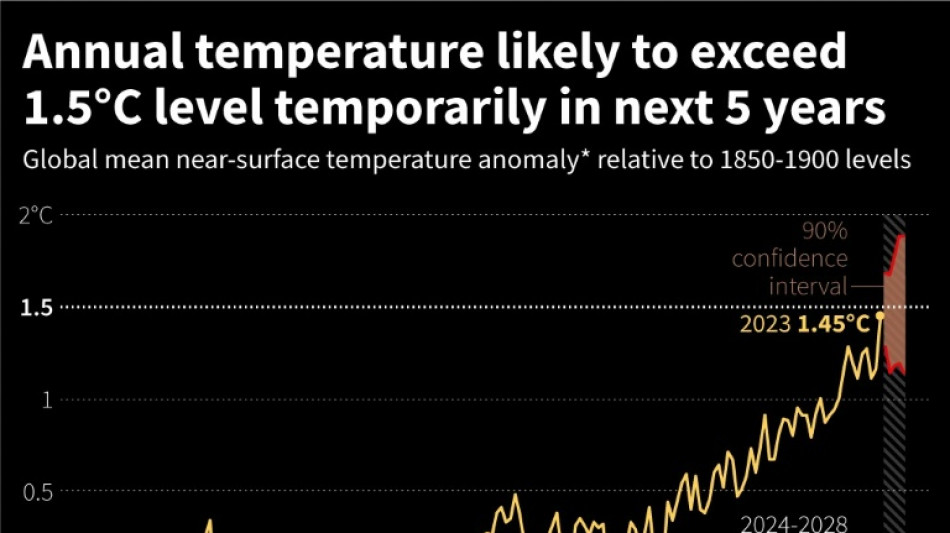
"There is an 80 percent likelihood that the annual average global temperature will temporarily exceed 1.5C above pre-industrial levels for at least one of the next five years," WMO said.

In 2023, the risk of temporarily breaching the limit within five years was estimated at 66 percent.

Already, dramatic climate shifts have begun taking a heavy toll worldwide, fuelling extreme weather events, flooding and drought, while glaciers are rapidly melting away and sea levels are rising.

- 'Record-breaking' path -

"We are on a record-breaking warming path," WMO deputy chief Ko Barrett told reporters in Geneva.

"WMO is sounding the alarm that we will be exceeding the 1.5 C level on a temporary basis with increasing frequency."

She added that "we have already temporarily surpassed this level for individual months".

Barrett noted though that temporary breaches "do not mean that the 1.5 C goal is permanently lost because this refers to long-term warming over decades".

"But the trend is alarming and cannot be denied."

Temperature levels are rising, with 2023 by far the hottest year on record, amid warnings that 2024 could be even hotter.

Currently, the WMO predicts that the mean near-surface temperature for each year between 2024 and 2028 will be 1.1-1.9 C above the pre-industrial levels recorded between 1850 and 1900.

- 'Way off track' -

Pointing to repeated monthly temperature records over the past year, the WMO highlighted that already the past 12 months, from June 2023 to May 2024, were "the highest on record".

And it said there was now an 86-percent chance that one of the years between 2024 and 2028 would unseat 2023 as the annual record-holder.

It also said there was a 90-percent likelihood that the mean temperature for 2024-2028 would be higher than that over the past five-year period.

"We are way off track to meet the goals set in the Paris Agreement," Barrett said.

H.Nakamura--JT