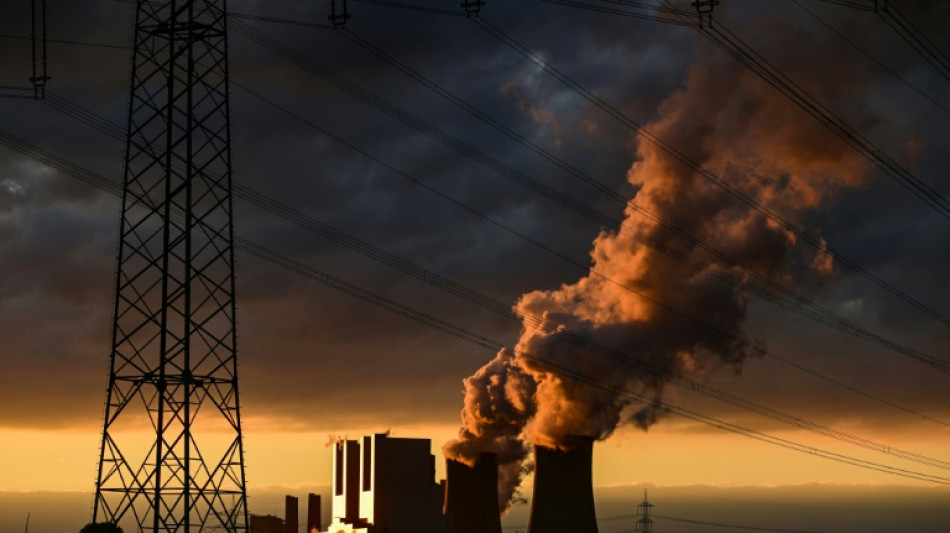
Global warming accelerating at 'unprecedented' pace: study / Photo: INA FASSBENDER - AFP/File

Global warming has accelerated at an "unprecedented" pace as the window to limit rising temperatures within internationally-set targets closes, over 50 leading scientists warned in a study published on Wednesday.
Looking at decade averages, temperatures climbed 0.26 degrees Celsius from 2014 to 2023, said the study published in the journal Earth System Science Data.
In that same period, average global surface temperatures reached 1.19C above the 1850-1900 pre-industrial benchmark for measuring a warming world.
It marks an increase from the 1.14C reported last year for the decade up to 2022.
"Human-induced warming has been increasing at a rate that is unprecedented in the instrumental record," the study said.
The study is part of a series of periodic climate assessments designed to fill the gap between UN Intergovernmental Panel on Climate Change (IPCC) reports that have been released on average every six years since 1988.
It came as diplomats from around the world were meeting in Germany this week for midyear climate talks ahead of the UN COP29 summit in November in Baku, Azerbaijan.
The 2015 Paris Agreement that resulted from a previous COP summit saw countries agree to cap global warming at "well below" 2C above preindustrial levels, while striving for the safer limit of 1.5C.
Wednesday's report found that, by the end of 2023, human activity had pushed temperatures 1.31C above the preindustrial level.
Earth warmed a total of 1.43C with other naturally-occuring drivers -- including the El Nino weather phenomenon -- taken into account.
- Carbon budget spent -
Another factor contributing to the heat is the decline in certain polluting particles in the atmosphere that reflect some of the Sun's energy back into space, the study found.
"The main reason is cleaning up of air pollution, first in Europe and the US (acid rain) and more recently in Asia, particularly China," Glen Peters of Norway's CICERO Center for International Climate Research told AFP.
Tightening of global shipping regulations and the decline of coal-fired energy have also contributed to a drop in sulphur dioxide emissions, which also had a cooling effect.
But by far the primary driver of global warming was "greenhouse gas emissions being at an all-time high", the study said.
Average annual emissions for the 2013-2022 period were 53 billion tonnes of carbon dioxide and the equivalent in other gases -- primarily from the use of fossil fuels like oil and gas, the report said.
In 2022, emissions amounted to 55 billion tonnes.
It means that the world's carbon budget -- the estimated amount of greenhouse gases that can to be emitted before driving the planet over the 1.5C threshold -- is "shrinking fast", the study warned.
In 2020, the IPCC calculated the remaining carbon budget in the range of 500 billion tonnes of CO2.
By early 2024, the budget had decreased to around 200 billion tonnes, the study said.
The report's lead author Piers Forster said there is a "bit of optimism" at least in one finding.
The rate at which emissions have grown in the most recent decade appears to have slowed since 2000, which he said signals "we're not necessarily going to get a big, increasing acceleration of climate change".
However, co-author Pierre Friedlingstein, told a press briefing that the slowing is not enough to avoid climate change.
"We don't need emissions to be stable. We need emissions to go down to net zero," Friedlingstein said.
"As long as emissions continue at the same level, the warming will continue at the same level."
Without significant change in emissions, the 1.5C threshold would be breached and become a "long-term average" within the next decade, he added.
K.Okada--JT