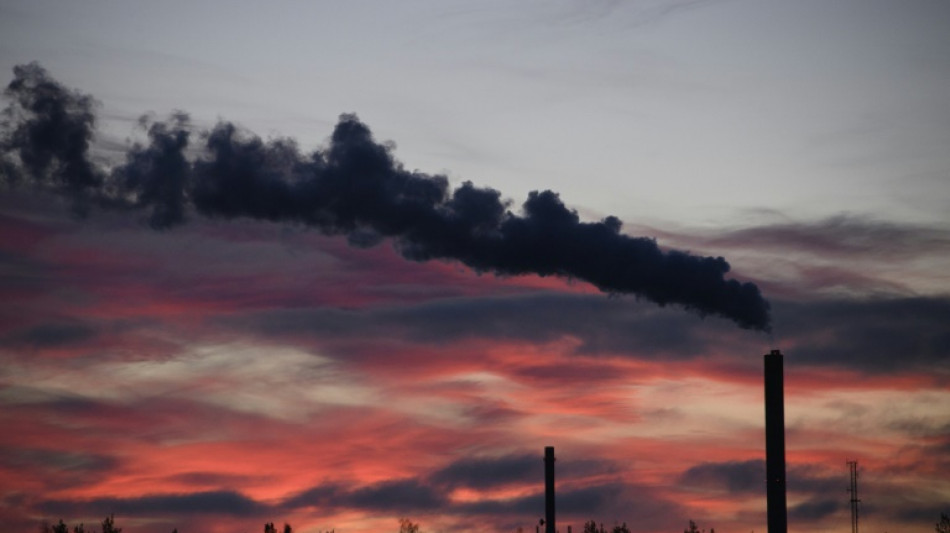
Climate pledges of big firms 'critically insufficient': report / Photo: Olivier MORIN - AFP

From carmakers to fast fashion, dozens of major international companies are failing to reduce their greenhouse gas emissions at the pace required to slow climate change, a report said Tuesday.
The nonprofit research groups NewClimate Institute and Carbon Market Watch looked at the climate pledges of 51 multinational firms and found many brands were inflating their sustainability claims.
Distinguishing real cuts to planet-heating greenhouse gas emissions from "unsubstantiated greenwashing" was a major challenge, particularly for consumers, they said.
Taken together, the brands scrutinised in this report -- mostly household names including H&M Group, Nestle and Toyota -- accounted for 16 percent of global emissions in 2022.
But their efforts were "critically insufficient" to limit global temperature rises to 1.5 degrees Celsius -- the safer limit set under the 2015 Paris climate agreement.
While "the collective ambition of companies' 2030 climate pledges has gradually improved over the last two years... most companies continue to fall far short of the economy-wide emission reductions required", the report said.
Global emissions need to be reduced by 43 percent by 2030 to align with the Paris goals, according to United Nations climate scientists.
These companies, on average, would be reducing their emissions by 33 percent under their current commitments, the report said.
- 'Creative accounting' -
Some firms could even be backsliding on their promises.
The report noted a growing call from the corporate sector for "flexibility" in how climate targets are met, namely through using carbon credits.
These allow businesses to offset their emissions by directing money toward a project that reduces or avoids emissions, such as protecting forests.
Critics say they allow companies to keep polluting.
"We can't afford wasting time with leniency and room for this creative accounting," Benja Faecks of Carbon Market Watch told reporters.
The companies assessed in this report -- majors from the automotive, food and agriculture, fashion and energy sectors -- were rated against the honesty of their climate pledges and progress toward the 1.5-degree-Celsius benchmark.
None scored the top rating of "high integrity".
Italian and Spanish energy giants Enel and Iberdrola led the pack with a "reasonable" integrity rating.
South Korean energy company Kepco and Japanese carmaker Toyota received the lowest score.
Toyota told AFP that while it had not seen the report, its 2050 commitments had been certified by the benchmark Science-Based Target initiative (SBTi).
"Only four companies' emission reduction plans embody the necessary shift from pledges to actual implementation," the report said.
It acknowledged some were doing better than others.
French food giant Danone, for example, had committed to "significantly" reducing methane emissions from fresh milk production and increasing the share of plant-based products, the report said.
It said Enel and Iberdrola had increased their renewable energy capacity, notably solar and wind, but both could set more ambitious timeframes for achieving net-zero emissions.
Heavy-duty vehicle manufacturer Volvo Group was highlighted for its investments in "zero-emission vehicles, charging infrastructure and low-carbon steel and aluminium".
- Policy, not pledges -
Meanwhile, the fashion industry was singled out for being "ambiguous" in how it would reach its targets.
None of the five brands analysed -- H&M Group, Nike, Adidas, Zara owner Inditex and Uniqlo owner Fast Retailing -- had plans to transition to business models that produced and sold fewer products.
Silke Mooldijk, from the NewClimate Institute, said the marketing of products could also be confusing for consumers.
She pointed to recycled polyester being advertised as a low-emissions alternative fabric, even though the material is largely sourced from recycled plastic bottles, not old clothing, meaning bottles are still produced to meet demands.
"There is no benefit for the climate but as a consumer, you normally wouldn't notice," she said.
H&M Group said the report had not analysed its latest climate data and argued it had achieved a 22-percent reduction to its emissions in 2023 compared with 2019.
The report called for a shift away from voluntary climate initiatives to stricter government regulation in order to hold companies accountable for their pollution.
"We need robust legislation and also regulations to compel companies to do what they need to do and not what they wish to do," Faecks said.
T.Sasaki--JT