The Japan Times - Jellyfish invade Venezuelan waters, worrying fishermen

EUR -
AED 4.334666
AFN 77.900095
ALL 96.685479
AMD 448.694275
ANG 2.112836
AOA 1082.337912
ARS 1713.79929
AUD 1.694419
AWG 2.124545
AZN 2.005766
BAM 1.954033
BBD 2.387541
BDT 144.978905
BGN 1.982165
BHD 0.445065
BIF 3526.345066
BMD 1.180303
BND 1.506906
BOB 8.220567
BRL 6.210516
BSD 1.185428
BTN 108.401979
BWP 15.613589
BYN 3.394331
BYR 23133.933487
BZD 2.384044
CAD 1.613958
CDF 2543.552008
CHF 0.918972
CLF 0.025872
CLP 1021.553077
CNY 8.198976
CNH 8.187477
COP 4263.253457
CRC 588.626555
CUC 1.180303
CUP 31.278022
CVE 110.165385
CZK 24.3032
DJF 211.089126
DKK 7.468307
DOP 74.930651
DZD 153.353162
EGP 55.572902
ERN 17.704541
ETB 184.925926
FJD 2.604456
FKP 0.861331
GBP 0.863167
GEL 3.180899
GGP 0.861331
GHS 12.998247
GIP 0.861331
GMD 86.741709
GNF 10409.789325
GTQ 9.095775
GYD 248.005745
HKD 9.219445
HNL 31.316093
HRK 7.535293
HTG 155.479942
HUF 380.936215
IDR 19803.119186
ILS 3.65993
IMP 0.861331
INR 106.529816
IQD 1552.889245
IRR 49720.252642
ISK 145.200468
JEP 0.861331
JMD 186.265181
JOD 0.836862
JPY 183.585472
KES 152.908055
KGS 103.218032
KHR 4776.383798
KMF 493.366547
KPW 1062.272456
KRW 1712.289129
KWD 0.36253
KYD 0.987803
KZT 598.623775
LAK 25492.948383
LBP 106151.713903
LKR 367.086512
LRD 219.891167
LSL 18.978739
LTL 3.485127
LVL 0.713953
LYD 7.489228
MAD 10.809925
MDL 20.068853
MGA 5290.183051
MKD 61.644021
MMK 2478.619753
MNT 4207.336901
MOP 9.536237
MRU 47.107923
MUR 53.880544
MVR 18.235445
MWK 2056.982346
MXN 20.515491
MYR 4.657524
MZN 75.244069
NAD 18.978899
NGN 1653.65118
NIO 43.654368
NOK 11.443584
NPR 173.578342
NZD 1.962897
OMR 0.453826
PAB 1.185428
PEN 3.99259
PGK 5.083409
PHP 69.496818
PKR 332.067813
PLN 4.221913
PYG 7881.872934
QAR 4.333382
RON 5.095842
RSD 117.441308
RUB 90.236055
RWF 1734.368902
SAR 4.426205
SBD 9.510999
SCR 17.774333
SDG 709.949829
SEK 10.564636
SGD 1.500655
SHP 0.885533
SLE 28.88796
SLL 24750.357209
SOS 678.009658
SRD 44.881036
STD 24429.883467
STN 24.497151
SVC 10.372577
SYP 13053.646429
SZL 18.983988
THB 37.181532
TJS 11.071589
TMT 4.142863
TND 3.420008
TOP 2.841885
TRY 51.318734
TTD 8.025811
TWD 37.254961
TZS 3054.718851
UAH 51.08951
UGX 4234.171314
USD 1.180303
UYU 45.988416
UZS 14491.89592
VES 436.466011
VND 30683.149741
VUV 140.640991
WST 3.199542
XAF 655.875164
XAG 0.014374
XAU 0.000247
XCD 3.189827
XCG 2.136359
XDR 0.815674
XOF 655.364397
XPF 119.331742
YER 281.354641
ZAR 18.912758
ZMK 10624.131341
ZMW 23.262965
ZWL 380.056997
  • SCS

    0.0200

    16.14

    +0.12%

  • BCC

    0.9400

    81.75

    +1.15%

  • NGG

    -0.6600

    84.61

    -0.78%

  • BTI

    0.3100

    60.99

    +0.51%

  • CMSC

    -0.0100

    23.75

    -0.04%

  • JRI

    0.0700

    13.15

    +0.53%

  • BCE

    -0.0300

    25.83

    -0.12%

  • CMSD

    0.0300

    24.08

    +0.12%

  • BP

    -0.1800

    37.7

    -0.48%

  • RBGPF

    0.1000

    82.5

    +0.12%

  • GSK

    0.8700

    52.47

    +1.66%

  • RIO

    1.4900

    92.52

    +1.61%

  • RYCEF

    0.7000

    16.7

    +4.19%

  • RELX

    -0.2700

    35.53

    -0.76%

  • VOD

    0.2600

    14.91

    +1.74%

  • AZN

    1.3100

    188.41

    +0.7%

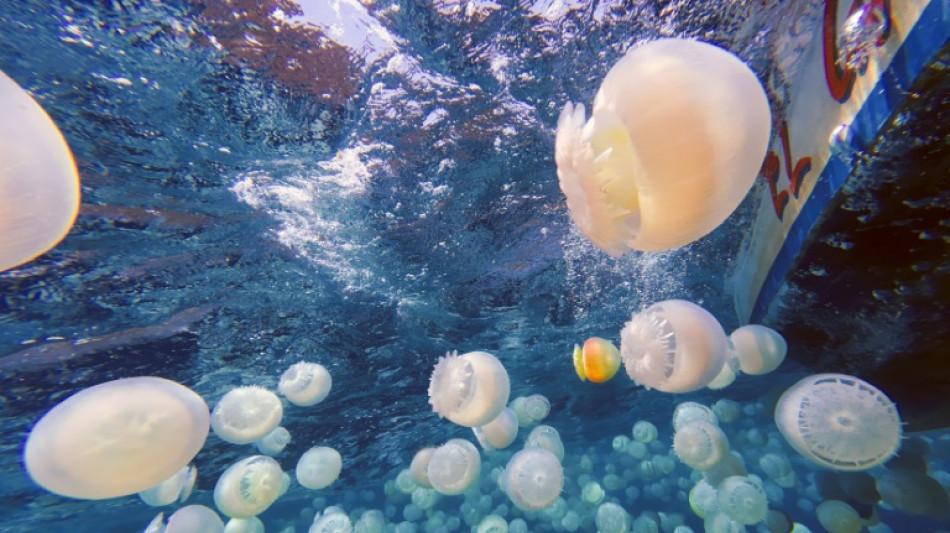
Jellyfish invade Venezuelan waters, worrying fishermen
Jellyfish invade Venezuelan waters, worrying fishermen / Photo: Juan BARRETO - AFP

Jellyfish invade Venezuelan waters, worrying fishermen

A thick bloom of varying hues drifts in the turquoise waters of Aragua in Venezuela, a surreal vision attributed to climate change that has decimated fishing stocks.

Text size:

"It is like there are flowers in the sea. This has never happened before," said Elvis Morillo, 59, a fisherman in the northern village of Chuao, where verdant mountains hug the Caribbean coast.

The invasive cannonball jellyfish is filling fishermen's nets, in a surge the environment ministry attributes to warming waters from climate change and a decline in jellyfish predators such as sharks and sea turtles.

At the same time, "sardines and other species that serve as fishing bait have disappeared. Fishing is at its lowest level in years," said Gustavo Carrasquel, of the NGO Azul Ambientalistas, who lives in Choroni, a town neighboring Chuao.

Globally, jellyfish populations have soared. Researchers have warned of a tipping point in which the oceans could go from being dominated by fish populations, to jellyfish -- mostly as a result of overfishing.

The gelatinous creatures, which do not have a heart, brain or complex organs, thrive in harsh conditions and need little oxygen.

This is an "atypical event, completely abnormal," said Joxmer Scott-Frias, a researcher at the Institute of Zoology and Tropical Ecology at the Central University of Venezuela.

"A few individuals had been observed in recent years, but the increase in the population this year exceeded previous estimates," he said while collecting samples of the jellyfish for study.

Scott-Frias said the reasons for the surge were not yet clear.

The jellyfish bloom and the presence of the invasive coral Unomia stolonifera, which smothers native corals, have become a headache for local fishermen.

"It has been almost nine months without fish production," said Fernando Mayora, head of the fishermen's council in Choroni.

"With the problem of jellyfish and invasive corals, we don't know what to do. The fish have disappeared," he said.

In Chuao, fishermen who would bring in between 3,000 and 5,000 kilograms a week have seen their yields drop to between 500 and 1,000 kilograms, said Douglas Martinez, 44, a fisherman.

Mayora said that Venezuela should draw inspiration from countries such as Mexico, which exploits jellyfish commercially, exporting it to Asian countries where it is used in gastronomy or the pharmaceutical industry.

"We need to know if we can take advantage of this in Venezuela," he said.

S.Ogawa--JT