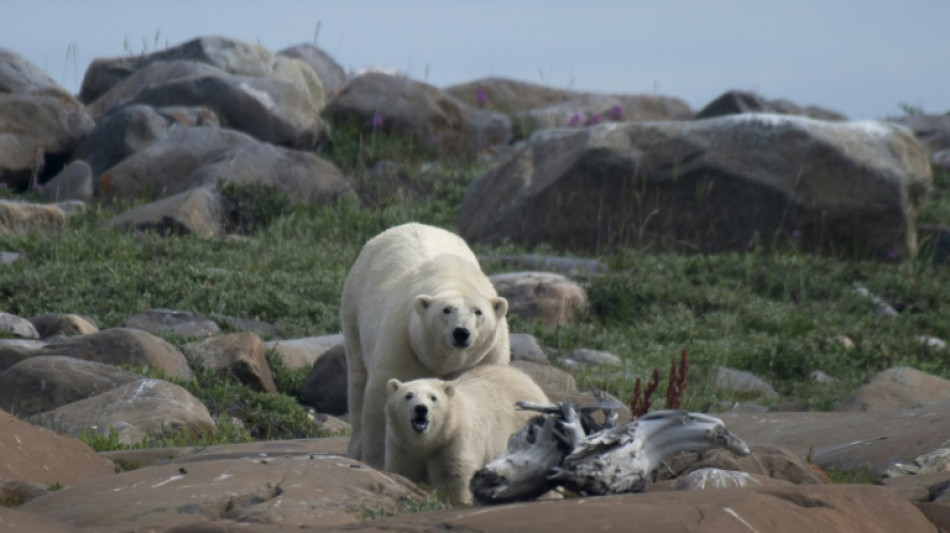
Polar bears struggling to adapt to longer ice-free Arctic periods / Photo: Olivier MORIN - AFP/File

Polar bears in Canada's Hudson Bay risk starvation as climate change lengthens periods without Arctic Sea ice, despite the creatures' willingness to expand their diets.
Polar bears use the ice that stretches across the ocean surface in the Arctic during colder months to help them access their main source of prey -- fatty ringed and bearded seals.
In the warmer months when the sea ice recedes, they would be expected to conserve their energy and even enter a hibernation-like state.
But human caused climate change is extending this ice-free period in parts of the Arctic -- which is warming between two and four times faster than the rest of the world -- and forcing the polar bears to spend more and more time on land.
New research looking at 20 polar bears in Hudson Bay suggests that without sea ice they still try to find food.
"Polar bears are creative, they're ingenious, you know, they will search the landscape for ways to try to survive and find food resources to compensate their energy demands if they're motivated," Anthony Pango, a research wildlife biologist with the US Geological Survey and lead author of the study, told AFP.
The research, published in the journal Nature Communications, used video camera GPS collars to track the polar bears for three-week periods over the course of three years in the western Hudson Bay, where the ice-free period has increased by three weeks from 1979–2015, meaning that in the last decade bears were on land for approximately 130 days.
The researchers found that of the group, two bears indeed rested and reduced their total energy expenditure to levels similar to hibernation, but the 18 others stayed active.
The study said these active bears may have been pushed to continue to look for food, with individual animals documented eating a variety of foods including grasses, berries, a gull, a rodent and a seal carcass.
Three ventured off on long swims -- one travelled a total distance of 175 kilometres (more than a hundred miles) -- while other bears spent time playing together or gnawing on caribou antlers, which researchers said was like the way dogs might chew bones.
But ultimately the researchers found that the bears' efforts to find sustenance on land did not provide them with enough calories to match their normal marine mammal prey.
Nineteen out of the 20 polar bears studied lost weight during the period consistent with the amount of weight they would lose during a period of fasting, researchers said.
That means that the longer polar bears spend on land, the higher their risk for starvation.
- Cause for alarm -
"These findings really support the existing body of research that's out there, and this is another piece of evidence that really raises that alarm," Melanie Lancaster, senior Arctic species specialist for the World Wildlife Fund, who is not associated with the study, told AFP.
The world's 25,000 polar bears remaining in the wild are endangered primarily by climate change.
Limiting planet-warming greenhouse gases and keeping global warming under the Paris deal target of 1.5 degrees Celsius above pre-industrial levels would likely preserve polar bear populations, Pango said.
But global temperatures -- already at 1.2C -- continue to rise and sea ice dwindles.
John Whiteman, the chief research scientist at Polar Bears International, who was not involved in the study, said the research was valuable because it directly measures the polar bears' energy expenditure during the ice-free periods.
"As ice goes, the polar bears go, and there is no other solution other than stopping ice loss. That is the only solution," he told AFP.
M.Ito--JT