The Japan Times - Australia scientists pluck rare handfish from ocean due to climate risk

EUR -
AED 4.27647
AFN 76.85373
ALL 92.304242
AMD 424.523883
ANG 2.084124
AOA 1068.970686
ARS 1760.97915
AUD 1.61839
AWG 2.097477
AZN 1.976574
BAM 1.955449
BBD 2.3458
BDT 143.57549
BGN 1.975344
BHD 0.439125
BIF 3475.506687
BMD 1.164456
BND 1.480254
BOB 13.656669
BRL 6.009778
BSD 1.164701
BTN 111.030046
BWP 15.606336
BYN 3.512631
BYR 22823.341766
BZD 2.3425
CAD 1.613226
CDF 2649.13758
CHF 0.936287
CLF 0.027367
CLP 1077.075457
CNY 7.82503
CNH 7.827545
COP 3678.691844
CRC 525.610272
CUC 1.164456
CUP 30.85809
CVE 110.243813
CZK 24.150359
DJF 207.404593
DKK 7.474743
DOP 68.378327
DZD 155.035466
EGP 58.51136
ERN 17.466843
ETB 190.247322
FJD 2.553129
FKP 0.856304
GBP 0.857185
GEL 3.039093
GGP 0.856304
GHS 13.044773
GIP 0.856304
GMD 86.169916
GNF 10238.032435
GTQ 8.890482
GYD 243.678401
HKD 9.128953
HNL 31.242398
HRK 7.533802
HTG 152.373988
HUF 364.864852
IDR 20630.670717
ILS 3.461637
IMP 0.856304
INR 111.119224
IQD 1525.826419
IRR 1600661.509937
ISK 140.794817
JEP 0.856304
JMD 184.616898
JOD 0.825606
JPY 185.914163
KES 150.634134
KGS 101.832082
KHR 4713.215632
KMF 492.564863
KPW 1048.010933
KRW 1600.754881
KWD 0.359561
KYD 0.970634
KZT 539.757856
LAK 26119.541062
LBP 104300.094649
LKR 381.964794
LRD 210.814011
LSL 18.632719
LTL 3.438336
LVL 0.704368
LYD 7.38174
MAD 10.76187
MDL 20.137562
MGA 5024.142315
MKD 61.5095
MMK 2445.092559
MNT 4190.618952
MOP 9.405394
MRU 46.857001
MUR 54.578295
MVR 17.991228
MWK 2019.655219
MXN 19.731536
MYR 4.688089
MZN 74.406152
NAD 18.632559
NGN 1560.77888
NIO 42.862683
NOK 10.859928
NPR 177.647673
NZD 1.958569
OMR 0.447727
PAB 1.164701
PEN 3.902834
PGK 5.165074
PHP 72.488599
PKR 323.120739
PLN 4.336452
PYG 6901.821771
QAR 4.245675
RON 5.25833
RSD 117.296886
RUB 99.561464
RWF 1712.107721
SAR 4.369287
SBD 9.315942
SCR 15.882335
SDG 700.411858
SEK 11.089023
SGD 1.480455
SHP 0.862706
SLE 28.703406
SLL 24418.063648
SOS 665.586376
SRD 43.937254
STD 24101.892572
STN 24.495818
SVC 10.191041
SYP 15140.259566
SZL 18.618822
THB 38.357352
TJS 10.773561
TMT 4.075597
TND 3.397291
TOP 2.803731
TRY 56.179534
TTD 7.904651
TWD 36.813122
TZS 3082.90133
UAH 51.894641
UGX 4391.250358
USD 1.164456
UYU 46.901993
UZS 13763.65037
VES 920.708859
VND 30360.284601
VUV 137.453315
WST 3.155621
XAF 655.847855
XAG 0.016529
XAU 0.000253
XCD 3.147002
XCG 2.099142
XDR 0.823331
XOF 655.845039
XPF 119.331742
YER 275.397571
ZAR 18.631179
ZMK 10481.494751
ZMW 22.042237
ZWL 374.954425
  • BCC

    -0.8800

    77.89

    -1.13%

  • JRI

    -0.0250

    12.375

    -0.2%

  • AZN

    -1.7900

    162.73

    -1.1%

  • CMSD

    -0.0200

    21.16

    -0.09%

  • BP

    -0.4050

    41.935

    -0.97%

  • BCE

    0.0800

    23.48

    +0.34%

  • RYCEF

    -0.0500

    20.7

    -0.24%

  • CMSC

    0.0100

    21.32

    +0.05%

  • RIO

    -0.7600

    104.02

    -0.73%

  • RBGPF

    -0.4400

    70.69

    -0.62%

  • NGG

    0.4100

    79.84

    +0.51%

  • GSK

    -0.2000

    50.07

    -0.4%

  • BTI

    -0.1700

    56.11

    -0.3%

  • RELX

    0.1100

    36.41

    +0.3%

  • VOD

    0.0550

    15.935

    +0.35%

Australia scientists pluck rare handfish from ocean due to climate risk
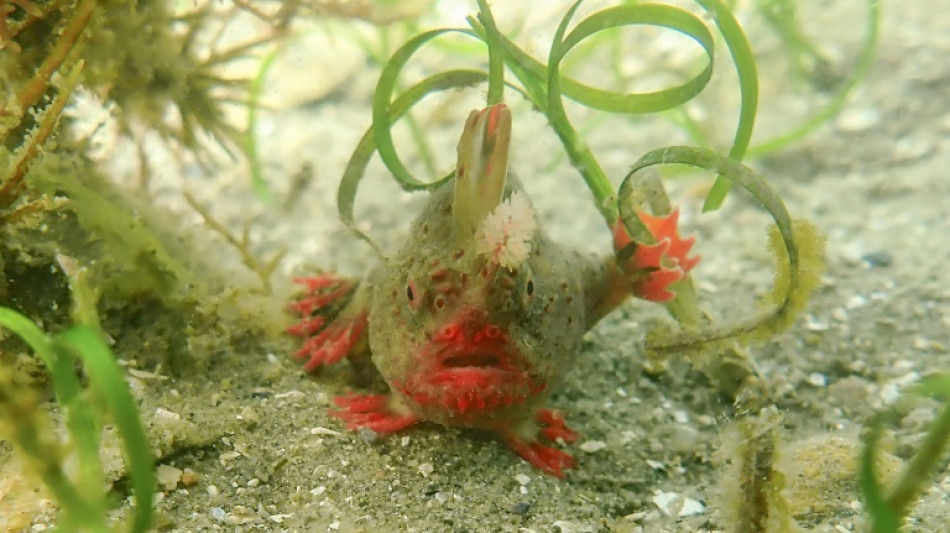
Australia scientists pluck rare handfish from ocean due to climate risk / Photo: Jemina STUART-SMITH - UNIVERSITY OF TASMANIA/AFP

Australia scientists pluck rare handfish from ocean due to climate risk

Scientists have collected 25 extremely rare red handfish from the ocean off Australia, hoping to protect the struggling species from warming seas, human-caused habitat changes and ravenous urchins.

Text size:

Only about 100 red handfish -- which have the appearance of a crimson and brown goldfish with stubby arms and webbed hands -- are left in the wild, living in a small section of reef off southeast Tasmania.

About eight centimetres (three inches) long, they "walk" along the sea floor on their pectoral and pelvic fins rather than swimming.

But overgrazing urchins, run-off from urban areas, disturbances from boats and rising sea temperatures have resulted in "severe habitat loss and degradation", according to the University of Tasmania's Institute for Marine and Antarctic Studies.

Scientists at the institute recently made the difficult and risky decision to take dozens of the fish out of the wild for safekeeping.

"This summer has already well exceeded previous temperature maximums," said marine scientist Jemina Stuart-Smith.

"We can only assume that this additional stressor will impact the already fragile population," she said.

On Wednesday, scientists said the 25 specimens were doing well in their temporary aquarium homes and were being closely monitored for stress or ill health.

"We have highly experienced staff looking after the fish seven days a week, and a 24-hour call-out roster," said the institute's Andrew Trotter.

"We believe they are quite safe with us -- but there is certainly a feeling of heightened responsibility among our team, given how small the wild population is."

Trotter and his colleagues are hoping to return the fish to their natural habitat when temperatures drop with the onset of the austral winter in June.

Sea temperatures off Australia have been increasing steadily since records began at the beginning of the 1900s.

Experts believe the change is being fuelled by the emission of carbon dioxide and other greenhouse gases into the atmosphere.

S.Yamada--JT