Syrian farmers abandon the land for steadier jobs / Photo: Delil SOULEIMAN - AFP

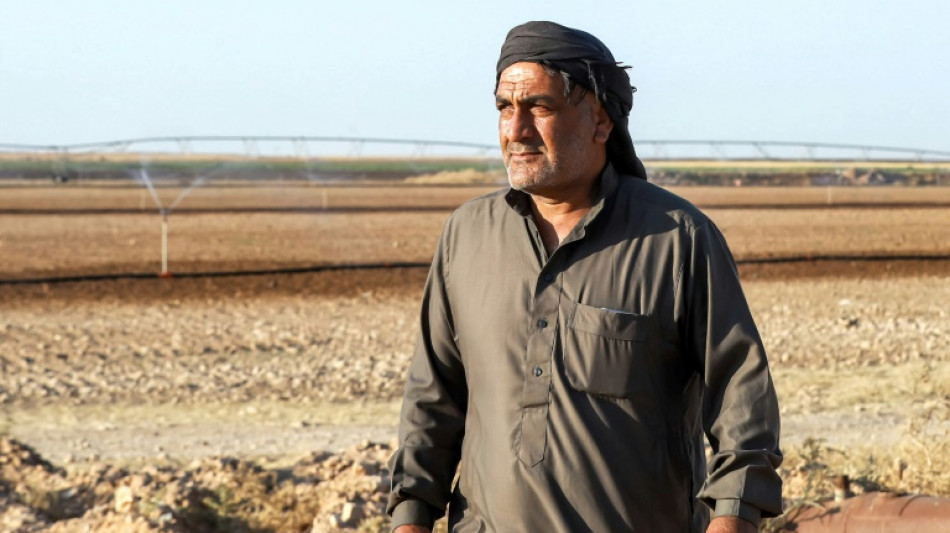
After years of war, drought and economic crisis, Omar Abdel-Fattah was forced to rent out his farmland in northeast Syria, preferring a more stable job to provide for his family.
"It breaks my heart to see someone else working my land," said Abdel-Fattah, 50, who grew wheat, cotton and vegetables in Jaabar al-Saghir, in Syria's Raqa province, for three decades.
He said he had to abandon agriculture to make ends meet and provide an education for his eight children because he can "no longer keep up with the costs of farming", including irrigation.
Agriculture was once a pillar of northeast Syria's economy.
The region was the country's breadbasket before 2011, when the government repressed peaceful protests, triggering a conflict that has killed more than 500,000 people and displaced millions.
Now the effects of climate change -- particularly rising temperatures and drought -- along with spiralling costs are dealing a heavy blow to agricultural production and the families that depend on it to survive.
Abdel-Fattah found a job at a water pumping station run by the area's semi-autonomous Kurdish administration.
It pays around $70 a month, so he also runs a small shop on the side selling hardware and other items to get by.
Some of his relatives have also rented out their land, while others have left Syria because of the dire financial situation there, Abdel-Fattah said.
He urged the Kurdish administration and international agricultural organisations to provide "support and loans" for farmers in the area.
"This is the only solution to save agriculture, help farmers and encourage them to return to their fields again," he said.
- Farming a 'loss' -
Across vast swathes of Raqa province, empty farmland sits beside cultivated fields where farmers and workers harvest crops, including potatoes and corn.
Syria has endured more than 12 years of civil war, and Raqa was the centre of the Islamic State group's brutal "caliphate" in Syria until their ouster from the city in 2017.
In the town of Qahtaniyah, Jassem al-Rashed, 55, said agriculture was his only income for 30 years but now it has become a "loss".
His children initially helped him on the land, but now he looks after the crops alone.
"Two of my children work in the livestock trade, and two others left for Europe, while three others joined the traffic police and security forces," he said.
"Farming is no longer right for them, after the recent years of drought," he added.
In November, the World Weather Attribution group said that human-caused climate change had raised temperatures, making drought about 25 times more likely in Syria and neighbouring Iraq.
Suhair Zakkout is the spokesperson in Damascus for the International Committee of the Red Cross.
She has previously told AFP that "Syria's agricultural production has fallen by approximately 50 percent over the last 10 years" because of war and climate change.
In the far northeastern corner of the country, former farmer Faruk Mohammed, 40, gazed at his uncultivated land at Tal Hamis in Hasakeh province.
Now a teacher employed by the Kurdish administration, he said he had changed job "to earn a living -- nothing more, nothing less".
- 'Dangerous factors' -
He too expressed the hope that local authorities would help farmers and work to "save what's left of the agricultural land".
"Years of drought have hurt farmers, as well as the rise in fuel prices," he said.
More than a decade of war has shattered Syria's economy, and long daily blackouts mean people have to rely on generators for power amid regular fuel shortages.
Farmers told AFP they struggled to pay for seeds and fertiliser, with some turning to solar panels to help power water pumps.
Leila Sarukhan, an official with the Kurdish administration, acknowledged that factors including drought and rising costs had led to a decline in agriculture.
"Climate change is impacting rainfall, while desertification expands in northeast Syria," she told AFP, adding: "These are dangerous factors for farming."
Back in Raqa province, farmer Adnan Ibrahim said his children had left agriculture behind and joined the Kurdish security services instead "to earn a steady salary".
He pointed to farming equipment sitting idle near the house, and lamented the impact of climate change as well as rising prices.
But the 56-year-old also said the ever-present spectre of conflict influenced his children's decision.
"We are afraid of cultivating our land," he said.
"War could break out at any time and warplanes could bomb our lands. So having a steady job is better."
K.Inoue--JT