UAE to pump CO2 into rock as carbon capture debate rages / Photo: Karim SAHIB - AFP

High in remote mountains in the oil-rich United Arab Emirates, a new plant will soon take atmospheric CO2 and pump it into rock -- part of controversial attempts to target planet-heating emissions without abandoning fossil fuels.
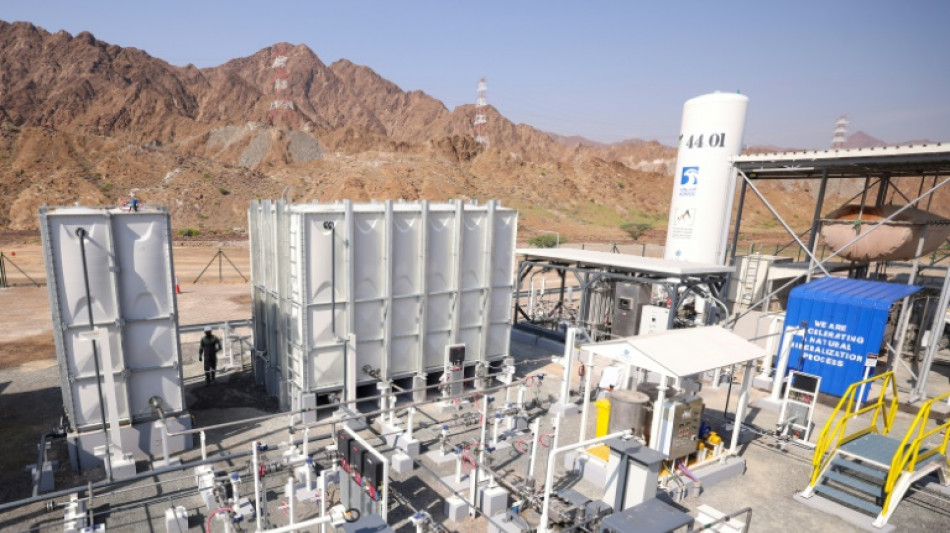
Using novel technology developed by Omani start-up 44.01, the solar-powered plant will suck carbon dioxide from the air, dissolve it in seawater and inject it deep underground, where it will mineralise over a period of months.
The new site on the Gulf of Oman is funded by state oil giant ADNOC, whose CEO Sultan Al Jaber is president of the UN's COP28 climate talks and chairman of Masdar, a renewable energies company.
The first CO2 injection is expected during COP28 which starts on Thursday in nearby Dubai, and where the debate over hydrocarbons will be a key battle between campaigners and the oil lobby.
"We believe this volume of rocks here in the UAE has the potential to store gigatons of CO2," ADNOC's chief technology officer Sophie Hildebrand told AFP during a tour of the facility this week.
"ADNOC has committed $15 billion to decarbonisation projects," she added, declining to say how much was spent on the Fujairah plant.
The UAE is the world's seventh largest oil producer, and plans to invest $150 billion by 2027 to expand its oil and gas production capacity.
Oil producers are throwing their weight behind carbon capture and storage (CCS) technology as a global warming solution despite criticism from climate experts who caution it is insufficient to tackle the crisis.
With little investment and few projects in operation around the world so far, the technology is currently nowhere near the scale needed to make a difference to global emissions.
- 'Unproven at scale' -
The UN's Intergovernmental Panel on Climate Change (IPCC) says the existing fossil fuel infrastructure -- without the use of carbon capture -- will push the world beyond the desired limit of 1.5 degrees Celsius above pre-industrial levels.
At the plant in Fujairah, one of the UAE's seven sheikhdoms, giant fans extract CO2 directly from the surrounding atmosphere.
Liquid CO2 is stored in vertical tanks, then converted into gas and dissolved in seawater that will be injected into a well that is one kilometre (0.6 mile) deep.
"It will be around eight months for the CO2 to be fully mineralised in the subsurface from the moment of injection," said Talal Hasan, CEO of 44.01.
The company, one of the 2022 winners of the UK's Earthshot Prize, has already carried out a test injection of around 1.2 tons of CO2 in Oman.
"This is a 10 to 15 times scale-up of the Oman pilot," said Hasan.
The "target rate is one ton of CO2 per day for an initial period of 10 days," he added.
When asked about cost, he said the aim is to make it competitive with more conventional carbon storage techniques.
"Our target is to eventually reach a cost of about $15 per ton of CO2 sequestered, not including the cost of the actual capture of the CO2," he said.
Jaber, the COP28 president and head of ADNOC, has said climate diplomacy should focus on phasing out oil and gas emissions -- not necessarily the fossil fuels themselves.
Climate campaigners have raised concerns about the influence of fossil fuel interests at COP28, where the benefits of carbon capture will be strongly pushed.
"When negotiating parties speak of phasing down unabated fossil fuels, they are excluding those fuels whose emissions were mitigated by carbon capture and storage," said Karim Elgendy, associate fellow at Britain's Chatham House think tank.
"The issue with carbon capture and storage technologies is that they are unproven at scale," he said.
Y.Kimura--JT