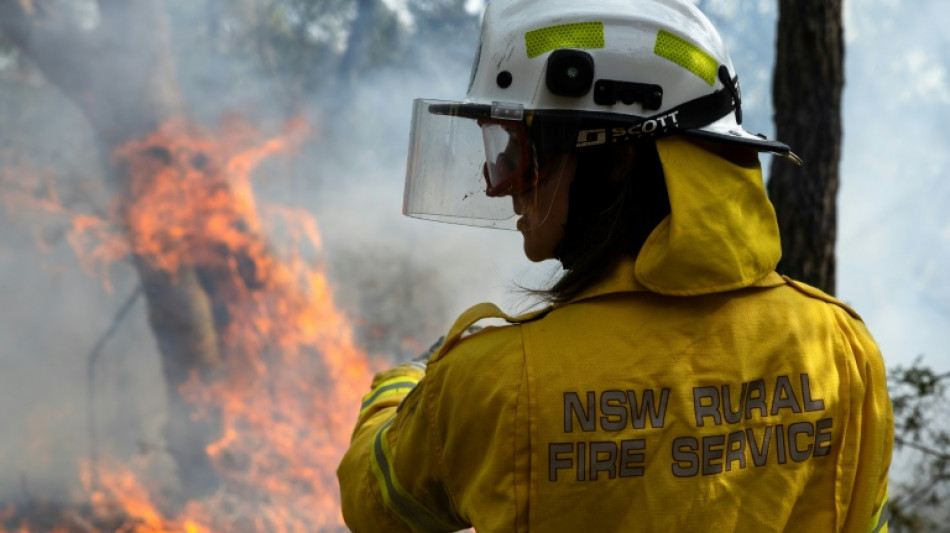
Australia's firefighters face worst season in years / Photo: Aston Brown - AFP

Volunteer firefighters are scorching Australia's forest undergrowth, reducing fuel for what is expected to be the fiercest fire season since the monster "Black Summer" blazes.
Deadly wildfires have devastated forests in Canada, Greece, Hawaii and elsewhere around the world this year but unlike many other countries, Australia heavily relies on a 190,000-strong volunteer cohort to battle the flames.
Their courage was on display during the "Black Summer" fires of 2019-2020 that killed 33 people and millions of animals, as well as destroying thousands of homes and razing vast swathes of eucalyptus forest.
But some of them fear their brigades may not be able to cope in the future should global warming make fires even more intense and frequent.
"It's terrifying but, if 2019-20 became the norm, I don't know how you sustain that year on year. I don't think that's sustainable," said Andy Hain, a 41-year-old volunteer with the NSW Rural Fire Service, who is married with two young sons.
Faced with repeated fires on the scale of the "Black Summer", Australia and other countries would have to share personnel and resources more than they do already, said Hain, who has volunteered for nearly 10 years in Picton, a rural town southwest of Sydney with a population of about 5,000.
Because of wet conditions since "Black Summer", the RFS warns that the threat of grass fires is the highest it has been in two decades.
- 'Ready to burn' -
Driving through Picton, as kangaroos hop along in front of houses lit up by the late afternoon sun, Hain points at the grass growing along the roadside.
"There's green in it but see that straw colour? That's ready to burn," he told AFP.
In New South Wales, as in other states, firefighters have been burning off leaf litter and dense scrub to give themselves the best chance in the coming summer.
They carry fuel-filled "drip torches" -- a metal can with a long narrow tube that has a small flame at its end -- to set the brush alight before hosing down the embers.
Like most of the RFS's 70,000 volunteers in New South Wales, Hain has a paid job elsewhere -- in his case, airline flight operations.
But he is looking at another fire season when his paid job might have to take a back seat.
As the fire season approaches, Hain worries about the toll on colleagues juggling paid work and family alongside their dangerous volunteer roles.
An estimated 82,000 people fought the "Black Summer" fires across Australia, 78 percent of them volunteers.
After the fires, research by the University of Western Australia found that roughly 5,000 of the personnel had a "high need" for mental health support.
- 'Massive, massive fire' -
In a world of fiercer, more frequent fires, what happens when other Australian states and foreign countries are unable to lend a hand as they struggle with their own disasters?
Former NSW Fire and Rescue commissioner Greg Mullins is worried about just that as fire seasons around the world extend and overlap.
"You're asking people to leave their work for months, they have to be their breadwinners, they have to put bread on the table," he said. "At what stage does it become too much?"
During the "Black Summer", some firefighters found themselves saving the homes of their neighbours even as their own properties were burning, and that pressure takes a "huge toll", Mullins said.
"I've seen colleagues who have really broken down because of what they've seen."
But it is not just fires that strain the state's firefighters.
Wisemans Ferry, about 90 minutes' drive north of Sydney, is nestled on the banks of the Hawkesbury River and surrounded by dense national parks.
In late 2019, a large fire sparked by lightning erupted not far from the home of 35-year-old RFS volunteer Kim Brownlie.
"We were very lucky that we didn't lose a single home during those fires, and that was a massive, massive fire," she said.
"So much effort was put in by volunteers from everywhere -- they were coming down from Queensland or coming up from Victoria as well."
Months after the flames were extinguished, the first of four floods hit Brownlie's town.
Fellow volunteer Mitchell Brennan watched his home go under and then battled to save others from the rising waters.
"We helped them survive the flood with food, water, fuel, as much as we could," he said.
"There was nothing to be saved when the water came through and the way it came up. There was nothing you could do, there was no way of stopping it."
H.Takahashi--JT