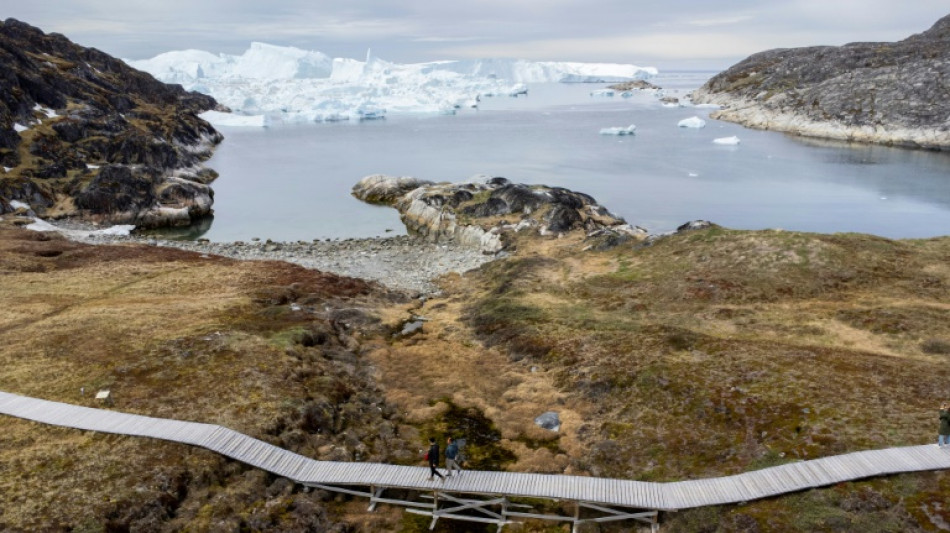
Greenland melted recently, says study that raises future sea level threat / Photo: Odd ANDERSEN - AFP/File

A mile-thick ice sheet in Greenland vanished around 416,000 years ago during a period of moderate natural warming, driving global sea rise to levels that would spell catastrophe for coastal regions today, a study said Thursday.
The results overturn a long-held view that the world's largest island was an impregnable fortress of ice over the past 2.5 million years, and instead show it will be far more vulnerable to human-caused climate change than previously thought.
"If we want to understand the future, we need to understand the past," University of Vermont scientist Paul Bierman, who co-led the paper published in Science, told AFP.
The research relied on an ice core extracted 4,560 feet (1,390 meters) under the surface of Northwest Greenland by scientists at Camp Century, a secretive US military base that operated in the 1960s.
This 12-foot long tube of soil and rock was lost in a freezer only to be rediscovered in 2017.
Scientists were stunned to learn it contained not just sediment but leaves and moss -- irrefutable evidence of an ice-free landscape, perhaps covered by an ancient forest that woolly mammoths would have roamed.
- A green Greenland -
Though researchers were deprived for decades of access to the precious sample, Bierman said in some ways it was "providential," as the cutting-edge techniques used to date the core are very recent.
Key among these is "luminescence dating," which allowed scientists to determine the last time that sediment buried beneath the Earth's surface was exposed to light.
"As sediment is buried beneath the surface, background radiation from soil fills in the little holes or imperfections in minerals like quartz or feldspar, and builds up what we call a luminescence signal over time," co-author Drew Christ told AFP.
In a dark room, scientists took interior strips of the ice core and exposed them to blue-green or infrared light, releasing trapped electrons that form a kind of ancient clock that shows the last time they were exposed to sunlight, which erases the luminescence signal.
"And the only way to do that at Camp Century is to remove a mile of ice," said Tammy Rittenour, a co-author of the study at Utah State University. "Plus, to have plants, you have to have light."
Luminescence dating provided the end point of the ice-free period, with the start point coming from another technique.
Inside the quartz from the Camp Century core, rare forms -- called isotopes -- of the elements beryllium and aluminum build up when the ground is exposed to the sky and cosmic rays.
Looking at the ratio of the normal forms of these elements to the rare isotopes, the scientists could derive a window for how long the rocks were at the surface versus how long they were buried.
They found the sediment was exposed for less than 14,000 years, meaning this was how long the area was ice-free.
- Coastal cities imperiled -
The Camp Century core was taken only 800 miles from the North Pole, with the study showing the entire region would have been covered in vegetation.
This took place in a time of natural warming called an interglacial period, when temperatures were similar to today, around 1.8-2.7 degrees Fahrenheit (1-1.5C) warmer than the pre-industrial era.
The team's modeling showed that the ice sheet melting would have caused between five and twenty feet of sea level rise at that time.
This suggests that every coastal region of the world, home to many global population centers, are at risk of submersion in the coming centuries.
Joseph MacGregor, a climate scientist at NASA who was not involved in the study, noted that the interglacial period that warmed Greenland during this period lasted tens of thousands of years, much longer than what humans have induced so far.
But even so, "we've far surpassed the magnitude of the greenhouse gas forcing back then," he said.
Atmospheric levels of heat-trapping carbon dioxide are currently 420 parts per million (ppm) against 280 ppm during Greenland's ice-free period, and this will remain in the skies for thousands of years.
"We're doing a giant experiment on Earth's atmosphere, and we don't know the results of that experiment," said Bierman. "I don't take that as 'Oh my god the sky is falling,' I take that as we've got to get it together."
H.Nakamura--JT