The Japan Times - Oceans are changing colour and climate change may be to blame

EUR -
AED 4.255618
AFN 75.309998
ALL 92.358548
AMD 422.104822
ANG 2.073658
AOA 1062.444686
ARS 1736.920935
AUD 1.616843
AWG 2.085496
AZN 1.974235
BAM 1.94563
BBD 2.33402
BDT 142.854512
BGN 1.965425
BHD 0.436831
BIF 3466.5575
BMD 1.158609
BND 1.47282
BOB 13.58809
BRL 6.017355
BSD 1.158853
BTN 110.472498
BWP 15.527967
BYN 3.494992
BYR 22708.732283
BZD 2.330737
CAD 1.611683
CDF 2633.518199
CHF 0.937844
CLF 0.027407
CLP 1078.676828
CNY 7.793672
CNH 7.798949
COP 3720.315997
CRC 522.970872
CUC 1.158609
CUP 30.703133
CVE 110.651651
CZK 24.143674
DJF 205.90841
DKK 7.476971
DOP 68.068722
DZD 154.54919
EGP 57.696928
ERN 17.379132
ETB 185.961199
FJD 2.547554
FKP 0.854831
GBP 0.856009
GEL 3.016856
GGP 0.854831
GHS 12.970672
GIP 0.854831
GMD 85.737462
GNF 10172.585588
GTQ 8.845838
GYD 242.454748
HKD 9.086216
HNL 31.132268
HRK 7.537218
HTG 151.608828
HUF 365.25187
IDR 20573.879727
ILS 3.448256
IMP 0.854831
INR 110.571309
IQD 1518.356819
IRR 1592594.677879
ISK 140.643968
JEP 0.854831
JMD 183.689828
JOD 0.821499
JPY 185.464348
KES 149.970767
KGS 101.320784
KHR 4687.156258
KMF 492.409141
KPW 1042.748251
KRW 1596.065155
KWD 0.357918
KYD 0.96576
KZT 537.047413
LAK 25981.802519
LBP 103753.417546
LKR 380.046723
LRD 208.839676
LSL 18.526596
LTL 3.421071
LVL 0.700831
LYD 7.346021
MAD 10.762362
MDL 20.03644
MGA 5015.617853
MKD 61.200624
MMK 2432.762691
MNT 4168.372878
MOP 9.358164
MRU 46.472237
MUR 54.269674
MVR 17.91253
MWK 2011.345259
MXN 19.736326
MYR 4.664448
MZN 74.047125
NAD 18.526591
NGN 1554.366817
NIO 42.544551
NOK 10.862889
NPR 176.755599
NZD 1.959758
OMR 0.441521
PAB 1.158853
PEN 3.883082
PGK 5.123658
PHP 72.147003
PKR 321.572303
PLN 4.341713
PYG 6867.163647
QAR 4.223174
RON 5.259509
RSD 117.395089
RUB 99.813465
RWF 1701.996312
SAR 4.390852
SBD 9.269084
SCR 16.081921
SDG 696.907446
SEK 11.097561
SGD 1.476651
SHP 0.858374
SLE 28.530786
SLL 24295.446125
SOS 662.149166
SRD 43.726325
STD 23980.86273
STN 24.765263
SVC 10.139866
SYP 15064.231378
SZL 18.526582
THB 38.408309
TJS 10.71946
TMT 4.066717
TND 3.375071
TOP 2.789652
TRY 55.891714
TTD 7.864957
TWD 36.65688
TZS 3064.517976
UAH 51.634047
UGX 4369.199296
USD 1.158609
UYU 46.666471
UZS 13700.549328
VES 916.085443
VND 30222.310286
VUV 137.006296
WST 3.13732
XAF 652.554455
XAG 0.017451
XAU 0.00026
XCD 3.131199
XCG 2.088601
XDR 0.819197
XOF 652.297133
XPF 119.331742
YER 274.039987
ZAR 18.737613
ZMK 10428.873593
ZMW 21.93155
ZWL 373.071558
  • CMSC

    -0.0200

    21.29

    -0.09%

  • CMSD

    0.0000

    21.18

    0%

  • JRI

    -0.0500

    12.35

    -0.4%

  • BP

    -0.1900

    42.15

    -0.45%

  • RYCEF

    -0.2500

    20.5

    -1.22%

  • AZN

    -1.8200

    162.7

    -1.12%

  • BCC

    -0.0200

    78.75

    -0.03%

  • GSK

    0.5500

    50.82

    +1.08%

  • RBGPF

    0.0800

    70.77

    +0.11%

  • NGG

    -0.0800

    79.35

    -0.1%

  • RIO

    -1.4800

    103.3

    -1.43%

  • RELX

    0.2400

    36.54

    +0.66%

  • BCE

    0.0600

    23.46

    +0.26%

  • VOD

    0.1600

    16.04

    +1%

  • BTI

    -0.1500

    56.13

    -0.27%

Oceans are changing colour and climate change may be to blame
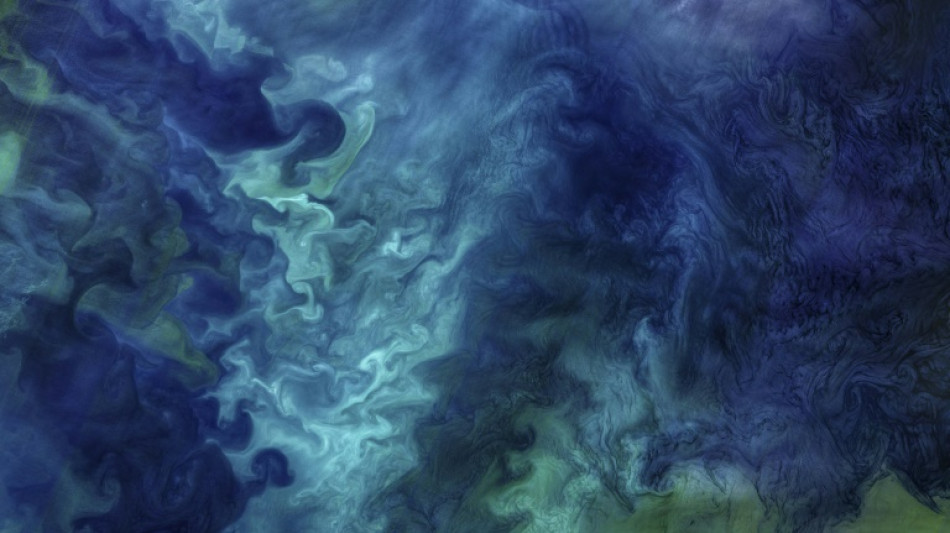
Oceans are changing colour and climate change may be to blame / Photo: HO - NASA/AFP/File

Oceans are changing colour and climate change may be to blame

Over the past 20 years huge swathes of the world's oceans have changed colour, displaying a subtle greening towards the tropics that researchers say points to the effect of climate change on life in the world's seas.

Text size:

In the new research published on Wednesday, scientists said they had detected shifts in colours across more than half of the world's oceans -- an expanse bigger than Earth's total land area.

Authors of the study in Nature think that is down to changes in ecosystems, and particularly in tiny plankton, which are the centrepiece of the marine food web and play a crucial part in stabilising our atmosphere.

"The reason we care about the colour changes is because the colour reflects the state of the ecosystem, so colour changes mean ecosystem changes," lead author B.B. Cael, of Britain's National Oceanography Centre, told AFP.

The colour of the seas when seen from space can paint a picture of what is going on in the upper layers of the water.

A deep blue would tell you that there is not much life, while if the water is greener it is likely to have more activity, specifically from the photosynthesising phytoplankton, which like plants contain the green pigment chlorophyll.

These produce a significant amount of the oxygen we breathe, are a crucial part of the global carbon cycle and are a foundational part of the ocean food web.

- Life colours -

Researchers are keen to develop ways of monitoring changes in ecosystems in order to track climate changes and enshrine protected areas.

But previous studies have suggested you would need three decades of ocean chlorophyll monitoring to detect a trend because of annual variations.

In the latest study, researchers broadened the colour spectrum, looking at seven hues of ocean colour monitored by the MODIS-Aqua satellite from 2002 to 2022.

These are too subtle for humans to see and would look largely blue to the naked eye.

The authors analysed the observational data to detect a trend above the year-to-year variability and then compared it to computer models of what would be expected with climate change.

They found that the real-world observations tallied closely with the changes predicted.

While the researchers said more work would be needed to find out what exactly those colour changes might mean, they said climate change was very likely to be the cause.

"I've been running simulations that have been telling me for years that these changes in ocean colour are going to happen," said co-author Stephanie Dutkiewicz, of MIT's Department of Earth, Atmospheric and Planetary Sciences at the Center for Global Change Science.

"To actually see it happening for real is not surprising, but frightening. And these changes are consistent with man-induced changes to our climate."

T.Ikeda--JT