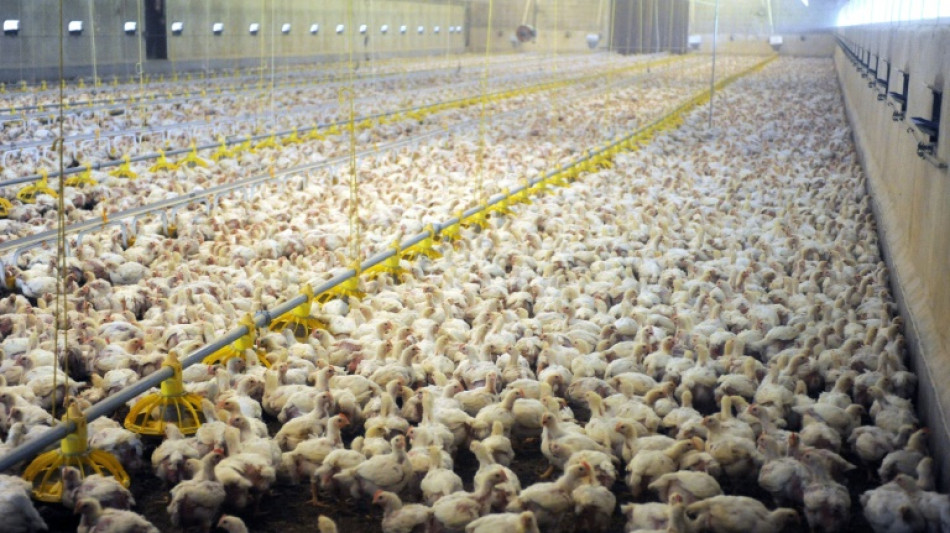
Proof humans reshaped the world? Chickens / Photo: INGO WAGNER - DPA/AFP/File

When aliens or our distant progeny sift through layers of sediment 500,000 years from now to decode the Earth's past, they will find unusual evidence of the abrupt change that upended life half-a-million years earlier: chicken bones.
That is the conclusion of scientists whose findings are offered as proof that rapid expansion of human appetites and activity so radically altered natural systems as to tip Earth into a new geological epoch called the Anthropocene, or the "era of humans".
There will be other telltale clues in mud and rocks of a planetary-scale rupture around the mid-20th century: the sudden rise of CO2, methane and other greenhouse gases; radioactive detritus from nuclear bomb tests; omnipresent microplastics; and the spread of invasive species.
But chicken bones could be among the most revealing findings, and tell the story in more ways than one.
To begin with, they are a human invention.
"The modern meat chicken is unrecognisable compared to its ancestors or wild counterparts," said Carys Bennett, a geologist and lead author of a 2017 study in Royal Society Open Science laying out the evidence for the animal as a "marker species" of the Anthropocene.
"Body size, the shape of the skeleton, bone chemistry and genetics are all distinct."
Their very existence, in other words, is evidence of humanity's capacity to hack nature and intervene in natural processes.
- 'Clear signal' -
The modern broiler chicken's origins are in the jungles of Southeast Asia, where its forebear, the red junglefowl (Gallus gallus), was first domesticated some 8,000 years ago.
The species has long been prized for its meat and eggs, but its engineered breeding into the rotund, short-lived creature found in supermarkets the world over started only after World War II.
"It usually takes millions of years for evolution to occur, but here it has taken just decades to produce a new form of animal," Jan Zalasiewicz, an emeritus professor of palaeobiology at the University of Leicester, told AFP.
Last year, the official Anthropocene Working Group he chaired for more than a decade determined that the Holocene Epoch -- which began 11,700 years ago as the last ice age ended -- gave way to the Anthropocene in the mid-20th century.
On Tuesday, it will announce which spot on Earth best exemplifies that shift.
Another line of evidence is the omnipresence of broiler chickens: virtually anywhere on Earth there are people, there will also be copious remains of our species' favourite source of animal protein.
Today, there are some 33 billion of the flightless birds worldwide at any given time, according to the UN's Food and Agriculture Organization (FAO).
The biomass of domesticated chickens is more than three times that of all wild bird species combined.
At least 25 million are culled every day, whether for chicken tikka in the Punjab, yakitori in Japan, poulet yassa in Senegal or McDonald's nuggets everywhere.
And while many societies shun the eating of beef or pork, how many cultures in the world do not have chicken on the menu?
"Chickens are a symbol of how our biosphere has changed and is now dominated by human consumption and resource use," said Bennett, formerly a researcher at the University Of Leicester and now an officer at People for the Ethical Treatment of Animals (PETA) in Britain.
"The enormous number of distinctive chicken bones discarded worldwide will leave a clear signal in the future geological record," she said.
S.Suzuki--JT