Venice exhibition shines light on Africa's forced urbanisation / Photo: Vincenzo PINTO - AFP

From nomads to deforestation, this year's Venice Architecture Biennale focuses on Africa and the impact of colonisation on the development of a continent undergoing the most rapid urbanisation in the world.
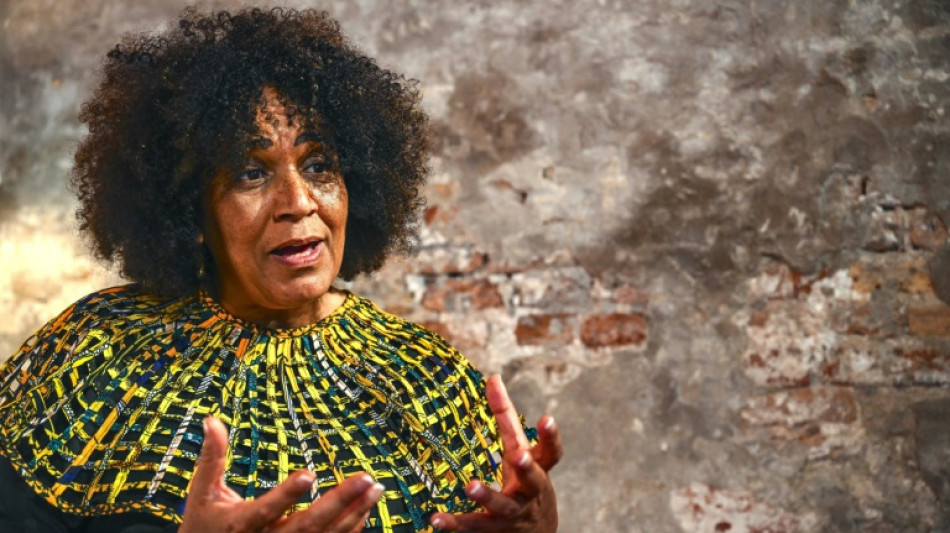
Away from the national pavilions, the main exhibition put together by Biennale curator Lesley Lokko shines a light on the enduring impact of the colonising Europeans who upended traditional ways of life.
Mounir Ayoub, a 40-year-old Tunisian architect based in Geneva, has long been interested in the phenomenon in Tunisia of forced settlement.
Before being colonised by France in 1881, the North African country of his birth "was mostly a country with a nomadic population -- 600,000 nomads and 400,000 sedentary (settled) people", he told AFP.
But through his collection of photos, documents and video testimony from the few remaining nomad families, he argues that France initiated a policy that eventually left the Tunisian desert depopulated.
"The desert was not empty, it was a rich ecosystem with a huge culture. The desert was populated, it was a place of immense civilisation," he told AFP at the exhibition at Venice's former shipyards.
But "France created new cities with oases where water was extracted deep in the desert in order to settle the nomads, to control them, in fact, to start setting up borders", said Ayoub.
The policy continued even after Tunisian independence in 1956, he said, with Tunisian nomads definitively settled by the 1970s and 1980s.
Pointing to places on a map that he said once teemed with life, he lamented that "now there is almost nothing left... even though the whole of Arab civilisation comes from the desert and nomadism".
The end of nomadism was a cultural loss but also an environmental one, as the travelling families had "a minimal impact on the environment", said Ayoub.
The exhibit includes a nomadic tent -- "organic architecture in the first sense of the word: goats, sheep and camels provide hair that is woven into tents".
- No return to 'pure state' -
The number of cities in Africa has doubled since 1990, with their combined population increasing by 500 million people, according to the African Development Bank.
But urban and economic growth has been not only at the expense of Africa's vast deserts but also the continent's forests.
Sammy Baloji, a photographic artist from Lubumbashi, a city in the south of the Democratic Republic of Congo, charted the depletion of his country's rainforests in his project for the exhibition.
He says the process began with Belgium's rule over his country, as part of a colony also including Rwanda and Burundi, when traditional methods of cultivation were abandoned in favour of intensive agriculture.
Baloji said his project, "Debris of History, Issues of Memory", examines "all this human activity from which global warming stems, through the colonisation and devastation of this original vegetation".
The basin of the Congo River is a huge rainforest, second in size only to the Amazon, that absorbs more carbon than it releases -- an environmental benefit threatened by deforestation.
"The question is not to return Africa to its pure state," said Baloji.
"What is interesting is to observe what has been done so far: has it been done taking into account the local populations, their knowledge? Or has it been a devastation of that system to impose another system?"
- Past trauma, future visions -
The exhibition is the brainchild of Lokko, a Ghanaian-Scottish architect who curated this year's Biennale.
She invited 89 participants to contribute to "The Laboratory of the Future", with more than half of them from Africa or the African diaspora.
"We're looking at the more painful aspects of the past, and using that trauma and that vulnerability around questions of identity, migration... which are generally questions architects don't deal with, to inform new visons of the future," Lokko told AFP.
"Our relationship to the environment is a cultural relationship, it's not only a scientific or transactional relationship."
The job of every architect, she said, is "to look at the past in order to project an idea about the future".
Y.Hara--JT