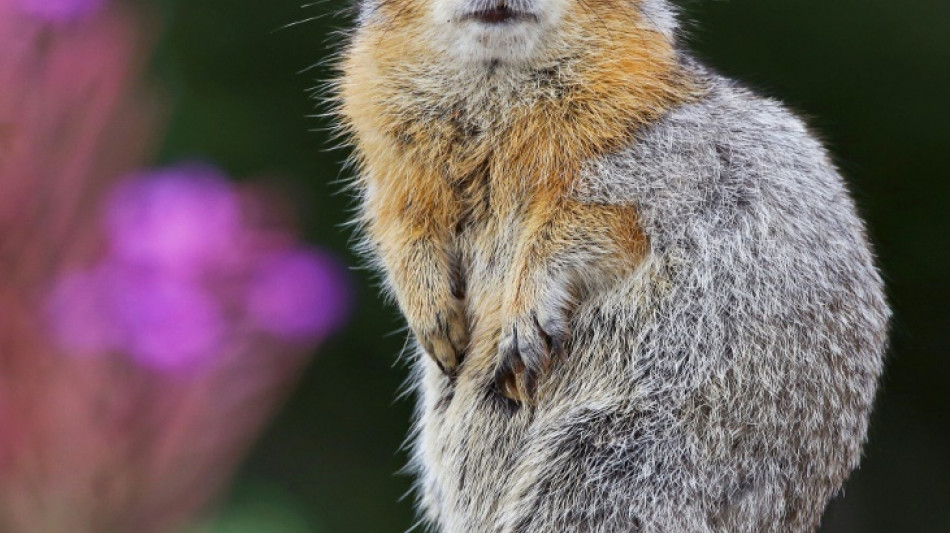
Warming Arctic could put chill on squirrel 'date nights' / Photo: Emily Mesner - US National Park Service/AFP

As Alaska's bleak winter sets in, arctic ground squirrels burrow deep into the ground to begin an eight-month-hibernation before popping up again in spring, famished and eager to breed.
Scientists studying the critters have now discovered a startling new consequence of climate change: as temperatures rise, females of the species have been gradually advancing the date they re-emerge, now a full 10 days earlier than a quarter century ago.
On the other hand, males are not ending their deep sleep sooner: a fact that could soon spell trouble for "date nights," according to a paper published Thursday in the journal Science.
Males previously terminated hibernation a month before females, allowing enough time for their testicles, which shrivel up every fall, to regrow and descend, in an annual cycle of puberty. But this interval is narrowing.
"If this continues, we expect to start to see females emerging ready to mate with males before those males are actually fully reproductively mature," senior author Cory Williams, a biologist at Colorado State University, told AFP.
- Unique adaptations -
Like many Arctic animals, ground squirrels have evolved to have unique adaptations to the extreme winter.
They hibernate around eight months of the year, digging about three feet (a meter) deep in the sandy banks of rivers, just above the tundra's permafrost.
During this time, their body temperatures drop from about 99 degrees F (37 degrees C) to almost 27F (-3C), the lowest in any mammals, drastically slowing their brain, lungs, heart and other organ functions, in a state called "torpor."
The team behind the study were able to harness long-term air and soil temperature data at two sites, and fused those with data collected from biologgers, which measured abdominal and skin temperatures of 199 ground squirrels over the same period.
They detected a significant increase in ambient temperature, as expected for a region known to be warming from climate change at a rate four times greater than the global average.
"The minimum soil temperatures in winter are warmer. It's not getting as cold," said Williams. "And then we also saw a change in the freeze-thaw cycle of the soil. So the soils are now freezing later, and they're thawing earlier."
This had two effects on the animals.
Though they entered hibernation at the same time, the point at which their core body temperature fell below 32F (0C) was delayed, which in turn pushed back the date at which they need to generate heat to prevent tissue death during torpor, an energy-intensive process.
Second, females ended hibernation earlier, matching the earlier spring thaw.
Exactly why this second effect impacts females only isn't confirmed, but the scientists have some theories.
For males, rising testosterone levels as they prepare to breed in spring appear to force an end to hibernation at a fixed point, but females seem more responsive to environmental conditions.
"We've found that females will sometimes end hibernation, and then they'll go to the surface and assess conditions, and they'll go back down and re-enter hibernation when there's what we assume is too much snowpack," said Williams.
- Fatter, but more exposed to predators -
The advantage of this reduced hibernation was that females emerged with more mass, and could get a head start on foraging for roots, shoots, berries and seeds. This in turn could produce healthier litters and better survival rates.
On the other hand, they are exposed for a longer period to their predators -- golden eagles, gyrfalcons, foxes and wolves -- in addition to the looming disruption in sexual interactions.
There could also be cascading impacts up the food chain, if the squirrels' predators adapt to earlier prey availability by advancing their own breeding season.
It's too soon to say, then, what the overall impacts might be.
But what is striking is the concrete proof of climate directly impacting an ecosystem over a relatively short period of time, said first author Helen Chmura, a US Department of Agriculture Forest Service researcher.
"We have a 25-year-dataset, which is a fairly long term thing for science but that's a short period of time in ecology," she told AFP. "We have evidence of effects on ecosystems within the time span of people's lives, including young people."
K.Hashimoto--JT