Climate change, farmers draining ancient Balkan lake / Photo: Armend NIMANI - AFP

For millennia, Lake Prespa was pristine. But under pressure from climate change, unchecked pumping and pollution, the prehistoric body of water in southeast Europe is shrinking at an alarming rate.
Straddling the borders of Albania, Greece and North Macedonia, Lake Prespa is believed to be home to thousands of species that rely on the water and its surrounding habitat.
Warming temperatures have wreaked havoc on the annual snowfall in the area, drying up vital streams that feed into Prespa -- which has put the species that depend on the lake and another nearby body of water at risk.
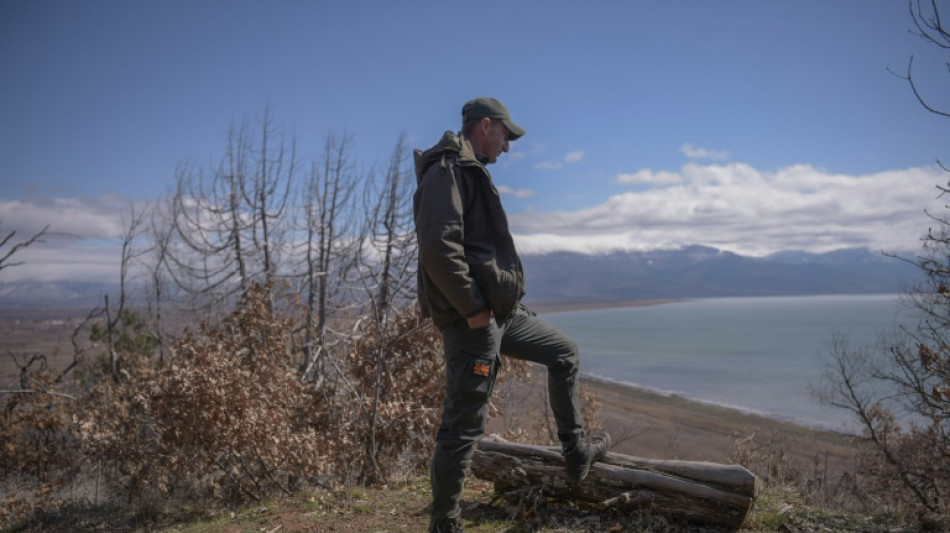
The drop in precipitation has led to the steady retreat of the water, which in some places has receded by up to three kilometers (nearly two miles), according to park rangers who keep a close eye on the lake.
"Earlier there was a lot more snow that could reach one meter or a meter and a half, while in recent years the snowfall has been almost nonexistent," Goran Stojanovski, a 38-year-old ranger who has spent over a decade monitoring the lake in North Macedonia, told AFP.
Other experts concur, pointing to the numerous ways the fallout from climate change has led to the steady shrinking of its shores.
"The changes noted in the lake's levels are connected to climate change," said Spase Shumka, a professor at the Agricultural University of Tirana in the Albanian capital.
Shumka pointed to the higher temperatures that have also increased evaporation and slashed annual precipitation.
"Based on the location, the only solution lies in joint action," the professor added.
To add to Prespa's woes, the surrounding apple farms rely heavily on its water, with one study cited by NASA reporting that the lake had lost seven percent of its surface area and half of its volume between 1984 and 2020.
- 'Pollution' -
Environmental pollution coming from agricultural run-off from the seemingly endless rows of nearby orchards only adds to its problems, leading to algae blooms that spur fears of creating dead zones.
"The lake has been polluted intensively for decades," says Zlatko Levkov, a biologist at the University of Cyril and Methodius in Skopje.
"Simply said, the habitat of many species could completely change, and the population of those species would decrease and potentially go extinct."
According to experts, Prespa has filled this picturesque valley in southeastern Europe for between one and five million years, making it one of the oldest freshwater ecological systems on the continent.
Approximately 2,000 species of fish, birds and mammals along with an array of flora depend on its waters for sustenance.
Further degradation could prove catastrophic for the local ecosystem, but also for neighbouring Lake Ohrid that lies 10 kilometres to the west.
Due to Prespa's location on higher ground, Ohrid relies on underground water flows through the surrounding limestone to maintain its levels.
Any additional stress heaped on Prespa is likely to be felt downstream in Ohrid, which was at risk of losing its place on UNESCO's list of Natural World Heritage Sites just two years ago due to excessive pollution and unregulated development.
According to a report by the United Nations Development Program (UNDP), around 65 tonnes of pesticides are used annually in the region, with large amounts of the chemicals reaching Prespa through run-off.
The pesticides and fertilisers are largely used in the apple orchards that are famed in the region, accounting for roughly 70 percent of the economic activity in and around Prespa's shores in the North Macedonia areas of the lake.
The "dumping of biodegradable waste and over-using fertilisers and pesticides" has spurred the rapid growth of biomass in the lake, including algae and invasive grass, that endangers the endemic species, said UNDP.
- Mounting problems -
Myriad initiatives have been launched in recent years to better manage the fallout from the agricultural sector.
One project has seen the construction of eight meteorological stations that gather data that provides farmers with better information about when to spray pesticides, resulting in a 30 percent reduction of their use.
"By decreasing the number of treatments, we have more economic benefit and we improve the protection of the environment," Frosina Gjorgjievska, a 56-year-old apple farmer living near the lake in North Macedonia's Resen, told AFP.
But in a region where economic hardships, creaky infrastructure and falling birth rates remain the most pressing issues, environmental concerns are often relegated to the backburner of government priorities.
Most experts, however, believe more needs to be done to protect the lake's future, including better enforcement of a raft of agreements signed by North Macedonia, Albania and Greece in 2012.
Activists have called for a shift to organic farming along with investment in sustainable tourism to help spread awareness.
"We want to keep Prespa's authenticity, its beauty, while still being able to enjoy it," said Marija Eftimovska, 42, a local environmental activist.
K.Nakajima--JT