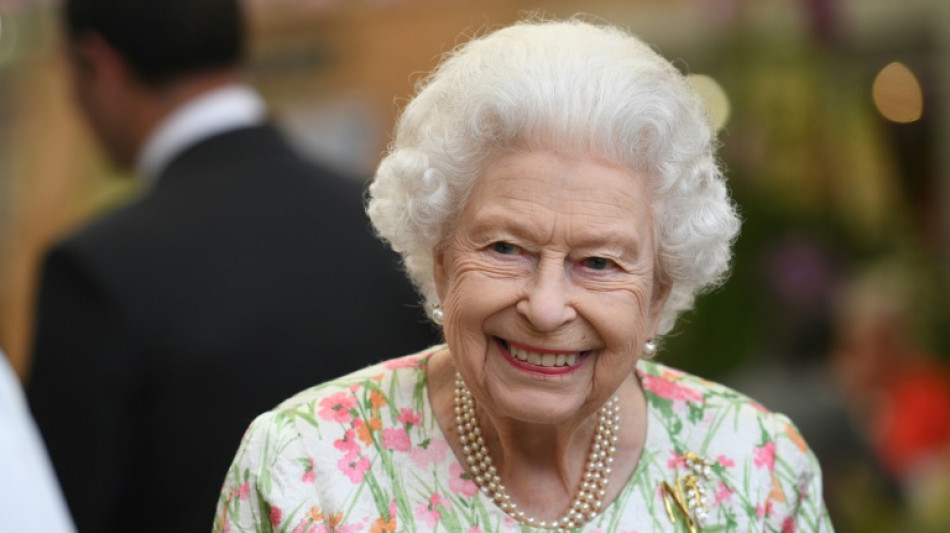
Elizabeth II: Queen of the world / Photo: Oli SCARFF - POOL/AFP

Elizabeth Alexandra Mary Windsor was not just Queen Elizabeth II. She was simply The Queen.
For billions of people, she was the one constant in a world of bewildering change, an omnipresent matriarch linking the past with the present.
While the enormous British Empire she once presided over shrank, her symbolic influence only seemed to grow, her mystique bolstered by films like "The Queen" and the Netflix series "The Crown".
Against the tide of history and logic, she made a medieval anachronism somehow modern, a stoic old lady in a hat onto whom so much could be projected.
Perhaps only the pope held as much sway, and she saw seven of them come and go during her record-breaking seven-decade reign.
- Accident of history -
Although Elizabeth Windsor became the very definition of the word, she was not born to be queen.
An accident of history brought her to the throne.
Until her "Uncle David" -- Edward VIII -- abdicated to marry the twice-divorced American Wallis Simpson in 1936, she had only an outside chance of reigning.
Even as heir apparent, the birth of a baby brother would have sent her back into relative aristocratic obscurity under succession laws in place at the time that gave precedence to males.
All changed for "Lilibet" when she was 10 and her reluctant, stammering father became George VI.
Until the "shock" of the abdication, she had been brought up exactly like her more outgoing younger sister Margaret. The two were often dressed like twins.
Her tough-minded mother, also called Elizabeth, was her emotional lodestar. She made sure the girls had an "insulated and care-free childhood" in contrast to the suffocating Palace strictures their father suffered.
Nevertheless, she learned duty early.
"Princess Elizabeth was quite a good tap dancer and mimic and could be very funny when she wanted to be," said royal biographer Andrew Morton, whose study of her close but often strained relationship with Margaret appeared in 2021.
And she "could be depended upon to do what was asked, keeping her toys and clothes in perfect order".
- 'Magnificent isolation' -
An introvert, she adapted easily to the "magnificent isolation" of royal life spent surrounded by scores of servants and courtiers.
The royal family -- George VI, Queen Elizabeth, princess Elizabeth and princess Margaret -- referred to themselves as "we four", Morton said, and were close.
Yet as queen, Elizabeth looked more to her steely and stolid grandfather George V -- a reformer who believed in leading by example.
Her biographer, Robert Lacey, told AFP that like him she saw the decline of the English class system, and wanted to establish a direct relationship with the people.
George V began the royal broadcasts, which the queen used to hone her own mix of mystery and intimacy, inviting television viewers into Buckingham Palace or Windsor Castle for rather stilted fireside chats surrounded by photographs of her children, dogs and horses.
- Young queen -
Her coronation on June 2, 1953 was the first major event of the television age.
The news that morning of New Zealander Edmund Hillary's conquest of Everest made the celebrations all the more giddy.
The Union Jack had been planted on the top of world, as Britain financed the expedition, alongside that of the United Nations and Nepal.
But for all the glamour of the young queen -- then just 25 -- and talk of a second Elizabethan age, Imperial Britain was in trouble.
India -- the so-called "Jewel in the Crown" -- had already gained independence in 1947.
Hard-won victory in World War II had left the country exhausted and virtually bankrupt, its cities bomb-scarred and rationing was in its 14th year.
The Suez Crisis in 1956 would deal Britain's status as a world power a final shattering blow.
While the Tudor-era Elizabeth I in the 16th century oversaw the birth of England's imperial project, Elizabeth II's fate was to watch the flag come down on the biggest empire the world has ever seen.
The latest to go was Barbados, which cut ties with the British Crown after nearly four centuries in 2021.
- Quiet reformer -
Such a retreat would have carried other monarchies with it, but the queen was the embodiment of British stiff upper lip and its "keep calm and carry on" spirit.
She had already done her dynastic duty by giving birth to an "heir and a spare" -- a successor and a younger sibling -- by the time she was crowned.
With the ageing Winston Churchill -- the first of 15 British prime ministers to serve under her -- at her side, she began to slowly reinvent the institution.
Decades sidestepping diplomatic bear traps on never-ending royal tours and state visits made her a formidable operator.
Those skills have been "capital" in holding the Commonwealth of incredibly diverse mostly former British colonies together, Lacey insisted.
Despite crises and conflicts, it still counts 54 countries with a combined population of 2.57 billion people.
- Princess in love -
The queen was 13 when she fell for her 18-year-old third cousin Philip in 1939, then a dashing naval cadet preparing to go to war.
Her nanny noted that "she never took her eyes off him". Letters were soon flying back and forth.
Despite the constant threat, the future queen experienced her greatest freedom during those teenage wartime years.
Relatively safe behind the thick walls of Windsor Castle, west of London, she became a volunteer driver and mechanic.
When victory was declared in 1945, the 19-year-old princess joined the crowds celebrating in central London along with her friends and her sister Margaret.
She later described it as "one of the most memorable nights of my life. I remember we were terrified of being recognised."
Two years later, despite her mother's reservations -- the Queen Mother referred to plain-speaking Philip as "the Hun" because of his German wider family -- she married the impecunious Danish-Greek prince.
She gave birth to Charles 11 months later and Anne followed in 1950. Andrew -- said to be her favourite -- arrived in 1960, with Edward born four years later.
The queen was a one-man woman, who "never looked at anyone else", her cousin and confidant Margaret Rhodes said.
Philip's marital fidelity was reportedly less sure, but his sense of duty was equally iron cast.
Their 73-year partnership, which lasted until his death in April 2021, was her "strength and stay", the queen later confessed.
Both loved horses. The queen's racing stables turned out some 1,700 winners, with the Racing Post occupying pride of place on her desk alongside state papers.
She only missed two Epsom Derbies in her entire reign.
Philip played polo into his 50s and raced carriages into his 90s. Fittingly both were obsessed with breeding.
On her highly sensitive royal visit to Ireland in 2011 -- the first by a British royal since its independence -- the queen met almost as many horses as people after asking to take in two famous stud farms.
- Humanising the royals -
Thoroughbreds can be difficult to handle. And this was also to prove true with members of the royal family, known as "The Firm", who would become more visible than ever under Elizabeth's reign.
The world got its first glimpse of their private lives in 1969 when BBC cameras were allowed around the Buckingham Palace breakfast table.
The documentary was part of a bid to "humanise" the monarchy masterminded by Philip's uncle, Lord Louis Mountbatten, and the former viceroy of India's son-in-law, film producer John Knatchbull, the seventh Baron Brabourne.
Since the beginning of her reign, the Palace had sought to portray the royals as a family like any other, a more well-born, well-appointed version of a modern British household.
But "Royal Family" lifted the veil further than ever before, revealing some surprising quirks -- behind her shy and dutiful exterior, the queen was actually a rather racy driver.
Not for the last time, it was Prince Philip who delivered the biggest bombshell, telling viewers how the queen's father King George VI would take out his rage on the rhododendrons.
"Sometimes I thought he was mad," he deadpanned.
Critics, including Princess Anne -- who called the film "rotten" -- blamed it for opening the door to the tabloid voyeurism that would soon dog the clan.
- Tabloid troubles -
The queen's rather unruly and resentful sister, Margaret, was first in the firing line, her colourful private life making her prime paparazzi material.
All the royals, apart from the "untouchable" queen herself and Prince Philip, would in time feel the swipe of the media's double-edged sword.
Yet the queen seemed to float above it all, her life a carefully guarded secret.
Beyond her love of horses and rather snappy Corgi dogs, along with a fondness for crossword puzzles and a Dubonnet and gin cocktail before lunch, very little about her private life was known.
In later life she developed a fondness for television soap operas, and while self-isolating in Windsor during the coronavirus lockdown is said to have become a fan of the police corruption drama "Line of Duty".
She even reportedly watched the upper-class period drama "Downton Abbey".
In 2021, when she was forced to slow down because of ill health, The Times reported that late-night television had left her "knackered".
She even stopped drinking her lunchtime gin and martini in the evening.
- 'Annus horribilis' -
For a time, there was much to celebrate in her children's lives.
The "fairytale" marriage of Charles to Lady Diana Spencer in 1981 was a massive global media event, as was the wedding of Andrew to Sarah Ferguson five years later.
Yet the couples' private lives would soon provide endless fodder for the voracious British tabloids.
Both marriages very publicly fell apart in 1992, as did Anne's to Captain Mark Phillips. To top it all, Windsor Castle was badly damaged by fire.
The queen called it her "annus horribilis".
In an effort to win back public support, she began paying tax and Buckingham Palace was opened to the public for the first time.
But the rancour between Charles and Diana became poisonous as they settled scores in rival TV interviews in what became known as the "War of the Waleses".
And then the unimaginable happened. Diana's tragic end in a car crash in Paris in 1997 not only shook confidence in the monarchy, but in the queen herself.
- Diana -
A series of missteps in the days after her daughter-in-law's death left the queen looking cold, uncaring and out of touch.
"Show us you care," said one newspaper front page after the queen opted to stay in her Scottish summer retreat of Balmoral rather return to London.
"Speak to us Ma'am," headlined another, in criticism that would have been unthinkable only a few years before.
And her decision to strip the so-called "People's Princess" of her royal status in the wake of Diana's bombshell 1995 BBC interview came back to haunt the monarch.
But through it all, the queen kept her counsel, sticking doggedly to the royals' reputed mantra of "never complain, never explain".
It may have helped maintain the institution's mystique in past but here it badly backfired.
A major Palace overhaul followed.
Help in restoring faith in the monarch was to come from an unlikely source -- the self-confessed "old republican left-winger" Stephen Frears.
His Oscar-winning 2008 movie "The Queen", set against the backdrop of the Diana crisis, did much to explain her position and rewrite the narrative.
Helen Mirren -- another republican -- won an Oscar for her moving portrayal of the queen's struggle between duty and family, winning her sympathy even from people who had little time for the monarchy.
- The problem with Charles -
Rehabilitating Charles would be trickier. As early as 1977, during her Silver Jubilee marking 25 years on the throne, the queen had vowed to rule until her death.
While this promised stability, it also seemed to undermine the Prince of Wales, whom some saw as unfit to follow her.
His buttonholing of politicians over his hobby horse causes seemed to challenge the unwritten rule that the royals stay out of politics.
However, as many of his once "fringe" ideas, such as on the environment, became mainstream, Charles has shown a more relaxed, self-deprecating side, particularly after his 2005 marriage to his lifelong lover Camilla.
With his mother in her 90s, he began to take over her duties as the most senior royal on overseas trips.
- Family -
Despite the consolation of grandchildren and great grandchildren in the twilight of her reign, her greatest headaches continued to come from within her own family.
Now the longest serving British monarch ever, the marriages of both of her grandsons William and Harry to commoners seemed to offer another phase of modernisation and renewal.
However, within three years of Harry's mould-breaking marriage to the mixed-race American actress Meghan Markle in 2018, a rift with the Palace became horribly public.
A month after allegations of racism within the family were raised in a television interview with Oprah Winfrey, Philip died aged 99 in April 2021, leaving her ever more alone.
With Andrew also mired in underage sex allegations over links with convicted sex offender Jeffrey Epstein, it was another "annus horribilis".
- Last of her kind? -
Yet the monarch herself remained hugely popular and admired, an embodiment of traditional values and all that seemed eternal about England.
In his book on her and her sister, Morton recounts how Margaret burst in on the queen's weekly audience with the prime minister early in her reign.
"If you weren't queen, nobody would talk to you," Margaret fumed, angry at being left out.
Time and again since, Elizabeth proved the contrary, that she was infinitely worthy -- the first and perhaps the "last global monarch", as the New York Times put it in 2021.
The unknowable mystique she cultivated in a world ever more demanding of transparency may well die with her.
M.Sugiyama--JT