The Japan Times - Indonesia floods were 'extinction level' for rare orangutans

EUR -
AED 4.220543
AFN 72.388508
ALL 96.069869
AMD 433.653783
ANG 2.056852
AOA 1053.656538
ARS 1602.316393
AUD 1.627158
AWG 2.071119
AZN 1.954639
BAM 1.957206
BBD 2.313763
BDT 140.962519
BGN 1.96404
BHD 0.43391
BIF 3412.606207
BMD 1.149026
BND 1.469526
BOB 7.966794
BRL 6.056166
BSD 1.148826
BTN 105.963064
BWP 15.664392
BYN 3.422323
BYR 22520.902917
BZD 2.310571
CAD 1.570287
CDF 2602.543398
CHF 0.905323
CLF 0.026454
CLP 1044.475571
CNY 7.99291
CNH 7.919291
COP 4250.487208
CRC 539.592433
CUC 1.149026
CUP 30.44918
CVE 111.024626
CZK 24.44554
DJF 204.568778
DKK 7.471792
DOP 70.492583
DZD 151.974943
EGP 60.167035
ERN 17.235385
ETB 180.954804
FJD 2.543885
FKP 0.867444
GBP 0.863976
GEL 3.137121
GGP 0.867444
GHS 12.507131
GIP 0.867444
GMD 84.454608
GNF 10082.700083
GTQ 8.805404
GYD 240.474892
HKD 8.997164
HNL 30.412118
HRK 7.536576
HTG 150.569506
HUF 390.656654
IDR 19516.200819
ILS 3.588528
IMP 0.867444
INR 106.008301
IQD 1504.894474
IRR 1517920.347018
ISK 143.202585
JEP 0.867444
JMD 180.709853
JOD 0.814624
JPY 182.897883
KES 148.690295
KGS 100.482161
KHR 4617.336547
KMF 492.931898
KPW 1034.123085
KRW 1713.237502
KWD 0.352234
KYD 0.957296
KZT 554.753459
LAK 24675.3256
LBP 102895.247939
LKR 357.730169
LRD 210.559301
LSL 19.326656
LTL 3.392774
LVL 0.695034
LYD 7.363355
MAD 10.792749
MDL 19.988537
MGA 4782.665625
MKD 61.652816
MMK 2412.542911
MNT 4103.498066
MOP 9.264938
MRU 45.802311
MUR 53.706171
MVR 17.752803
MWK 1991.648479
MXN 20.438007
MYR 4.516248
MZN 73.433763
NAD 19.326656
NGN 1575.923439
NIO 42.270374
NOK 11.140758
NPR 169.547948
NZD 1.964362
OMR 0.441796
PAB 1.148836
PEN 3.96555
PGK 4.953603
PHP 68.630731
PKR 320.913193
PLN 4.270986
PYG 7456.357939
QAR 4.199154
RON 5.094546
RSD 117.398301
RUB 93.501567
RWF 1676.619365
SAR 4.312118
SBD 9.25163
SCR 17.126377
SDG 690.564479
SEK 10.756207
SGD 1.46884
SHP 0.862067
SLE 28.208659
SLL 24094.505996
SOS 655.37664
SRD 43.170617
STD 23782.511268
STN 24.517618
SVC 10.052311
SYP 126.996044
SZL 19.312045
THB 37.157203
TJS 11.028321
TMT 4.02159
TND 3.393138
TOP 2.766577
TRY 50.767309
TTD 7.790666
TWD 36.723435
TZS 2993.211975
UAH 50.645333
UGX 4337.154309
USD 1.149026
UYU 46.703967
UZS 13890.101941
VES 508.678973
VND 30207.884576
VUV 137.383546
WST 3.142832
XAF 656.434409
XAG 0.014252
XAU 0.00023
XCD 3.105299
XCG 2.070406
XDR 0.818715
XOF 656.434409
XPF 119.331742
YER 274.100137
ZAR 19.244818
ZMK 10342.620646
ZMW 22.372271
ZWL 369.985793
  • RYCEF

    -0.1500

    16.4

    -0.91%

  • CMSC

    -0.0300

    22.96

    -0.13%

  • VOD

    0.1700

    14.58

    +1.17%

  • RBGPF

    0.1000

    82.5

    +0.12%

  • GSK

    0.5600

    53.95

    +1.04%

  • BP

    0.2350

    42.905

    +0.55%

  • BTI

    1.2200

    61.15

    +2%

  • RIO

    1.6800

    89.51

    +1.88%

  • NGG

    -0.2800

    90.62

    -0.31%

  • BCE

    0.6321

    25.88

    +2.44%

  • RELX

    0.3200

    34.46

    +0.93%

  • BCC

    1.7800

    71.78

    +2.48%

  • CMSD

    0.0180

    23.008

    +0.08%

  • JRI

    0.0100

    12.6

    +0.08%

  • AZN

    1.8900

    191.79

    +0.99%

Indonesia floods were 'extinction level' for rare orangutans
Indonesia floods were 'extinction level' for rare orangutans / Photo: YT Hariono - AFP

Indonesia floods were 'extinction level' for rare orangutans

Indonesia's deadly flooding was an "extinction-level disturbance" for the world's rarest great ape, the tapanuli orangutan, causing catastrophic damage to its habitat and survival prospects, scientists warned on Friday.

Text size:

Only scientifically classified as a species in 2017, tapanulis are incredibly rare, with fewer than 800 left in the wild, confined to a small range in part of Indonesia's Sumatra.

One dead suspected tapanuli orangutan has already been found in the region, conservationists told AFP.

"The loss of even a single orangutan is a devastating blow to the survival of the species," said Panut Hadisiswoyo, founder and chairman of the Orangutan Information Centre in Indonesia.

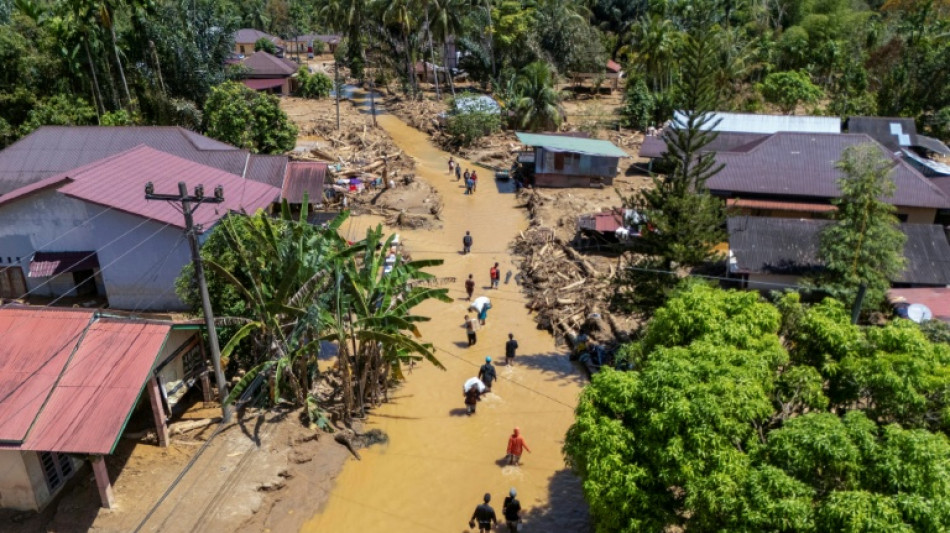
And analysis of satellite imagery combined with knowledge of the tapanuli's range suggests that the flooding which killed nearly 1,000 people last month may also have devastated wildlife in the Batang Toru region.

The scientists focused on the so-called West Block, the most densely populated of three known tapanuli habitats, and home to an estimated 581 tapanulis before the disaster.

There, "we think that between six and 11 percent of orangutans were likely killed," said Erik Meijaard, a longtime orangutan conservationist.

"Any kind of adult mortality that exceeds one percent, you're driving the species to extinction, irrespective of how big the population is at the start," he told AFP.

But tapanulis have such a small population and range to begin with that they are especially vulnerable, he added.

Satellite imagery shows massive gashes in the mountainous landscape, some of which extend for more than a kilometre and are nearly 100 metres wide, Meijaard said.

The tide of mud, trees and water toppling down hillsides would have carried away everything in its path, including other wildlife like elephants.

David Gaveau, a remote sensing expert and founder of conservation start-up The Tree Map, said he was flabbergasted by the before-and-after comparison of the region.

"I have never seen anything like this before during my 20 years of monitoring deforestation in Indonesia with satellites," he told AFP.

The devastation means remaining tapanulis will be even more vulnerable, with sources of food and shelter now washed away.

Over nine percent of the West Block habitat may have been destroyed, the group of scientists estimated.

In a draft paper shared with AFP and set to be published as a pre-print in coming days, they warned the flooding represents an "extinction-level disturbance" for tapanulis.

They are urging an immediate halt to development in the region that will damage remaining habitat, expanded protected areas, a detailed survey of the affected area and orangutan populations and work to restore lowland forests.

The highland homes currently inhabited by tapanulis are not their preferred habitat, but it is where remaining orangutans have been pushed by development elsewhere.

Panut said the region had become eerily quiet after the landslides.

"This fragile and sensitive habitat in West Block must be fully protected by halting all habitat-damaging development," he told AFP.

S.Suzuki--JT