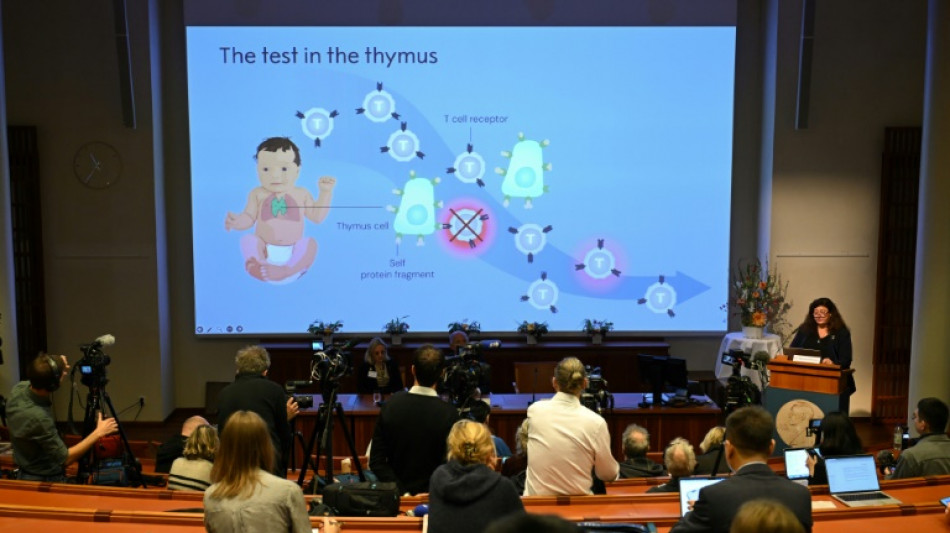
What are regulatory T-cells? Nobel-winning science explained / Photo: Jonathan Nackstrand - AFP

The Nobel Prize in Medicine was awarded on Monday to three scientists for discovering how a particular kind of cell can stop the body's immune system from attacking itself.
The discovery of these "regulatory T-cells" has raised hopes of finding new ways to fight autoimmune diseases and cancer, though treatments based on the work have yet to become widely available.
After Americans Mary Brunkow and Fred Ramsdell and Japan's Shimon Sakaguchi were announced new Nobel laureates at a ceremony in Stockholm, here is what you need to know about their work.
- What is the immune system? -
The immune system is your body's first line of defence against invaders such as microbes that could give you an infection.
Its most powerful weapons are white blood cells called T-cells. They seek out, identify and destroy these invading germs -- or other unwanted outsiders such as cancerous cells -- throughout the body.
But sometimes these T-cells identify the wrong target and attack healthy cells, which causes a range of autoimmune diseases such as type 1 diabetes and lupus.
Enter regulatory T-cells -- also called Tregs -- which the Nobel committee dubbed the body's "security guards".
"They put the brakes on the immune system to prevent it from attacking something that it shouldn't," Jonathan Fisher, head of the innate immune engineering laboratory at University College London, told AFP.
For a long time, it had been thought this crucial regulation role was performed entirely by the thymus, a small gland in the upper chest.
T-cells have things called "receptors" which make sure they can detect the shape of an invading microbe -- such as the famously spiky Covid-19 virus.
When T-cells grow in the thymus, the gland has a way to eliminate any that have receptors which match healthy cells, to avoid friendly fire in the future.
But what if some of these rogue T-cells slip through?
- What did the Nobel winners do? -
Some scientists had once thought there could be some other cell out there, patrolling for escapees.
But by the 1980s, most researchers had abandoned this idea -- except Sakaguchi.
His team took T-cells from one mouse and injected them into another which had no thymus. The mouse was suddenly protected against autoimmune diseases, showing that something other than the gland must be able to fight off self-attacking T-cells.
A decade later, Brunkow and Ramsdell were investigating why the males of a mutated strain of mice called "scurfy" only lived for a few weeks.
In 2021, they were able to prove that a mutation of the gene FOXP3 caused both scurfy and a rare autoimmune disease in humans called IPEX.
Scientists including Sakaguchi were then able to show that FOXP3 controls the development of regulatory T-cells.
- How does this help us? -
A new field of research has been probing exactly what this discovery means for human health.
French immunologist Divi Cornec told AFP that "a defect in regulatory T-cells" can make autoimmune diseases more severe.
These cells also play a "crucial role in preventing transplanted organs from being rejected," Cornec said.
Cancer can also "hijack" regulatory T-cells to help it escape the immune system, Fisher said.
When this happens, the cells crack down too hard on the immune system -- like an overzealous security guard -- and allow the tumour to grow.
- What about new drugs? -
There are now over 200 clinical trials testing treatments involving regulatory T-cells, according to the Nobel ceremony.
However the breakthroughs which won Monday's Nobel have not yet led to a drug that is currently in wide use.
On Monday, Sakaguchi said he hopes the Nobel spurs the field "in a direction where it can be applied in actual bedside and clinical settings".
Fisher emphasised that a lot of progress had been made over the last five years -- and that these things take a lot of time and money.
"There is a big gap between our scientific understanding of the immune system and our ability to investigate it and manipulate it in a lab -- and our ability to actually deliver a safe-in-humans drug product that will have a consistent and beneficial effect," Fisher said.
S.Yamamoto--JT