Horseshoe crabs: 'Living fossils' vital for vaccine safety / Photo: Bastien INZAURRALDE - AFP

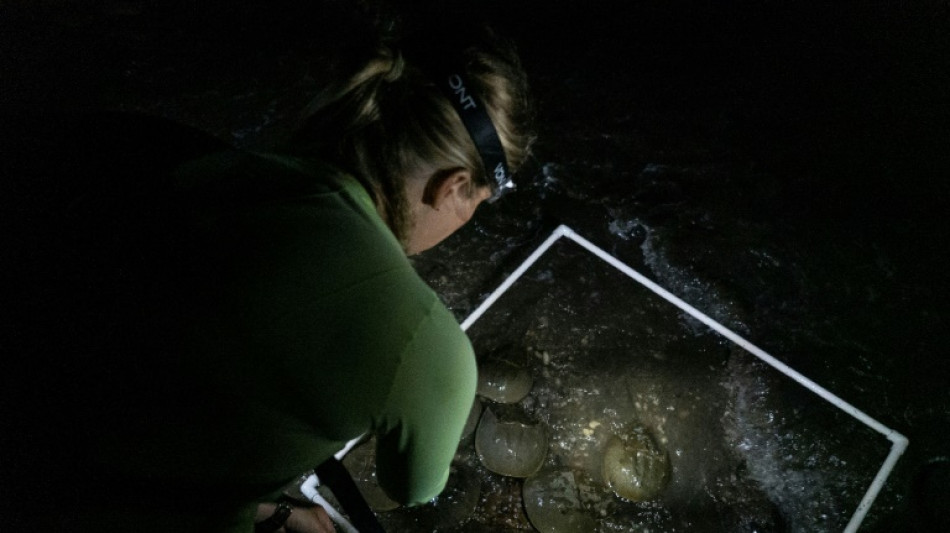
On a bright moonlit night, a team of scientists and volunteers head out to a protected beach along the Delaware Bay to survey horseshoe crabs that spawn in their millions along the US East Coast from late spring to early summer.
The group make their way up the shoreline laying a measuring frame on the sand, counting the individuals inside it to help generate a population estimate, and setting right those unfortunate enough to have been flipped onto their backs by the high tide.
With their helmet-like shells, tails that resemble spikes and five pairs of legs connected to their mouths, horseshoe crabs, or Limulidae, aren't immediately endearing.
But if you've ever had a vaccine in your life, you have these weird sea animals to thank: their bright blue blood, which clots in the presence of harmful bacterial components called endotoxins, has been essential for testing the safety of biomedical products since the 1970s, when it replaced rabbit testing.
"They're really easy to love, once you understand them," Laurel Sullivan, who works for the state government to educate members of the public about the invertebrates, tells AFP.
"They're not threatening at all. They're just going about their day, trying to make more horseshoe crabs."
For 450 million years, these otherworldly creatures have patrolled the planet's oceans, while dinosaurs arose and went extinct, and early fish transitioned to the land animals that would eventually give rise to humans.
Now, though, the "living fossils" are listed as vulnerable in America and endangered in Asia, as a result of habitat loss and overharvesting for use in food, bait, and the pharmaceutical industry, which is on a major growth path, especially in the wake of the Covid pandemic.
Recruiting citizen scientists helps engage the public while also scaling up the government's data collection efforts, explains the survey project's environment scientist Taylor Beck.
- Vital ecological role-
"Crabs" are something of a misnomer for the animals, which are in fact more closely related to spiders and scorpions, and are made up of four subspecies: one that inhabits the Eastern and Gulf coasts of North America, and the other three in Southeast Asia.
Atlantic horseshoe crabs have 10 eyes and feed by crushing up food, such as worms and clams, between their legs then passing the food to their mouths.
Males are noticeably smaller than females, whom they swarm in groups of up to 15 when breeding. Males grasp females as they head to shore, where the females deposit golf ball-size clusters of 5,000 eggs for the males to spray their sperm on.
Millions of these eggs, tiny green balls, are inadvertently churned up onto the beach surface, where they are a vital food source for migrating shorebirds, including the near-threatened Red Knot.
Nivette Perez-Perez, manager of community science at the Delaware Center for the Inland Bays, points out a vast band of eggs that stretch nearly the whole beach at the James Farm Ecological Preserve.
As she gestures, aptly-named laughing gulls with bright orange beaks swoop down to feast.
Like others in the area, Perez-Perez long ago succumbed to the crabs' charms.
"You're so cute," she tells a female she has picked up to point out its anatomical features.
- Just flip 'em -
Breeding is a dangerous business for horseshoe crabs as it's on the beach that they are at their most vulnerable: as the tide washes in, some end up on their backs, and while their long hard tails can help some right themselves, not all are so lucky.
Around 10 percent of the population is lost each year as their exposed undersides bake in the Sun.
In 1998, Glenn Gauvry, founder of the Ecological Research & Development Group, helped start the "Just flip 'em" campaign, encouraging members of the public to do their part by gently picking up upturned crabs that are still alive.
"Where it matters most of all, is changing the heart," he tells AFP on Delaware Bay's Pickering Beach, proudly sporting a "Just flip 'em" baseball cap festooned with horseshoe crab pins.
"If we can't get people to care and to connect to these animals, then they're less likely to want legislation to protect them."
Every year around 500,000 horseshoe crabs are harvested and bled for a chemical called Limulus Amebocyte Lysate, vital for testing against a type of bacteria that can contaminate medications, needles and devices like hip replacements.
Estimates place the mortality rate of the process at 15 percent, with survivors released back to sea.
A new synthetic alternative called recombinant factor C appears promising, but faces regulatory challenges.
Horseshoe crabs are a "finite source with a potentially infinite demand, and those two things are mutually exclusive," Allen Burgenson, of Swiss biotech Lonza, which makes the new test, told AFP.
K.Yoshida--JT