'Turkish salmon': the Black Sea's new rose-coloured gold / Photo: Ozan KOSE - AFP

Sitting in his spacious office with a view of the Black Sea, Tayfun Denizer smiles: his rainbow trout, raised in submerged cages, have made him a wealthy man.
"Our exports surged from $500,000 in 2017 to $86 million last year, and this is just the beginning," said Denizer, general manager of Polifish, one of the Black Sea's main producers of what is marketed as "Turkish salmon".
In its infancy just a decade ago, production of trout -- which in Turkey is almost exclusively farmed for export -- has exploded in line with the global demand for salmon, despite criticism of the intensive aquaculture required to farm it.
Last year, the country exported more than 78,000 tonnes of trout raised in its cooler northern Black Sea waters, a figure 16 times higher than in 2018.
And it brought in almost $498 million for Turkish producers, a number set to increase but is still far from the $12.8 billion netted by Norwegian salmon and trout giants in the same year.
Russia, which banned Norwegian salmon in 2014 after the West imposed sanctions over its annexation of Crimea, accounts for 74.1 percent of "Turkish salmon" exports, followed by Vietnam with 6.0 percent, and then Belarus, Germany and Japan.
- 'Spectacular success' -
Stale Knudsen, an anthropologist at Norway's Bergen University and a specialist on Black Sea fishing, said Russia offered "an available market that was easy to access, near Turkey".
For him, the "spectacular success" of trout is also down to Turkey's experience and the technology used in farming sea bass and sea bream, a field in which it leads Europe.
Turkish producers have also benefitted from the country's large number of reservoirs where the fish are a raised for several months before being transferred to the Black Sea.
There, the water temperature -- which stays below 18 degrees Celsius (64.4 Fahrenheit) between October and June -- allows the fish to reach 2.5 to 3.0 kilogrammes (5.5-6.6 pounds) by the time they are harvested.
Last, but not least, is the price.
"Our 'salmon' is about 15 to 20 percent cheaper than Norwegian salmon," said Ismail Kobya, deputy general manager of Akerko, a sector heavyweight that mainly exports to Japan and Russia.
"The species may be different but in terms of taste, colour and flesh quality, our fish is superior to Norwegian salmon, according to our Japanese clients," Kobya told AFP at Akerko's headquarters near the northeastern town of Trabzon, where a Turkish flag flies alongside those of Russia and Japan.
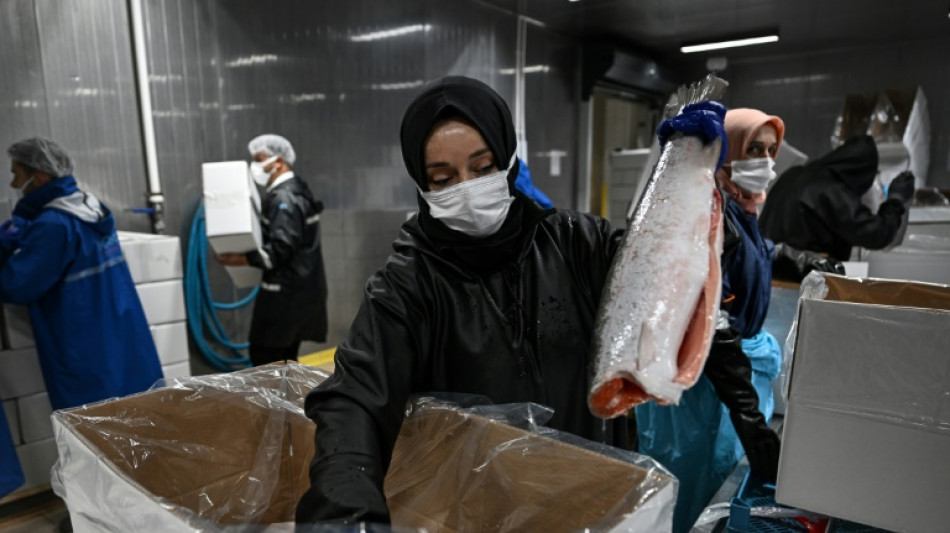
Inside, a hundred or so employees in long blue waterproofs, green head coverings and rubber boots behead, gut, clean and debone trout that has an Aquaculture Stewardship Council (ASC) certification for responsible farming practises.
- Disease risks -
"Over the last two years, many Turkish producers have moved to get those certifications," said Knudsen, though he does not believe such labels are always a guarantee of sustainability.
"I think the rationale behind that is not only to become more sustainable, but is more importantly a strategy to try to enter the European markets... where the Norwegians have some kind of control," he said.
In a 2024 study, researchers from a Turkish public institute raised concerns that "the rapid growth of the trout farming sector... led to an uncontrolled decline in the survival rate" of the fish.
Pointing to the "spread of diseases" and "improper breeding management", the researchers found that nearly 70 percent of the trout were dying prematurely.
Polifish, which also has an ASC certification, acknowledged a mortality rate of around 50 percent of their fish stocks, predominantly in the reservoirs.
"When the fish are small, their immune systems aren't fully working," said its deputy general manager Talha Altun.
Akerko for its part claims to have "reached a stage where we have almost no disease".
"In our Black Sea cages, the mortality rate is lower than five percent, but these are farming operations and anything can happen," Kobya said.
- 'Fake fish' -
Visible from the shore, the fish farms have attracted the wrath of local fishermen worried about the cages, which have a 50-metre (165-foot) diameter, being set up where they cast their nets to catch anchovy, mackerel and bonito.
Mustafa Kuru, head of a local fishermen's union, is a vocal opponent of a farming project that has been set up in his fishing zone just 70 kilometres (45 miles) from the Georgian border.
"The cages block the movement of the fish and what happens then? The fish start leaving the area," he said, accusing the trout farmers of pumping chemicals into their "fake fish".
He said a lack of fish stocks in the area had already forced two boats from his port to cast their nets much further afield -- off the western coast of Africa.
"If the fish leave, our boats will end up going to rack and ruin in our ports," he warned.
S.Suzuki--JT