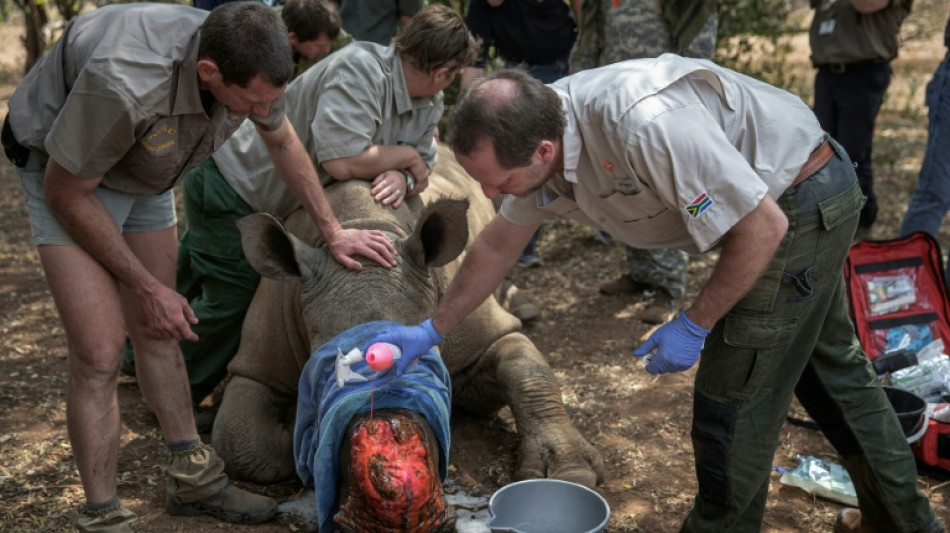
Dehorning of S.African rhinos slashed poaching: study / Photo: GIANLUIGI GUERCIA - AFP/File

The dehorning of rhinos resulted in a nearly 80-percent reduction in the poaching of the animals during a seven-year study in a major South African conservation area, researchers said Thursday.
Sawing off the sought-after horns was also a fraction of the cost of other counter-poaching measures such as deploying rangers or tracking dogs, according to the study published in the journal Science.
The study was carried out between 2017 and 2023 in 11 reserves around South Africa's famed Kruger National Park that protect the world's largest rhino population.
During this period, some 1,985 rhinos were poached in the reserves in the Greater Kruger area despite $74 million spent mostly on reactive law enforcement measures that netted around 700 poachers, it said.
By contrast, dehorning 2,284 rhinos cut poaching by 78 percent at just 1.2 percent of that budget, said the study published by the American Association for the Advancement of Science.
"Some poaching of dehorned rhinos continued because poachers targeted horn stumps and regrowth, signalling the need for regular dehorning alongside judicious use of law enforcement," the study said.
South Africa is home to most of the world's rhinos, including the critically endangered black rhino, and is a hotspot for poaching driven by demand in Asia where the horns are used in traditional medicine.
Rhino horn is highly sought after on the black market, where the price by weight rivals that of gold and cocaine.
Alongside ivory, the horns are coveted as status symbols or used in traditional medicine for their supposed aphrodisiac properties.
"Ongoing socioeconomic inequality incentivises a large pool of vulnerable and motivated people to join, or poach for, criminal syndicates even when the risks are high," the researchers said.
Corruption also played a role with gangs receiving insider tips to evade detection and arrest, they said.
- Impacts unclear -
"Although detecting and arresting poachers is essential, strategies that focus on reducing opportunities for and rewards from poaching may be more effective," the study said.
It added, however, that "the effects of dehorning on rhino biology are still unclear, with present research suggesting that dehorning may alter rhino space use but not survival and reproduction."
The co-authors of the study are from South Africa's Nelson Mandela University and the University of Cape Town, and various conservation groups including the Wildlife Conservation Network and United Kingdom's Save the Rhino International.
South Africa had more than 16,000 rhinos at the end of 2023, mostly white rhinos, according to government data.
But at least 34 rhinos were killed each month, the environment minister said in May.
In 2024 South African scientists injected radioactive material into live rhino horns to make them easier to detect at border posts in a pioneering project aimed at curbing poaching.
The radioactive material would not impact the animal's health or the environment in any way but make it poisonous for human consumption, according to the University of the Witwatersrand's radiation and health physics unit which spearheaded the initiative.
Black rhinos are listed by the International Union for Conservation of Nature (IUCN) as critically endangered.
K.Nakajima--JT