Giant mine machine swallowing up Senegal's fertile coast / Photo: PATRICK MEINHARDT - AFP

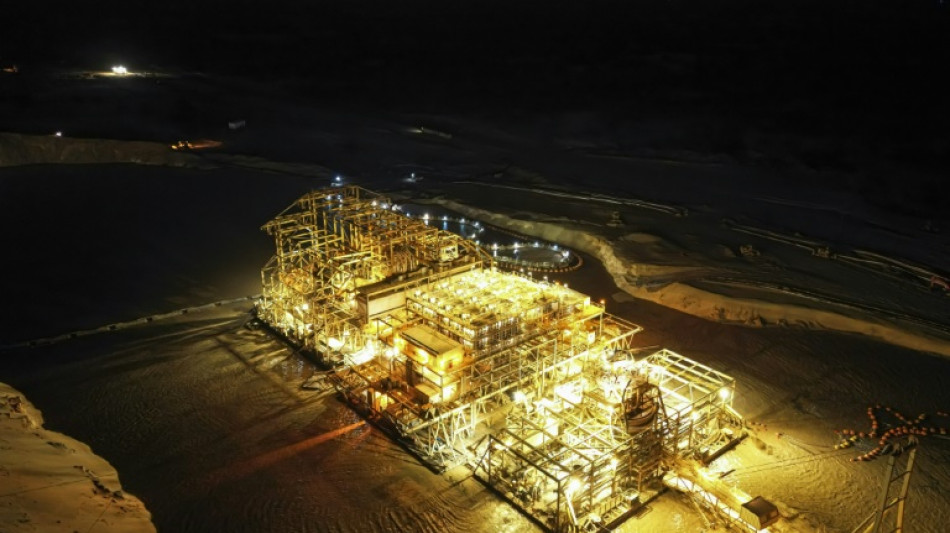
Like something from the science fiction film "Dune", the "world's biggest mining dredger" has been swallowing acre after acre of the fertile coastal strip where most of Senegal's vegetables are grown.
The jagged 23-kilometre-long (14-mile) scar the gigantic rig has left mining for zircon -- which is used in ceramics and the building industry -- is so big it is visible from space.
Amid a deafening din, the massive machine sucks up thousands of tonnes of mineral sands an hour, moving forward on an artificial lake created with water pumped from deep underground.
It is now tearing through the dunes of Lompoul -- one of the smallest and most beautiful deserts in the world -- a tourist hotspot by the endless beaches of Senegal's Atlantic coast.
Thousands of farmers and their families have been displaced over the past decade to make way for the colossal floating factory run by the French mining group Eramet.
It denies any wrongdoing, insists its operations are exemplary and even plans to step up the pace of mining.
But locals accuse it of destroying this rich but delicate ecosystem on the western edge of Africa's semi-arid Sahel region.
The project has brought "despair and disillusion", said Gora Gaye, the mayor of Diokoul Diawrigne district which takes in Lompoul.
For years critics of the mine said villagers' protests at losing the land were ignored, with complaints about "derisory" compensation smothered by the authorities.
- New president speaks out -
That has now changed, with tourist operators uniting with farmers and local leaders to demand a pause in the mining.
Senegal's President Bassirou Diomaye Faye has also spoken out on extractive mining practices, saying some "local populations do not benefit". He doubled down last week, demanding more transparency and oversight of "social and environmental impacts".
His government was elected last year promising a radical break with the past and to reclaim Senegal's sovereignty, particularly from the influence of former colonial power France.
Eramet -- which is 27 percent owned by France -- began mining in 2014 under the previous government after being awarded the concession 10 years earlier. The Senegalese state holds 10 percent of its local subsidiary, EGC, which mines the zircon and titanium-related minerals such as rutile and ilmenite.
AFP was granted rare access to its operations and to the dredger and the plants where the mineral sands are separated before being exported via the company's private rail link through the port of the capital Dakar, 150 miles to the south.
EGC insisted it was a "responsible company", that respects its agreement with the Senegal government and that has compensated locals "five times more" for the loss of their land than national guidelines, paying out 12,190 to 15,240 euros ($16,575) per hectare.
- Fertile oases 'destroyed' -
But what are they left with afterwards, asked hotelier Sheikh Yves Jacquemain, who runs a desert eco-lodge of traditional tents in Lompoul, where until recently the only sounds were from seabirds and passing camels.
"The mine is moving forward: the fate of people once the mine has passed is no longer their problem," he told AFP, the roar of the gigantic dredger 150 metres (165 yards) away almost drowning him out as it ate through the landscape.
Of Lompoul's seven tourist camps, six have accepted EGC's money and have moved. Jacquemain is holding out for "just" compensation for him and his 40 employees.
Local communities also accuse the mine of destroying and "degrading the soil and the dunes" and threatening their water and food security.
Farmers say the compensation for the land is based on guidelines dating from the 1970s and does not make up for the irredeemable loss of revenue from their once-fertile fields.
The hollows between the dunes were oases, a rare ecosystem "which produced until recently 80 percent of the fresh vegetables eaten in Senegal", according to mayor Gaye.
- 'We want our land back' -
Gaye said locals were initially optimistic about the mining.
But all they have gotten were "broken promises, intimidation, the destruction of our ecosystem and the catastrophic moving of villages. Economic development has gone backwards," he added.
EGC argues that it has rehoused farmers and their families in four large new villages with modern infrastructure.
"A total of 586 houses and community infrastructures (a health centre, school and mosques...) have been built" serving 3,142 people.
But gathered in the square of one of the new settlements at Foth, Omar Keita and around two dozen other heads of families were quick to show their anger.
"We want our land back and our village rebuilt so we can go back to how we were living before," Keita, 32, told AFP. "I appeal to the president and even to France," he declared.
He said he was not given a new home and showed AFP where his wife and three children have lived for the past six years -- a single room "loaned by my big brother", a mattress lying on the floor.
But EGC's managing director Frederic Zanklan insisted that "every family was rehoused in relation to how they were when the count was made", adding that it was "nothing to do" with them if families had since grown.
But Keita said that before he was displaced "I had my fields and my house... We earned our living decently but they reduced that to naught and I have to start again from zero..."
"Here I have to work in other people's fields," he said.
Ibrahima Ba, 60, was equally livid. "We have gone backwards in every way," he told AFP.
While still a farmer, today's harvests are nothing like what they were "in my village, the soil was very fertile, we had fresh water and we had no problems".
He called on President Faye and his prime minister to help them "because a foreign country is destroying the life of Senegalese citizens".
But EGC's Zanklan said the mining group had respected the law to the letter and argued that "the project is benefiting the country... generating 149 million euros for Senegal in 2023".
He said they had paid "25 million euros in taxes and dividends" on their 215-million-euros turnover.
"Nearly 2,000 people work in the mine and the separation factories, 97 percent of them Senegalese," with nearly half of them locals, Zanklan added.
He said the company made the fourth-biggest contribution among mining groups to Senegal's state budget, according to data from the Extractive Industries Transparency Initiative.
EGC is the "first mining company to return reclaimed land to Senegal" and replant it with trees, its managing director added.
But locals complain that the land is not "returned" to them but to the Senegalese state, which has traditionally allowed farmers to till state land.
"They promised to give the land back to us so we could continue to use it, but they have not kept the promise," farmer Ba said.
- Calls for moratorium -
Close to where AFP saw the restored land, farmer Serigne Mar Sow pointed to the murky puddles in a barren field which he said showed the "immeasurable damage" done by the mining.
The water pumped up from 450 metres underground for the lake for the dredger rig remains close to the surface. EGC insists that this benefits vegetable growers.
But Sow sees it differently. "The vegetables and bananas we used to grow here are dead because of the water that floods our fields from the dredger 2.5 kilometres from here."
"The land is no longer fertile," he said.
Surrounded by dead manioc and banana plants, he claimed that the water was polluted with "chemicals".
"There are 15 to 20 fields around here which have been abandoned because of that water coming up -- a drastic fall in the land we can get a harvest from."
But EGC insists that "no chemicals are used", and that the extraction is "purely mechanical".
Gaye, the mayor of Diokoul Diawrigne, has demanded that Senegal "stop the mining for the moment so serious studies can be carried out on the damage being done -- and so we can make a proper comparison of what all this is bringing to the state and to communities".
"We cannot close our eyes" to what people are going through, he argued, "whatever Senegal gets from this business".
Zanklan countered that there is "no need for a moratorium... If there are worries, the authorities can come and inspect when they like".
In fact, EGC hopes to increase the dredger's capacity by more than a fifth to 8,500 tonnes an hour from 2026, he said.
Pausing mining "would mean putting 2,000 people out of work and end the economic benefits for the state of Senegal -- it would be irresponsible when the country really needs to develop", he argued.
In the meantime, the dredger continues to swallow up the dunes of Lompoul, Africa's smallest and one of its most scenic deserts.
T.Sasaki--JT