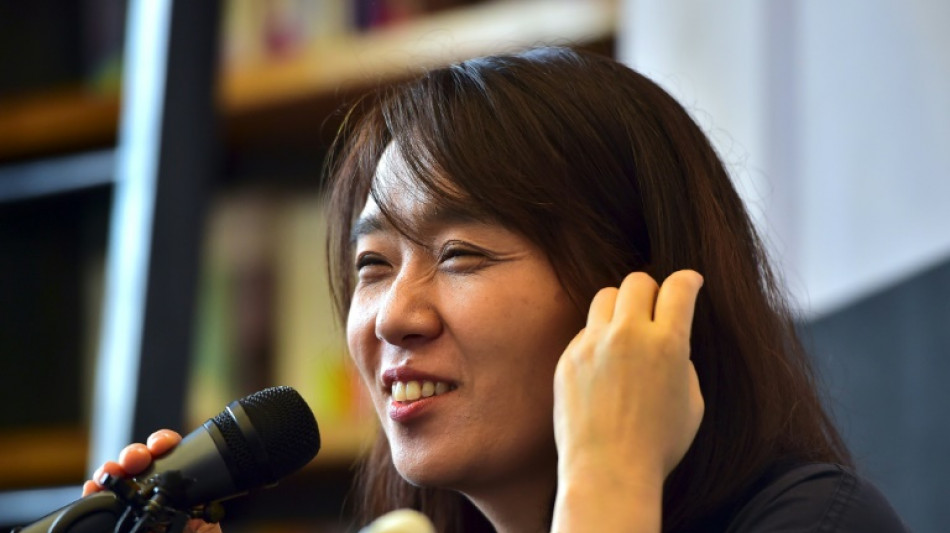
South Korea's Han Kang wins literature Nobel / Photo: JUNG YEON-JE - AFP

Author Han Kang on Thursday became the first South Korean to win the Nobel Prize in Literature for work characterised by the correspondence between mental and physical torment as well as historical events.
Han, 53, was honoured "for her intense poetic prose that confronts historical traumas and exposes the fragility of human life," the Swedish Academy said.
A short story writer and novelist, Han is best known for her book "The Vegetarian", which was her major international breakthrough and won the Man Booker Prize in 2016.
Written in three parts, the book details a woman's choice to stop eating meat and the devasting consequences it has on her personal life.
"This is a very rich and complex oeuvre that spans many genres," Academy member Anna-Karin Palm told reporters.
"Han Kang writes this really intense lyrical prose that is both tender and brutal and sometimes slightly surreal," she said.
Han's 2014 novel "Human Acts" was inspired by a massacre carried out by the South Korean military in 1980 and deals with the death of a young boy amid the democratic uprising.
Two years later, she published "The White Book", dedicated to her older sister who passed away hours after being born, with the Academy noting her "poetic style".
The Academy described Han's 2010 book "The Wind Blows, Go" as a "complex novel about friendship and artistry, in which grief and a longing for transformation are strongly present".
During the presidency of Park Geun-hye from 2013-2017, Han was among more than 9,000 artists blacklisted for their criticism of Park's government.
The artists had voiced support for liberal opposition parties, or criticised Park's conservative government and its policy failures, including the botched rescue efforts after the 2014 Sewol ferry sinking in which around 300 people died.
Han's Nobel win on Thursday surprised prize-watchers, not having featured in speculation in the run-up to the announcement.
Last year, the award went to Norwegian playwright Jon Fosse, whose plays are among the most widely staged of any contemporary playwright in the world.
The Academy has long been criticised for the overrepresentation of Western white men authors among its picks.
With no official shortlist, experts had speculated that it may shine its spotlight further afield this year.
- Eurocentric, male affair -
Since it was first awarded in 1901, the Nobel Prize in Literature has been a Eurocentric, male affair.
Out of 121 laureates, only 18 have been women. But the Academy has made strides in that regard, crowning nine women in the past two decades.
While 30 English-language authors and 16 French-language ones have won, Han is the first South Korean to have won.
Similarly, there has only been one Arabic writer to win: Egypt's Naguib Mahfouz in 1988.
The 18-member Swedish Academy has undergone major reforms since a devastating #MeToo scandal in 2018, vowing a more global and gender-equal literature prize.
Since the scandal, it has honoured four women including Han -- the others are Annie Ernaux of France, US poet Louise Gluck and Poland's Olga Tokarczuk -- and three men -- Austrian author Peter Handke, Tanzanian writer Abdulrazak Gurnah and Fosse.
The Academy is also known for its penchant for bringing lesser-known authors to a wider audience.
That was the case in 2021 -- when Zanzibar-born British author Abdulrazak Gurnah was chosen for his work exploring exile, colonialism and racism -- and in 2016, when US folk rock icon Bob Dylan won.
The Nobel Prize comes with a diploma, a gold medal and a $1 million prize sum.
Han will receive her award from King Carl XVI Gustaf in Stockholm on December 10, the anniversary of the 1896 death of scientist and prize creator Alfred Nobel.
K.Yoshida--JT