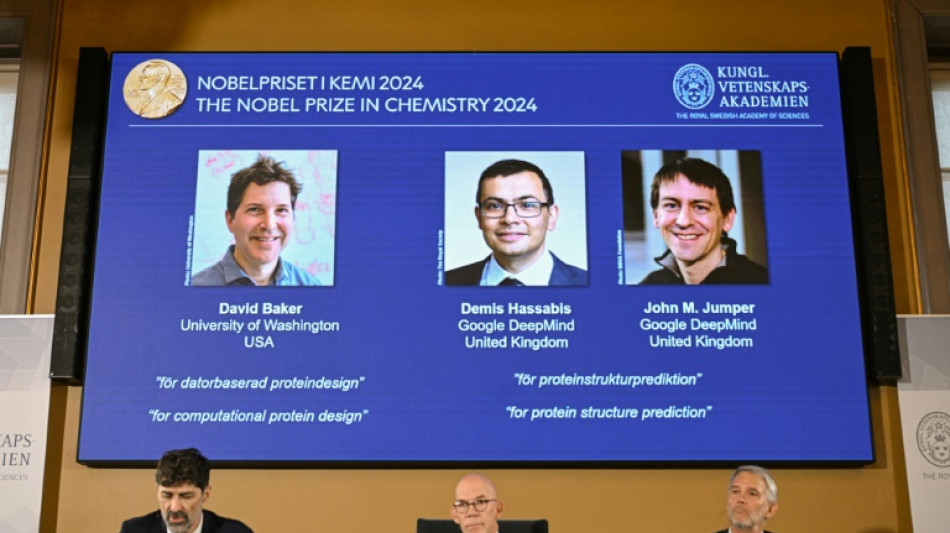
Demis Hassabis, from chess prodigy to Nobel-winning AI pioneer / Photo: Jonathan NACKSTRAND - AFP

Long before Demis Hassabis pioneered artificial intelligence techniques to earn a Nobel prize, he was a master of board games.
The London-born son of a Greek-Cypriot father and a Singaporean mother started playing chess when he was just four, rising to the rank of master at 13.
"That's what got me into AI in the first place, playing chess from a young age and thinking and trying to improve my own thought processes," the 48-year-old told journalists after sharing the Nobel prize in chemistry with two other scientists on Wednesday.
It was the second Nobel award in as many days involving artificial intelligence (AI), and Hassabis followed Tuesday's chemistry laureates in warning that the technology they had championed can also "be used for harm".
But rather than doom and gloom warnings of AI apocalypse, the CEO of Google's DeepMind lab described himself as a "cautious optimist".
"I've worked on this my whole life because I believe it's going to be the most beneficial technology to humanity -- but with something that powerful and that transformative, it comes with risks," he said.
- Dabbling in video games -
Hassabis finished high school in north London at the age of 16, and took a gap year to work on video games, co-designing 1994's "Theme Park".
In his 20s, Hassabis won the "pentamind" -- a London event that combines the results of bridge, chess, Go, Mastermind and Scrabble -- five times.
"I would actually encourage kids to play games, but not just to play them... the most important thing is to try and make them," Hassabis said.
He then studied neuroscience at University College London, hoping to learn more about the human brain with the aim of improving nascent AI.
In 2007, the journal Science listed his research among the top 10 breakthroughs of the year.
He co-founded the firm DeepMind in 2010, which then focused on using artificial neural networks -- which are loosely based on the human brain and underpin AI -- to beat humans at board and video games.
Google bought the company four years later.
In 2016, DeepMind became known around the world when its AI-driven computer programme AlphaZero beat the world's top player of the ancient Chinese board game Go.
A year later, AlphaZero beat the world champion chess programme Stockfish, showing it was not a one-game wonder. It also conquered some retro video games.
The point was not to have fun or win games, but to broaden out the capability of AI.
"It's those kinds of learning techniques that have ended up fuelling the modern AI renaissance," Hassabis said.
- Protein power -
Hassabis then turned the power he had been building towards proteins.
These are the building blocks of life, which take the information from DNA's blueprint and turn a cell into something specific, such as a brain cell or muscle cell -- or most anything else.
By the late 1960s, chemists knew that the sequence of 20 amino acids that make up proteins should allow them to predict the three-dimensional structure they would twist and fold into.
But for half a century, no one could accurately predict these 3D structures. There was even a biannual competition dubbed the "protein olympics" for chemists to try their hand.
In 2018, Hassabis and his AlphaFold entered the competition.
Two years later, it did so well that the 50-year-old problem was considered solved.
Around 30,000 scientific papers have now cited AlphaFold, according to DeepMind's John Jumper, who shared Wednesday's Nobel win along with US biochemist David Baker.
"AlphaFold has already been used by more than two million researchers to advance critical work, from enzyme design to drug discovery," Hassabis said.
K.Okada--JT