WiFi, drones and sharp blades on Japan's whaling mothership / Photo: Yuichi YAMAZAKI - AFP

In whale-motif jacket, shirt and tie plus a whale-shaped hat, Hideki Tokoro shows off Japan's new whaling "mothership", the Kangei Maru -- slicing blades, butchery deck, freezers and all.
"(Whales) eat up marine creatures that should feed other fish. They also compete against humans," said Tokoro, the president of whaling firm Kyodo Senpaku, touting an industry argument long rejected by conservationists.
"So we need to cull some whales and keep the balance of the ecosystem... It's our job, our mission, to protect the rich ocean for the future," he added while speaking with reporters invited to tour the Kangei Maru after it had docked in Tokyo.
The 9,300-tonne vessel set off this week from western Japan, bigger, better and more modern than its recently retired predecessor, with individual cabins for crew members, WiFi and drones to spot its quarry.
The whales will be harpooned by a smaller vessel and then brought, dead, to the Kangei Maru where a powerful winch can haul carcasses weighing up to 70 tonnes up a ramp and onto a lower deck around 40 metres (130 feet) long.
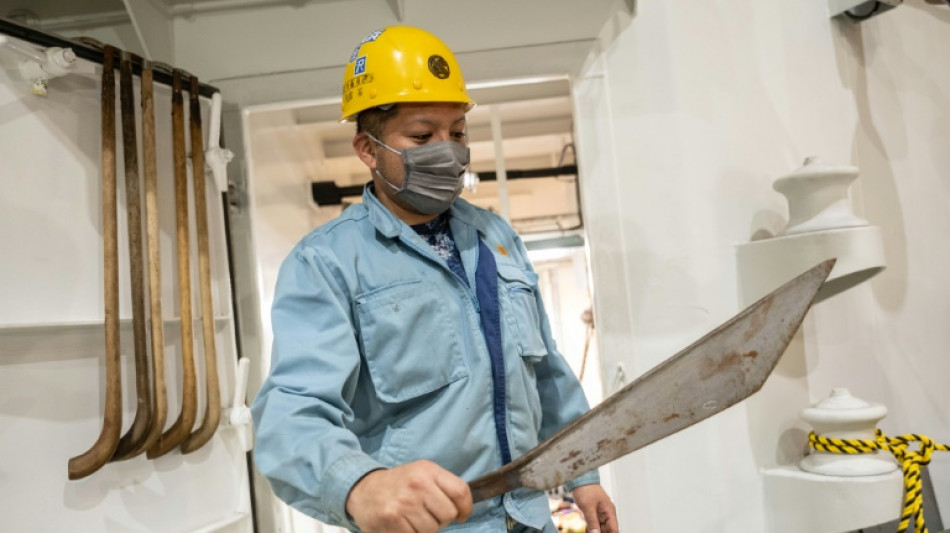
Once inside workers will butcher the whales using 30-centimetre (foot-long) blades attached to wooden staffs, discarding around half the animals' total weight as waste.
"Be careful, they are very sharp," Tokoro said, as a crew member unwrapped one such steel blade to show off.
The rest of the whale is processed, packaged and stored in 40 freezer containers, each with a capacity of 15 tonnes, ready to be transported around Japan once the ship returns to port.
- 'Scientific' -
Activists aggressively pursued the Kangei Maru's predecessor when prior to 2019 Japan hunted whales in the Antarctic and North Pacific for "scientific" purposes.
That year Japan quit the International Whaling Commission and nowadays conducts commercial whaling, but only in its own waters, and on what it calls a sustainable scale.
Japan has a quota this year of around 350 Bryde's, minke and sei whales, species which the government says are "abundant".
The Bryde's and common minke are listed as being of "least concern" on the International Union for the Conservation of Nature's Red List, but globally the sei is "endangered".
Japan also wants to resume hunting fin whales, the world's second-biggest animal after the blue whale. Fin whales are listed as "vulnerable" by the IUCN.
Tokyo argues that eating whale is part of Japanese culture and an issue of "food security" in the resource-poor country which imports large amounts of animal meat.
But consumption of whale has fallen to around 1,000 or 2,000 tonnes per year compared to around 200 times that in the 1960s.
"Japan has advanced bogus arguments about food security to justify its whaling for decades, even as its public has turned up its nose to whale meat," said Patrick Ramage from the International Fund for Animal Welfare.
Conservationists have also long refuted Japan's arguments that whales compete with humans for marine resources, saying that in fact the mammals improve the health of the ocean and therefore fish stocks.
Also they "have a unique role to play in global carbon dioxide capture and storage, acting like giant swimming tropical rainforests absorbing harmful CO2", said Nicola Beynon from the Humane Society International Australia.
T.Kobayashi--JT