The Japan Times - Self-care: Orangutan seen apparently treating wound

EUR -
AED 4.241501
AFN 76.225899
ALL 93.554047
AMD 421.168408
AOA 1060.230438
ARS 1715.656895
AUD 1.639343
AWG 2.078882
AZN 1.960998
BAM 1.957978
BBD 2.319179
BDT 142.188136
BHD 0.434183
BIF 3417.00026
BMD 1.154934
BND 1.477844
BOB 13.673207
BRL 5.867647
BSD 1.151481
BTN 109.772084
BWP 15.700461
BYN 3.349625
BYR 22636.715706
BZD 2.315876
CAD 1.618352
CDF 2627.475914
CHF 0.931576
CLF 0.027214
CLP 1074.552598
CNY 7.797307
CNH 7.795773
COP 3581.683414
CRC 522.981641
CUC 1.154934
CUP 30.605764
CVE 110.387769
CZK 24.225868
DJF 205.048047
DKK 7.475152
DOP 66.804297
DZD 153.472687
EGP 58.835639
ERN 17.324017
ETB 184.006946
FJD 2.556967
FKP 0.856809
GBP 0.855893
GEL 3.020138
GGP 0.856809
GHS 13.460971
GIP 0.856809
GMD 84.891799
GNF 10108.242008
GTQ 8.785771
GYD 240.867884
HKD 9.057285
HNL 30.853314
HRK 7.54669
HTG 150.557444
HUF 363.867906
IDR 20822.313646
ILS 3.537506
IMP 0.856809
INR 110.16978
IQD 1508.477672
IRR 1588179.269833
ISK 142.219015
JEP 0.856809
JMD 182.292739
JOD 0.818845
JPY 181.57706
KES 148.945652
KGS 100.999312
KHR 4659.181767
KMF 493.156852
KRW 1666.524381
KWD 0.357037
KYD 0.959567
KZT 545.626826
LAK 26077.001864
LBP 103117.983955
LKR 386.549906
LRD 207.841153
LSL 19.045882
LTL 3.410221
LVL 0.698608
LYD 7.367194
MAD 10.756663
MDL 20.122379
MGA 4924.476818
MKD 61.593502
MMK 2424.850425
MNT 4151.45627
MOP 9.302246
MRU 46.277468
MUR 54.282161
MVR 17.855218
MWK 1996.620567
MXN 20.037155
MYR 4.71814
MZN 73.811907
NAD 19.045882
NGN 1575.746553
NIO 42.37713
NOK 11.066871
NPR 175.635335
NZD 1.957192
OMR 0.444134
PAB 1.151481
PEN 3.90234
PGK 5.155734
PHP 70.745488
PKR 319.79146
PLN 4.307178
PYG 6865.635703
QAR 4.209281
RON 5.253334
RSD 117.520702
RUB 91.505504
RWF 1690.379977
SAR 4.325144
SBD 9.333147
SCR 15.60035
SDG 692.961179
SEK 11.020558
SGD 1.479777
SLE 28.523045
SOS 658.031838
SRD 43.635158
STD 23904.811825
STN 24.527278
SVC 10.075205
SZL 19.043179
THB 38.719182
TJS 10.62802
TMT 4.05382
TND 3.385065
TRY 54.854577
TTD 7.818696
TWD 37.31489
TZS 3050.792978
UAH 51.393558
UGX 4323.808778
USD 1.154934
UYU 46.331528
UZS 13783.329302
VES 861.230481
VND 30375.354155
VUV 137.078995
WST 3.158158
XAF 656.687343
XAG 0.020053
XAU 0.000285
XCD 3.121268
XCG 2.075208
XDR 0.816708
XOF 656.687343
XPF 119.331742
YER 275.221161
ZAR 19.011665
ZMK 10395.793255
ZMW 21.630056
ZWL 371.88843
  • CMSD

    0.0900

    22.11

    +0.41%

  • CMSC

    0.0300

    21.84

    +0.14%

  • NGG

    -0.4200

    79.97

    -0.53%

  • GSK

    -0.3800

    51.69

    -0.74%

  • JRI

    0.0900

    12.96

    +0.69%

  • BTI

    -1.0400

    60.65

    -1.71%

  • BCE

    -0.0200

    21.68

    -0.09%

  • RIO

    -0.3300

    96.85

    -0.34%

  • RBGPF

    0.0000

    69.21

    0%

  • BCC

    1.0000

    76.38

    +1.31%

  • VOD

    -0.3600

    15.78

    -2.28%

  • AZN

    -1.7000

    169.64

    -1%

  • RYCEF

    -0.3100

    19.55

    -1.59%

  • BP

    1.0000

    45.22

    +2.21%

  • RELX

    -1.1900

    35.42

    -3.36%

Self-care: Orangutan seen apparently treating wound
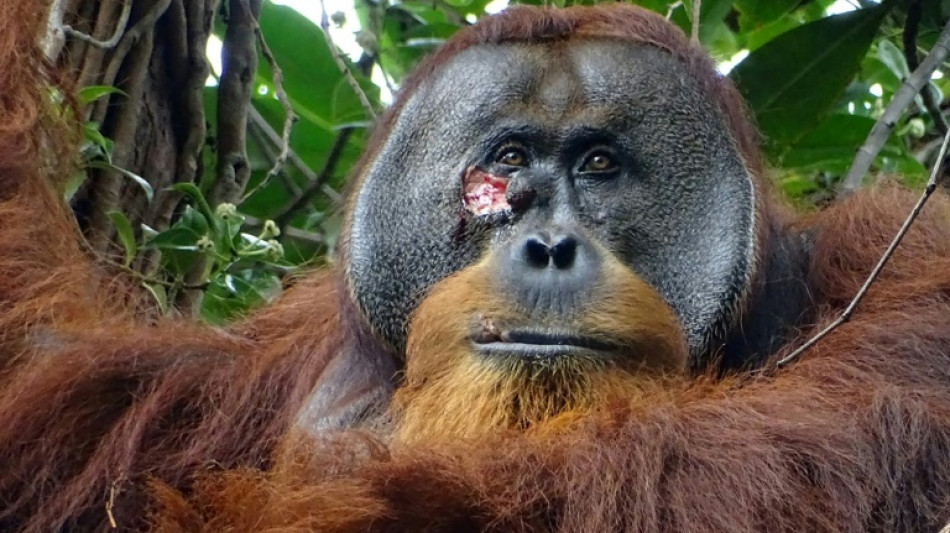
Self-care: Orangutan seen apparently treating wound / Photo: - - SUAQ Foundation/AFP

Self-care: Orangutan seen apparently treating wound

Scientists have observed an orangutan applying medicinal herbs to a face wound in an apparently successful attempt to heal an injury, the first time such behaviour has been recorded.

Text size:

Primates have previously been seen eating plants or rubbing them on themselves in behaviour scientists theorised was intended to ward off disease or discomfort.

But the apparent treatment seen by researchers in Indonesia in 2022, and reported in the journal Nature Scientific Reports on Thursday, is the first time a wild animal has been seen applying medicinal plants to a wound.

Scientists were tracking a male orangutan nicknamed Rakus at the Gunung Leuser National Park in Indonesia's Aceh province when they noticed an open wound on his face.

Three days later, they spotted him chewing the leaves of a vine called Fibraurea tinctoria, which is known for its medicinal properties and has long been used in local traditional medicine.

The orangutan "began chewing the leaves without swallowing them and using his fingers to apply the plant juice from his mouth directly onto his facial wound," said the study by Indonesian and German scientists.

When flies began to land on the site, Rakus "smeared the entire wound with the plant pulp until the red flesh was fully covered with the green leaf material."

The next day, Rakus was seen eating the vine's leaves again, and a week later his wound had closed up, subsequently healing without any sign of infection.

The study describes the behaviour as the "first systematically documented case of active wound treatment with a plant species known to contain biologically active substances by a wild animal."

Researchers said it was impossible to be sure the behaviour was intentional, but the fact that the juice and leaves were applied repeatedly and only to the wound suggests Rakus was trying to treat his injury.

They speculate the orangutan could have stumbled across the treatment, perhaps by first chewing the plant and then finding the juice offered pain relief when accidently touching it to a wound.

Orangutans are known to learn skills from each other through observation, but the scientists said they had no record of similar behaviour in 21 years and 28,000 observation hours in the area.

Rakus however had moved to the region from elsewhere, raising the possibility he learned the medical technique from a different community.

The observation adds to a growing body of evidence about the way primates use plants to keep healthy, including swallowing whole leaves that have anti-parasitic properties.

Elsewhere in Indonesia, orangutans have been seen rubbing the chewed leaves of a different plant into their skin, possibly to harness its anti-inflammatory properties.

And in 2022, scientists reported on chimpanzees in Gabon that were seen apparently applying insects to wounds.

K.Inoue--JT