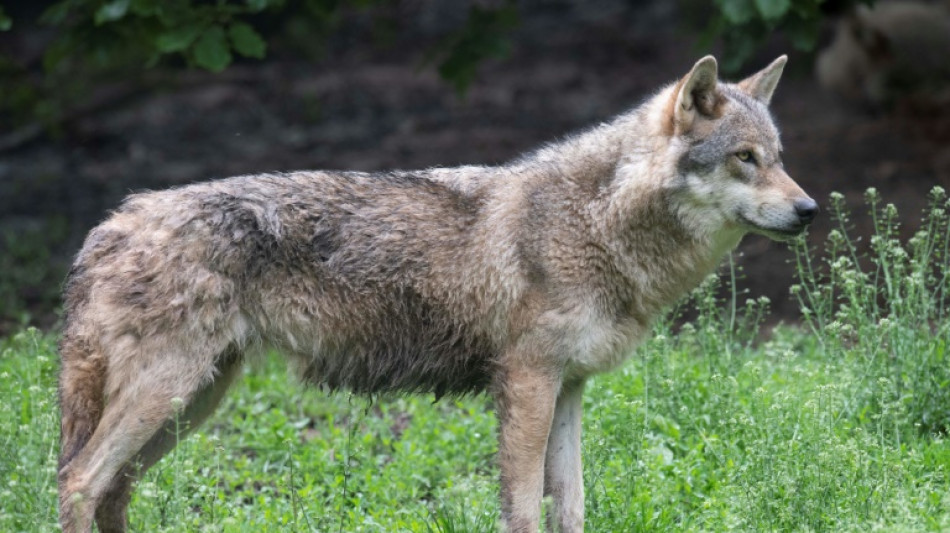
How a lone 'immigrant' wolf revived a forest ecosystem / Photo: THOMAS KIENZLE - AFP

In 1997, a lone wolf crossed an ice bridge that briefly connected Canada with the remote Isle Royale, which lies off the coast of Michigan in Lake Superior and is renowned for its rich biodiversity.
His arrival revived the flagging fortunes of the wider wolf population, which had been hit by disease and inbreeding, and triggered cascading effects that improved the health of the overall forest ecosystem, a study in Science Advances showed Wednesday.
"Issues like inbreeding and low genetic diversity are an important concern for scientists," first author Sarah Hoy, an ecologist at Michigan Technical University told AFP.
"But this is the first study that shows when you have these genetic issues, they don't just impact the particular population and increase the risk that they will go extinct: they also have these really big knock on effects on all the other species."
- 'Old Gray Guy' -
The first wolves arrived on the island in the late 1940s, and their main prey are moose -- giving rise to the longest running study of a predator-prey system anywhere in the world.
But by the 1980s, the wolves were in trouble due to the arrival of canine parvovirus which drove their numbers down from a high of 50 to around 12.
Though the disease eventually disappeared, the population didn't recover right away. The reason was severe inbreeding, which caused lower reproductive success, as well as poorer health outcomes such as spinal deformities of the kind often seen in purebred dogs.
"If you're a wild wolf and you're having to take down prey like a moose that's eight times your size, that can make life in the wild really tough for you," Hoy said.
Enter the immigrant, identified as "M93" by scientists, but affectionately nicknamed "The Old Gray Guy."
M93 was unrelated to the existing population, and also had the advantage of being unusually large -- a big benefit when defending turf from rivals or taking down 800 pound ungulates.
He quickly became the breeding male in one of the island's three wolf packs and went on to sire 34 pups, greatly improving the genetic health of the population and the kill rate of its prey.
- Restoring balance -
Moose are voracious herbivores, consuming up to 30 pounds (14 kilograms) of vegetation a day. By reducing their numbers, the wolves helped bring the forest back into balance, which was most notable in the effects on balsam firs -- the species commonly used as Christmas trees.
With fewer moose, the trees began growing at rates not seen in decades, which is vital for the renewal of the forest and the myriad plant and animal species that depend on it.
The benefits brought by M93's arrival lasted around a decade, then the situation deteriorated once more -- ironically as a result of his extreme reproductive success.
By 2008, two years after his death, 60 percent of the wolf population's gene pool was inherited from M93, which led to a return of genetic deterioration.
M93 himself began breeding with his daughter after his mate died, and simultaneous inbreeding by other members triggered a rapid population decline until 2015, when there were just two wolves left: a father-daughter pair who were also half siblings.
Fortunately, a restoration program beginning in 2018 has once more brought balance to the system, and there are currently around 30 wolves and just under a thousand moose on the island.
For Hoy, a key takeaway is that the same principle of inserting just a small number of individuals could be applied to other imperiled predator populations that suffer from the harmful effects of inbreeding, such as lions or cheetahs, to similarly improve their ecosystems.
William Ripple, a professor of ecology at Oregon State University who was not part of the research, told AFP it was an "important study" that advances understanding "by showing that genetic processes may limit the ecological effects of a keystone species, the gray wolf."
H.Nakamura--JT