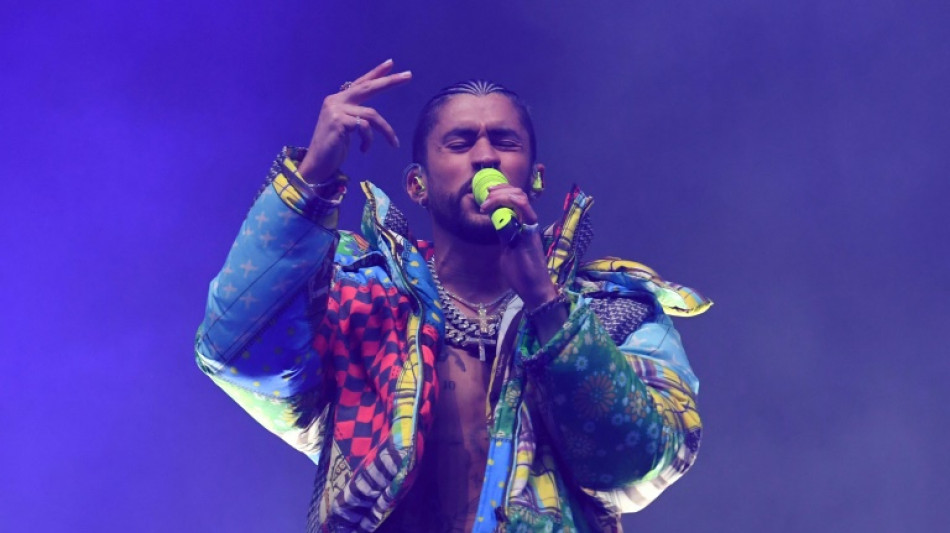
Bad Bunny: the reggaeton star transforming pop music / Photo: VALERIE MACON - AFP

High-octane hits, dance breaks, fireworks and a bonus lesson on the history of Caribbean music: with his groundbreaking Coachella set, Puerto Rican megastar Bad Bunny showcased a Latin revolution in pop fueled by his skyrocketing fame.
The reggaeton titan born Benito Antonio Martinez Ocasio first appeared at the influential music festival in 2018, as a guest of rapper Cardi B.
Five years on, the 29-year-old artist drew tens of thousands of screaming fans to the event's main stage in the California desert as the first-ever Spanish-language headliner.
His two-hour catalogue-spanning performance sent fans -- and the industry -- home with a message: the lineage of Latino music in the Americas is deep, rich and having a profound impact on today's most popular and most profitable music.
It's a message that music's power players are only starting to accept and process.
"I don't think the narrative of the nation of the US as a white, English-speaking nation is really fully changing anytime soon," said Vanessa Diaz, a professor at Loyola Marymount University who teaches the course "Bad Bunny and Resistance in Puerto Rico."
But "I think that we see a reckoning with the demand of the people and not necessarily just what the industry would normally prescribe."
Case in point: Coachella fans roared with delight for the hits off "Un Verano Sin Ti," his massively successful latest album, which was the first entirely Spanish-language work to earn a Grammy nomination for the coveted Album of the Year award.
Bad Bunny also did some of his earlier work, interspersing his songs with documentary-style footage tracing the heritage of the Latin music -- and, specifically, Caribbean rhythms -- that have fueled his blistering ascent to global stardom.
It culminated with an ode to the classics including Bronx-born Puerto Rican Pete Rodriguez's "I Like It Like That" -- the song sampled by Cardi B on her smash "I Like It" that featured.... you guessed it, Bad Bunny.
- Authenticity -
Bad Bunny -- the son of a truck driver and a teacher -- grew up in Vega Baja, a small town near the island's capital San Juan.
Young Benito honed his vocal skills in the children's choir at church, before growing into a pre-teen who loved spending hours developing beats on his computer, as he also began delving into everything from bachata to the Bee Gees.
He was working at a supermarket bagging groceries when he got a call from a label over his viral plays on the DIY platform SoundCloud.
Thus began his rapid explosion to the top of global music -- the highest-grossing tour, the most-streamed artist -- over the course of which he's remained firmly rooted in his own heritage.
He proudly celebrates Puerto Rico and its traditions through his music and his public persona, while also evoking a comfort with contemporary societal evolutions including gender fluidity, which is particularly appealing to youth.
"His artistry comes out of his experience as a person who was born in a colony and who grew up under direct colonialism and the struggles in Puerto Rico," said Diaz, noting that his authenticity is part of his mass appeal.
"Everyone understands that intimate connection to a homeland," Diaz said.
"His dedication to that, I think, resonates deeply on a global level."
- Price of fame -
From urgency over hurricane relief to the 2019 street protests demanding the ouster of Puerto Rico's governor, Bad Bunny's art and actions have also made him a de facto political poster child -- whether he wants to be or not.
"That's part of what makes him such a revered figure," said Petra Rivera-Rideau, a professor at Wellesley College who has also studied the reggaeton star.
But the constant eye of celebrity has heaped pressure on him to meet the varying expectations of loyal -- and therefore oft critical -- fans, a particular challenge for an artist widely known to enjoy spending time alone.
Some are unhappy about his purported relationship with model Kendall Jenner -- they don't think she's right for him. Others are disappointed that he seems to waver somewhat when taking a stand on racial politics.
But, as Diaz puts it: "If we want something polished and dressed up and strategic, then we don't want the same Bad Bunny we wanted before."
Bad Bunny addressed his audience head-on Friday night: "Humbly speaking, people think they know the lives of famous people but they don't."
"They don't know what we feel, what we live through. (...) Don't believe everything you hear."
For all the influences he honored at Coachella, Bad Bunny has grown into an influential icon himself, freshening reggaeton -- a fusion of hip-hop and reggae with Afro-Caribbean origins -- and imbuing it with Latin trap, which draws on rap from the American south.
He works regularly with fellow Latino artists and featured collaborators including Puerto Rican rapper Jhayco at Coachella.
When Post Malone, whose performance was marred by technical difficulties, joined him onstage, he smiled along quizzically as Bad Bunny addressed him in Spanish.
He was definitely in the minority: early in the set, Bad Bunny asked the crowd their language preference.
The response from the masses was unequivocal: "Espanol."
K.Yamaguchi--JT