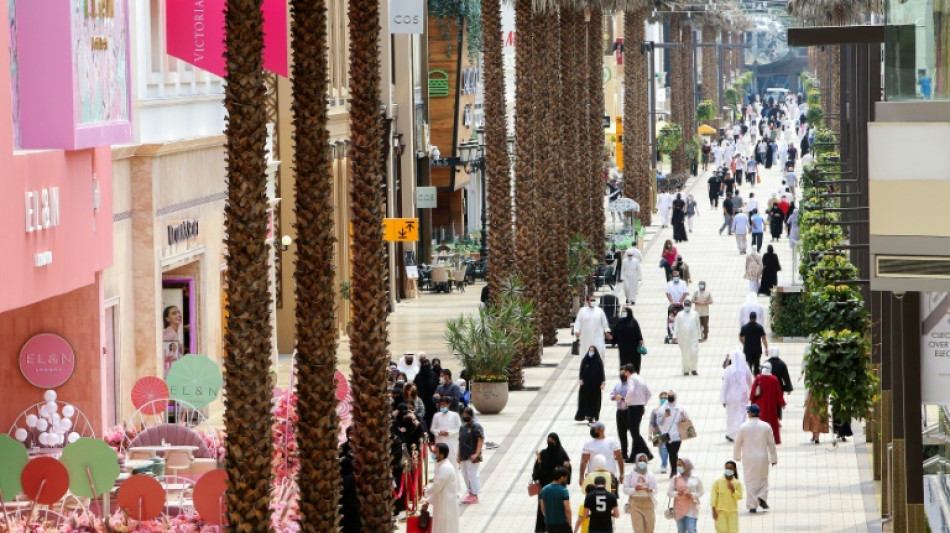
'Great misery': Kuwait political crisis drags down economy / Photo: YASSER AL-ZAYYAT - AFP/File

A seemingly never-ending political crisis is plunging oil-rich Kuwait's economy into the mire, affecting basic services and causing mounting public concern.
Despite its large oil reserves, hospitals and educational services are in decay as squabbling paralyses the wealthy Gulf region's only fully elected parliament.
Ahmed al-Sarraf, a businessman and newspaper columnist, says his concerns are growing as the country falters.
"I feel great anxiety for my family, for the future of my grandchildren, for their education, and for my health," the former banker told AFP.
"This situation is generating great misery."
Kuwait, which borders Saudi Arabia and Iraq, is home to seven percent of the world's crude reserves. It has little debt and one of the strongest sovereign wealth funds worldwide.
However, it suffers from constant stand-offs between elected lawmakers and cabinets installed by the ruling Al-Sabah family, which maintains a strong grip over political life, despite a parliamentary system in place since 1962.
The stasis has prevented lawmakers from passing reforms to diversify the economy, while repeated budget deficits and low foreign investment have added to the air of gloom.
The latest twist came last month, when the constitutional court dissolved an opposition-controlled assembly over alleged electoral irregularities and reinstated the previous parliament.
- 'Political dysfunction' -
Kuwait's parliament has now been dissolved around a dozen times in its 61-year history.
In January, Kuwait's government resigned three months after it was sworn in due to disputes with lawmakers. It was the sixth government in just three years.
Kuwait's neighbours the UAE, Saudi Arabia and Qatar have managed to transform their desert nations into booming modern metropolises, largely thanks to oil wealth and foreign investment.
Led by a new generation of rulers, they are stepping up projects to wean their hydrocarbon-centred economies away from oil.
Meanwhile Kuwait, led by 82-year-old Crown Prince Mishal al-Ahmad al-Jaber Al-Sabah, is struggling to implement a reform plan adopted in 2018.
"We were a liberal and innovative country in the 1980s... but we died out while the countries around us developed," the businessman Sarraf said.
According to economist Justin Alexander, "political dysfunction" has kept Kuwait from living up to its full economic potential.
The paralysis "has prevented it from taking painful reforms to control spending growth, generate non-oil revenue, diversify its economy or even invest to maintain its oil production capacity," the Gulf expert said.
Kuwait, which posted large deficits during the Covid-19 pandemic, was buoyed last year by the rise in oil prices, which generate most of the state's income.
But as prices stabilise, the country's budget deficit is expected to widen.
- Kuwait 'needs a reset' -
In January, the caretaker cabinet submitted a draft 2023-2024 budget that projected a deficit of five billion dinars (more than $16 billion) for the year starting in April.
That compares with a 1.35-billion-dinar surplus expected for the current year, according to Bloomberg.
Before Kuwait's last cabinet resigned in January, it had promised to tackle state spending and fight corruption.
It stepped down to outmanoeuvre lawmakers who were pressing ministers to pass a costly debt relief bill that would grant a debt amnesty for Kuwaiti citizens.
Kuwait "has a governance crisis", said researcher Kristin Diwan, of the Arab Gulf States Institute in Washington.
This is "apparent in systemic malaise, in failures of planning and in mounting social woes", including over the deterioration of public services, the expert said.
While politicians squabble, Kuwaiti citizens are paying the price, said Bader al-Saif, assistant professor of history at Kuwait University.
The "Kuwaiti street is exhausted," he said on Twitter, decrying a "perpetual impasse".
"Kuwait's politics needs a reset," Saif added, calling for a national dialogue and a new constitution.
H.Hayashi--JT